Where to sell pre-owned inventory: marketplace fees vs your own storefront

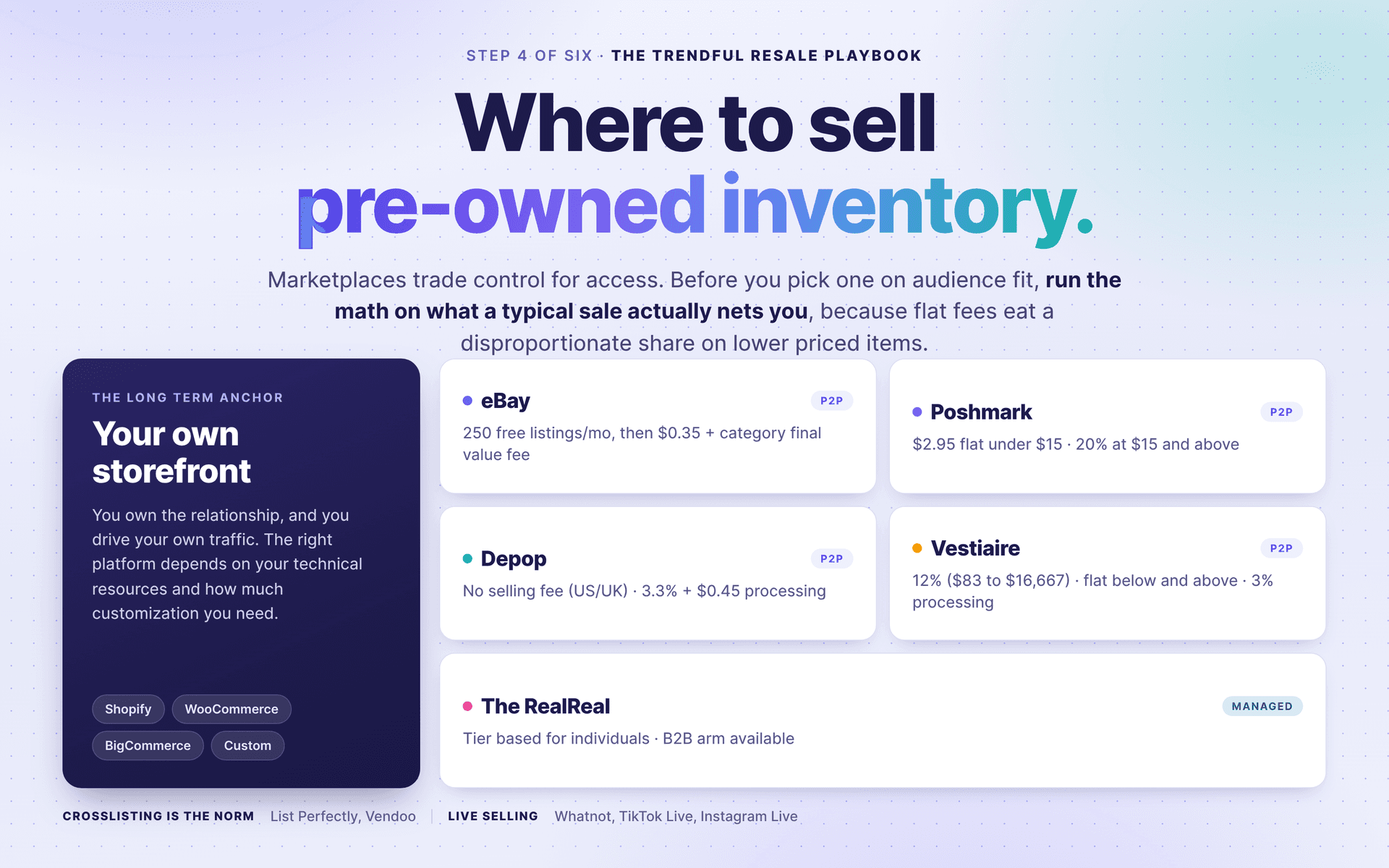
Do not pick a marketplace on audience fit alone. Run the math on what a typical sale actually nets you after fees, because flat fees eat a disproportionate share on lower priced items. A flat $10 charge on an $85 item reads very differently from a 12% cut on a $2,000 one, and most operators never compare the two.
This is step four of the Resale Playbook, the six step series we publish one Thursday at a time. Step three was about authenticating an item once it arrives. This one is about where it goes next.
Marketplaces trade control for access. You are renting space inside an audience somebody else built, which is genuinely valuable before you have one of your own. The fee structures vary enough to materially change your margin depending on what you sell and at what price.
Your own storefront
Shopify is the platform stores and resellers most often choose for a fully branded, scalable ecommerce presence. That said, WooCommerce, BigCommerce, and custom storefronts all work. The right choice depends on your technical resources, your existing setup, and how much customization you need.
If you do not have development resources in house, agencies that specialize in resale and ecommerce builds, like Monkeys and Hats, can help you get a storefront up quickly.
The tradeoff runs the other way from a marketplace. You own the relationship with the buyer, and you drive your own traffic.
Marketplaces
Most marketplaces you will crosslist onto are peer-to-peer platforms: eBay, Poshmark, Depop, Vestiaire Collective. The RealReal is the exception, primarily a managed marketplace, though it has a B2B arm for businesses.
| Platform | Fee structure | Type |
|---|---|---|
| eBay | Free for first 250 listings/mo, then $0.35/listing plus a category based final value fee | P2P |
| Poshmark | $2.95 flat under $15, 20% on $15 and above | P2P |
| Depop | No selling fee (US and UK), 3.3% plus $0.45 payment processing | P2P |
| Vestiaire Collective | 12% from $83 to $16,667, $10 flat under $83, $2,000 flat above, plus 3% processing with a $3 minimum. Nothing listed under $18 | P2P |
| The RealReal | Tier based for individuals, Trendsetter through VIP, with a B2B arm available | Managed |
Read the shape of each one, not just the headline number. A percentage fee scales with the sale, so it stays proportional at any price. A flat fee does not, which is why the same $10 charge barely registers on a $2,000 handbag and takes a real bite out of an $85 one. Depop's structure is the inverse case: no selling fee at all, with the cost showing up in payment processing instead. Our look at pricing data across eBay, Vestiaire, and Poshmark covers how differently these platforms behave on the listing side too.
Fee structures are also only half of the channel question. The other half is what you paid for the item in the first place, which is where pricing an offer for acquisition comes in.
Most resellers crosslist across several platforms rather than committing to one. Tools like List Perfectly and Vendoo let you create a listing once and push it across multiple marketplaces, which is what makes running four channels manageable instead of four times the work. Crosslisting is the norm, not the exception. Even Rebag lists across multiple channels.
Live selling
Live selling, on Whatnot, TikTok Live, and Instagram Live, has become a significant channel in resale, especially for streetwear, collectibles, sneakers, and vintage. It is worth treating as its own format rather than another place to post listings.
It requires a different skill set: hosting, pacing, and keeping an audience engaged. That is closer to running a show than writing a good description, and it rewards a different kind of operator. For the right category and the right operator, it can build a loyal repeat audience faster than almost any other channel.
Show your process
On every listing, be explicit about sourcing, authentication, and condition. Name the authentication provider you used. Write honest condition notes and photograph the flaws rather than cropping around them.
Secondhand buyers carry a baseline skepticism that transparency converts, and this is the cheapest place to do that work, because the listing is where the decision happens. It also compounds with the category you chose to own: the more specific your inventory, the more your process notes read as expertise rather than boilerplate. Most resale operators are vague about their process. Being specific builds the trust that drives conversion.
Where does Trendful fit in
Trendful's fully branded Resale App can be embedded on any website platform, so the channel you sell through does not dictate the channel you buy through. Your sourcing stays on your own site whether you sell on Shopify, on a marketplace, or on both.
The direct native sync is inventory management, which syncs with Shopify. For other platforms, you can export your inventory as a CSV and import it wherever you need it.
Frequently asked questions
Where should I sell pre-owned inventory? On a combination, usually. Your own storefront is the long term anchor because you own the buyer relationship, and marketplaces give you access to an audience you have not built yet. Most resellers crosslist across several platforms rather than committing to one.
What do resale marketplaces charge? eBay gives you 250 free listings a month, then charges $0.35 a listing plus a category based final value fee. Poshmark takes $2.95 flat under $15 and 20% at $15 and above. Depop charges no selling fee in the US and UK, just 3.3% plus $0.45 in payment processing. Vestiaire Collective runs 12% between $83 and $16,667, with flat fees below and above that band, plus 3% processing. The RealReal is tier based for individuals and has a B2B arm. These change often, so check the platform before you build a number into an offer.
Which marketplace is cheapest for low priced items? Look at the shape of the fee rather than the headline rate. Flat fees eat a disproportionate share on lower priced items, so a flat $10 charge on an $85 item costs you far more proportionally than a percentage would. Run the math on what a typical sale in your price band actually nets.
Should I crosslist or pick one marketplace? Crosslisting is the norm, not the exception, and even Rebag lists across multiple channels. Tools like List Perfectly and Vendoo let you create a listing once and push it across several marketplaces, which is what keeps multi-channel selling manageable.
Is live selling worth it for a resale business? For the right category, yes. Whatnot, TikTok Live, and Instagram Live have become a significant channel in resale, especially for streetwear, collectibles, sneakers, and vintage. It requires a different skill set, hosting and pacing rather than listing, so treat it as its own format rather than a place to repost listings.
Does my own storefront still matter if marketplaces drive the sales? Yes. A marketplace rents you access to an audience somebody else built. On your own storefront you own the relationship, and the cost is that you drive your own traffic. Most operations end up running both.
Does Trendful work if I do not use Shopify? Yes. The Resale App can be embedded on any website platform. The direct native sync is inventory management, which syncs with Shopify, and for other platforms you can export your inventory as a CSV and import it wherever you need it.
Sources
- Fee structures are as published in the Trendful Resale Playbook. Marketplace fees change often, so confirm the current rate on the platform before you build it into an offer or a margin model.
Get started
Want your sourcing to run on your own site no matter where you sell? Create an account and pick the plan that fits how you work today, or book a demo and we will walk you through it.
Keep reading
- How to start a resale business: the complete playbook
Secondhand is on track for about $393 billion by 2030 and growing twice as fast as apparel retail. The opportunity is not the hard part…
- How 2025 tariffs are reshaping resale: what every seller needs to know
As the Trump Administration rolls out sweeping new tariffs in 2025, the resale market is undergoing a major transformation. With higher…
- Authentication is not optional: how to authenticate pre-owned luxury
One undetected fake can undo months of trust building. Here is what the leading authentication providers cost, how to build authentication…