How to start a resale business: the complete playbook

Secondhand stopped being a trend somewhere around the time it became a tenth of everything people spend on clothes. ThredUp's 2026 Resale Report puts the global secondhand market on track for roughly $393 billion by 2030, growing about twice as fast as apparel retail overall. In the US alone, resale is heading for close to $79 billion by 2030, and in 2025 it grew four times faster than the broader retail market.
So the opportunity is not in question. That is the good news and also the trap, because a growing market makes starting a resale business look like a sourcing-optional exercise. It is not. What separates the resale merchants who scale from the ones who stall out at month six is whether they treat inventory acquisition as a system or as something they will figure out later.
We know that firsthand. Trendful was a resale business before it was software, back when running one meant spreadsheet tracking, manual payouts, pricing by gut feel, and intake buried in Instagram DMs. The processes in this playbook are not theoretical. They are what we figured out the hard way and then turned into software so other merchants would not have to.
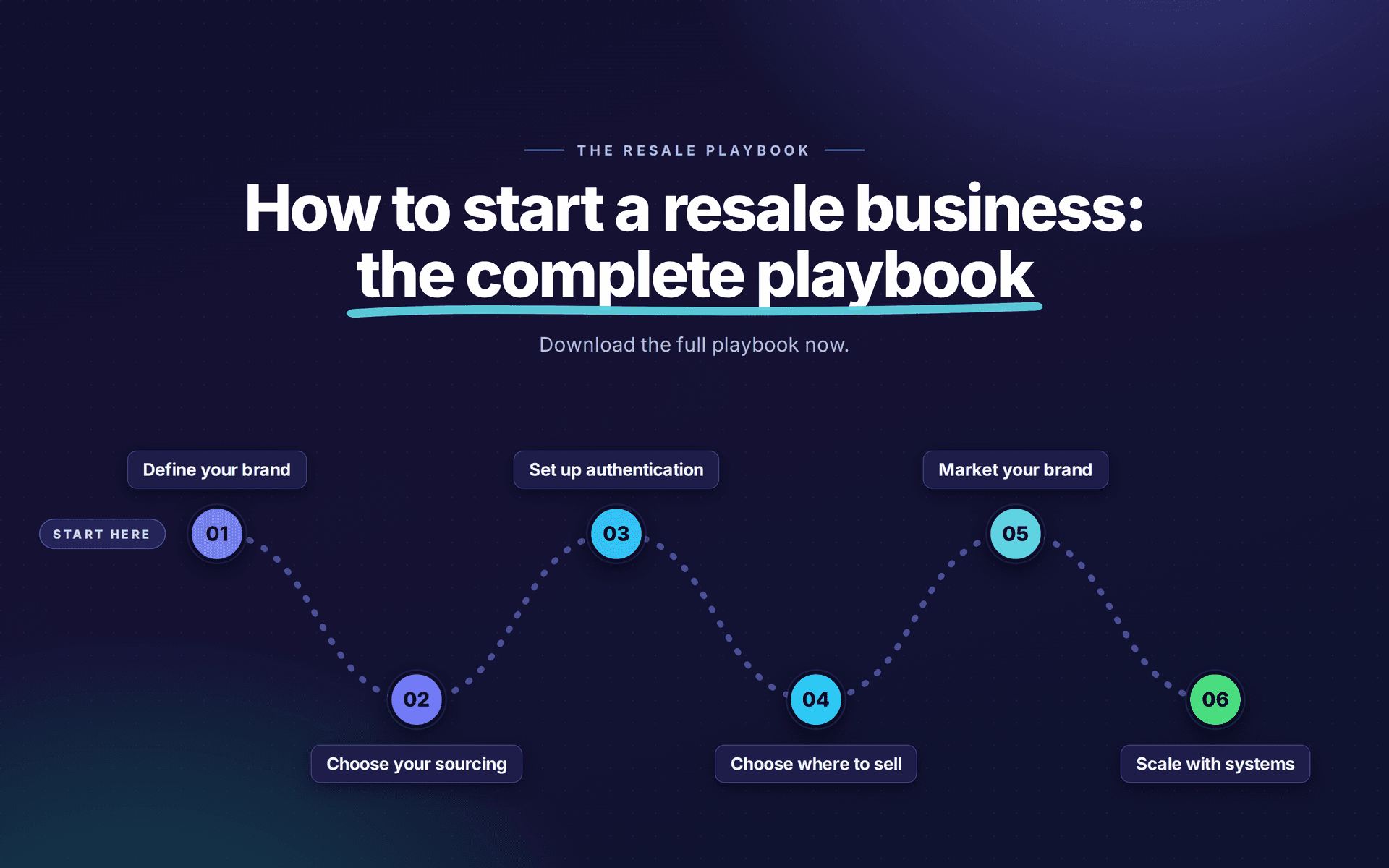
This post is the first chapter. Over the next six Thursdays we are publishing one step at a time: positioning, sourcing, authentication, sales channels, marketing, and the systems that let you scale. Or you can skip the wait and get the whole thing at once, which is what the box near the bottom of this page is for.
The opportunity is real, and it is the easy part
The model is proven at scale. ThredUp, TheRealReal, and Depop turned secondhand from a thrift-shop niche into a category that traditional retailers now scramble to add. Buyers arrived, stigma left, and the supply of pre-owned goods sitting in closets turned out to be effectively bottomless.
What none of that proves is that you can get your hands on it. Demand is now the commodity in resale. A well-photographed authenticated bag will sell. The question is what you paid for it, how long it took to arrive, and how many hours of your week it consumed on the way in.
That is why this playbook spends almost no time on how to sell and a great deal on how to buy. If you want the longer version of that argument, our piece on why your own customers are your best suppliers makes the case with our own platform data.
The hard part is supply, and most merchants run it by hand
Here is the shape of the problem in almost every resale business we meet.
A customer messages the shop asking whether you would buy her Chanel flap. Someone answers, eventually. Photos come in over DM. Someone eyeballs a price. The offer goes out in a message thread that is already forty replies long. She says yes, maybe. Somebody has to remember to send a shipping label, then remember to check whether the package arrived, then remember to pay her. Each of those steps lives in a different place: a phone, a spreadsheet, a payment app, someone's memory.
None of that is a technology problem at ten items a month. At a hundred it is the whole business. Offers go quiet because nobody followed up. Accepted items never ship because the label never went out. Sellers who had a perfectly good experience never hear from you again, and you pay to acquire their replacement. We wrote up exactly where those drop-offs happen in half your resale sellers come back, here is how to win the rest.
The merchants who break through are not the ones with the best eye. They are the ones who made buying repeatable.
Own the seller relationship and you own your supply chain
There are really only a few places inventory comes from: wholesale lots, auctions and liquidation, and your own customers. We covered the tradeoffs in how resale merchants source inventory, but the short version is that the first two put you in a bidding war against everyone else with a buyer account, and the third does not.
Buying directly from customers, what the industry calls C2B acquisition, flips the usual retail relationship. Your customers become your suppliers. You set the offer, you see the condition before you commit, and the relationship belongs to you rather than to a marketplace that can raise its fees next quarter.
It also compounds. A wholesale account is flat: the same spend and the same fight every month. A seller base is a curve, because a seller who had a good experience comes back, and often buys from you while she is there. That is the whole reason this playbook treats acquisition as step two rather than an afterthought.
Worth saying plainly: this works whether you buy items outright, take them on consignment, run trade-in, or pay in store credit. Most merchants end up running some combination, and the right mix depends on your cash position more than your taste.
We ran this business before we built software for it
Trendful started in late 2019 as an online resale shop, selling pre-owned designer pieces from my own closet across Tradesy, Poshmark, eBay, and Etsy. I had spent years in the secondhand world at art galleries and auction houses, so I knew the goods. What I did not know was how quickly the operations would become the job.
As inventory grew I brought in my sister-in-law Mailys, an engineer, to build us a proper Shopify storefront. We expanded past my closet into wholesale, estate sales, and auction houses. And by 2020 we had both noticed the same thing: there was no end-to-end way for a merchant to acquire inventory directly from their own customers. Every merchant we knew was stitching it together out of DMs and spreadsheets, exactly like we were.
So we built the first version of the resale app for ourselves, and by September 2020 we had stopped being a resale merchant and started being a software company. The full version of that story is in our origin story post, and it matters here only because it explains the bias running through this playbook: every step in it is something we got wrong first.
Who this playbook is for
Three groups, and the steps land differently for each.
Aspiring resale entrepreneurs. You are starting from zero and the hardest part is narrowing down. Step one will save you the most time, because picking a lane early is what makes everything after it cheaper.
Boutiques and retailers adding a resale channel. You already have customers, a storefront, and a brand. What you need is a way to buy from the people already walking through your door without blowing up your existing operations.
Established resale shops ready to systematize. You have proven demand and you are drowning. Steps five and six are yours. The question is not whether the business works, it is which manual process to kill first.
The six steps, one Thursday at a time
Here is what is coming, and what each chapter actually answers.
Step 1. Define your brand and objective. Niche beats broad, and positioning is an operational decision rather than a branding exercise. Online or brick and mortar, what you accept, and why owning one category first compounds.
Step 2. Choose your sourcing strategy. Buyout, consignment, trade-in, and wholesale compared on cash flow, risk, and margin, plus the natural progression from buying lots to buying from customers.
Step 3. Set up your authentication process. Authentication is not optional. One fake that slips through comes back as a chargeback you absorb, a marketplace account suspended over an authenticity claim, or legal exposure you did not plan for. Providers and real pricing, the intake sequence, and the failed-authentication policy almost nobody writes down until they need it. Our deep dive on authentication providers is a decent head start.
Step 4. Choose where to sell your inventory. Marketplace fee math against your own storefront, live selling, and the transparency copy that converts a skeptical secondhand buyer.
Step 5. Market your brand. Organic first. Platform choice, a posting cadence you can actually sustain, the content formats that reliably perform, and why your own sellers and customers outperform paid influencers.
Step 6. Scale and optimize with the right systems. Where spreadsheet-driven operations break, and what systematized intake, offers, inbound shipping, returns on declined items, inventory, and payouts look like when they hold. If you want to see one full loop end to end, the anatomy of a submission walks a single item from customer photo to payout.
Each of those posts goes live on a Thursday, and this page links out to them as they publish. Bookmark it if you want to follow along in order.
Frequently asked questions
How do I start a resale business? Start by deciding what you sell and to whom, before you buy a single item. Then pick how you will source: wholesale and auctions get you inventory fastest, buying from your own customers gets you better margin and a relationship that repeats. From there it is authentication, sales channels, marketing, and the systems that keep it all from living in a spreadsheet. Those six steps are the structure of this series.
How much does it cost to start a resale business? Less than most people expect, and the biggest variable is your sourcing model. Consignment and trade-in let you list inventory without paying for it up front, which is why undercapitalized merchants often start there. Buyout needs working capital but gives you full margin and control. Most shops end up running a mix, weighted by how much cash they can tie up in stock.
Is resale still growing, or did I miss it? Still growing, and quickly. ThredUp's 2026 Resale Report projects the global secondhand market at roughly $393 billion by 2030, expanding about twice as fast as apparel retail overall, with US resale outpacing broader retail four to one in 2025. Secondhand now makes up close to a tenth of total apparel spending, which means the category is mainstream rather than saturated.
Where do resale stores actually get their inventory? Three main channels: wholesale lots, auctions and liquidation, and direct from their own customers. Wholesale is inconsistent and getting scarcer, auctions turn into bidding wars that compress margin, and customer acquisition gives you control over price and condition while building a relationship that brings the seller back with the next item.
Do I need to choose between consignment and buying items outright? No, and most established merchants do not. Buyout, consignment, trade-in, and store credit each suit different items, price points, and cash positions. Running more than one gives you a way to say yes to sellers you would otherwise turn away, which matters more than picking the theoretically optimal model.
Sources
- ThredUp, 2026 Resale Market and Consumer Trend Report (14th Annual Resale Report, April 2026): global secondhand market size and growth, US resale projections, secondhand share of apparel spending.
- ThredUp Inc., 14th Annual Resale Report press release, April 2, 2026.
- Platform figures described as ours come from aggregate Trendful data across merchants on the platform.
Get started
Want to see what systematized intake, offers, and payouts look like before you build any of it by hand? Create an account and pick the plan that fits how you work today, or book a demo and we will walk you through it.
Keep reading
- How 2025 tariffs are reshaping resale: what every seller needs to know
As the Trump Administration rolls out sweeping new tariffs in 2025, the resale market is undergoing a major transformation. With higher…
- Half your resale sellers come back. Here's how to win the rest
About half the sellers you win come back to sell to you again, all on their own. The other half slip away at two simple moments. Here is…
- Anatomy of a submission: from customer photo to payout
Follow one resale item end to end, from the first customer photo to the final payout. Here is how selling to a resale store actually…