Niche beats broad: how to position a resale business people remember

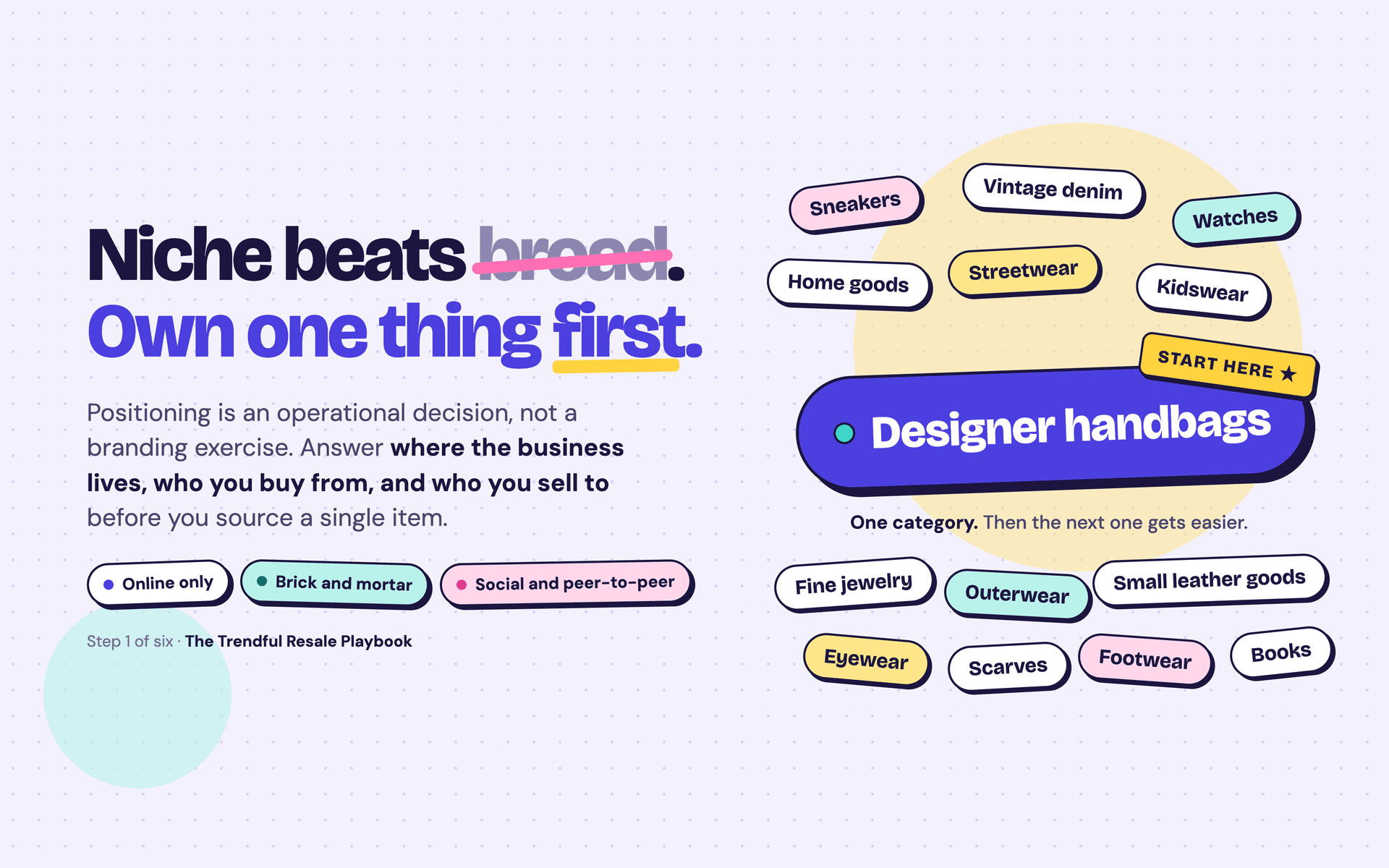
Resale is not one size fits all. The market spans luxury handbags, streetwear, vintage furniture, fine jewelry, everyday basics, and everything in between, and every one of those is a different business with a different buyer, a different seller, and a different set of problems. Trying to serve all of them is the fastest way to serve none of them well.
So before you source a single item, you need three answers: where your business lives, who you are buying from, and who you are selling to. Those are not branding questions, whatever the word positioning suggests. They decide your cost structure, they decide what your intake looks like, and they decide almost everything about how you market. Get them wrong and you will feel it in your margin long before you feel it in your logo.
This is step one of the Resale Playbook, the six step series we are publishing one Thursday at a time. It is first for a reason: every later step is cheaper once you have narrowed down.
Positioning is an operational decision
Most advice about positioning stops at voice and visuals. Pick a palette, write a mission statement, choose whether you are minimal and editorial or warm and vintage. That work matters, but it is the last mile, not the first one.
The first mile is operational. Decide you are a handbag shop and your authentication costs, your average order value, your shipping materials, and your photography setup all follow from that one sentence. Decide you are a sneaker shop instead and every one of those numbers changes. The same is true in reverse: merchants who never narrow down end up buying a little of everything, which means they never get good at pricing any of it, never build a reputation anyone can repeat, and never accumulate the specific expertise that makes a good offer fast.
That is the real cost of staying broad. Not a muddy brand, but a business where every item is the first of its kind.
Decide where the business lives first
Before the category question, answer a simpler one: where does this actually happen? There are three common answers, and each one sets a different cost structure and a different intake experience.
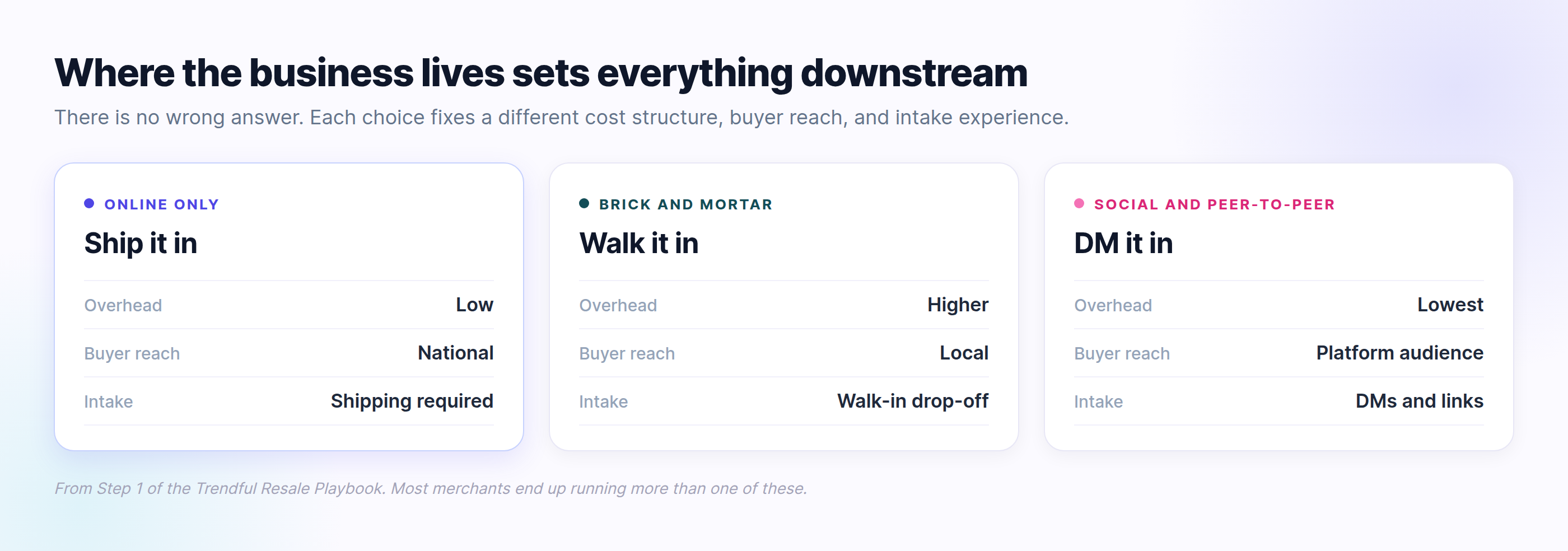
Online only keeps overhead low and puts your inventory in front of buyers nationally, but every acquisition depends on convincing someone to box up an item and ship it to a business they have not met. That makes trust and a smooth inbound experience load-bearing rather than nice to have.
Brick and mortar costs more to run and reaches a smaller radius, but walk-in drop-off removes the single biggest point of friction in acquisition. The seller hands you the bag. Nothing gets lost in transit, nothing sits in a hallway for three weeks, and you see condition before you commit.
Social and peer-to-peer is the cheapest way to start and the most dependent on someone else's audience. Intake runs through DMs and links, which works beautifully at low volume and becomes the bottleneck the moment it does not. If you are living on a platform, it is worth understanding how marketplaces differ from one another and what live selling on TikTok Shop has done to the category before you build your whole intake around one app.
There is no wrong answer here, and plenty of merchants run two of these at once. A store with a counter still takes shipped items from out of town, and a purely online shop still does pop-ups. What matters is knowing which one is your center of gravity, because that is the one your process should be built around. If you are starting from social and do not have a site yet, a sell form is a reasonable way to take structured intake before you have anywhere to put it.
Five questions that turn a vibe into a position
Your positioning is not a template you pick off a shelf. It is what falls out when you answer a short set of questions honestly.
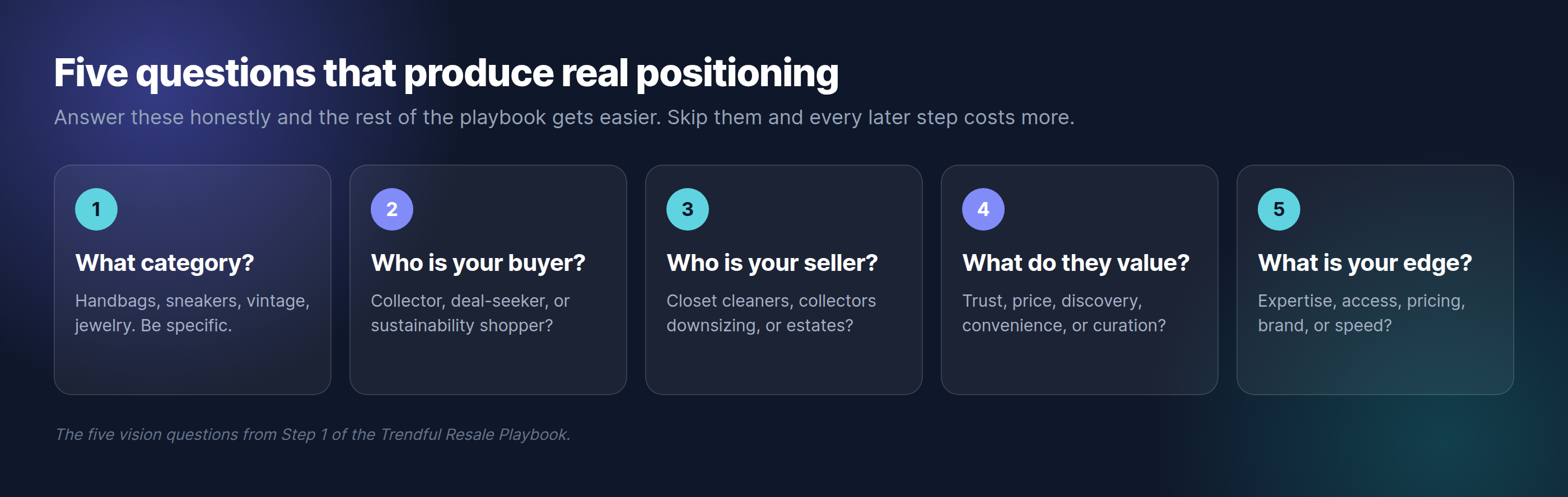
The one people rush is the fourth. What your customer values most is the question that decides where your money goes. A buyer who values trust wants authentication front and center and detailed condition notes on every listing. A buyer who values discovery wants new arrivals constantly and will forgive a thinner product page. A buyer who values convenience wants fast shipping and easy returns more than they want your story. You cannot lead on all four, and pretending otherwise is how merchants end up spending on everything and being known for nothing.
The fifth question is the honest one. Expertise, access, pricing, brand, speed: pick the one you can actually defend. If you have spent fifteen years around a category and can spot a fake across a room, that is an edge. If your edge is that you pay sellers in two days when everyone else takes two weeks, that is an edge too, and it is an operational one you control.
Your seller is an inventory source, not just a customer
Here is the question most new merchants skip entirely: who is selling to you?
In resale your supply comes from people, which makes your seller profile as strategic as your buyer profile. It is the whole idea behind C2B acquisition, and it is why we argue that your own customers are your best suppliers. But not all sellers are the same person, and they want different things from you.
Closet cleaners are clearing space. They want it easy and they want it over with. Speed and simplicity win, and a complicated intake loses them entirely.
Collectors downsizing know exactly what they own and roughly what it is worth. They want to be taken seriously, and they will notice if your offer suggests you do not recognize what you are looking at. Expertise wins here, not convenience.
Estates arrive in volume, often through a family member with no attachment to the items and a deadline. They want one contact, one process, and a clear timeline more than they want the highest number per piece.
Those three profiles pull your operation in different directions. They also shape which payout models make sense for you, since buyout, consignment, trade-in, and store credit suit different sellers and different cash positions. A closet cleaner usually wants cash now. A collector will often wait for consignment on a piece they know is worth it. Sourcing gets its own chapter next Thursday, and our tour of the sourcing channels covers the rest.
One thing all three share: they expect to know what is happening. Whichever seller you build for, the shops that lose sellers mostly lose them to silence, not to a low offer.
Start in a niche, then expand
This is the one principle that holds across every kind of resale merchant, at every size, in every category. It is better to be the go-to shop for one thing than a decent option for many.
Become the authority in designer handbags, then add shoes. Master vintage denim, then expand to outerwear. The order matters because reputation compounds and attention does not divide well. A seller with a Chanel flap to sell thinks of the handbag shop, not the shop that takes everything. A buyer who wants to be sure a bag is real goes where bags are all anyone talks about.
Narrowing also makes you better at the parts of the job that decide your margin. You price faster because you have seen the piece before. You spot fakes faster. You know which condition flaws kill resale value and which ones buyers shrug at. That accumulated judgment is the thing a broad shop never builds, and it is worth more than the handful of sales you turn down while you are building it.
Then the expansion gets easier, and that is the real payoff. Your reputation in one vertical is the credibility that gets you into the next one. The Vault Luxury Resale is a good example of a shop that knows exactly what it is and grew from there rather than starting everywhere at once.
Story does the work paid ads cannot
Buyers and sellers both need a reason to choose you over the next option, and in resale that reason is almost always story.
That is not a soft claim. Secondhand buyers are, reasonably, always asking themselves whether this is legitimate. A clear mission, a consistent aesthetic, and a visible point of view answer that question before they have to ask it. On the other side, sellers choose who to send a valuable item to based on whether the business feels like it will look after it, which is a judgment they make from your story long before they read your terms.
The practical version: say what you collect, say why, and say who you are. That single paragraph does more sourcing work than an ad budget, because it pulls in the sellers holding the inventory you actually want, and it filters out the ones you would have declined anyway.
Write down your brand foundations
Positioning only counts once it is written down, because a position you keep in your head is one you quietly abandon the first time an off-category item walks in with a good margin attached.
Six things are worth putting on paper: your target buyer and your target seller, the product categories you will and will not accept with a clear line between them, your price positioning as premium, mid-market, or value, your brand voice, your visual aesthetic, and a one sentence mission statement explaining why the business exists.
The hardest and most valuable of those is the second. Writing down what you will not accept is what keeps the shop coherent, and it is also what makes every later decision faster, from your intake rules to the offer you decline without a second thought.
Frequently asked questions
How do I start a resale brand? Start with positioning, before you buy anything. Decide where the business lives, whether that is online, a physical store, or social and peer-to-peer, then pick the category you will own, the buyer you serve, and the seller you want to buy from. Those choices set your cost structure, your intake process, and your marketing, so making them first is what keeps every later step from being a guess.
Should I niche down or sell a bit of everything? Niche down. It is better to be the go-to shop for one thing than a decent option for many. A narrow focus makes you faster at pricing, better at spotting fakes, and easier to remember, and the reputation you build in one category is exactly what makes the second category cheaper to enter later.
Online, brick and mortar, or social: which is best for resale? None of them is best, they are different trade-offs. Online keeps overhead low and reach national but depends on sellers shipping items in. Brick and mortar costs more and reaches a smaller radius, but walk-in drop-off removes the biggest friction in acquisition. Social is the cheapest to start and the most dependent on someone else's audience. Pick the one that will be your center of gravity and build your process around it.
Why does my seller profile matter as much as my buyer profile? Because in resale your sellers are your supply. Closet cleaners want speed and simplicity, collectors downsizing want to be taken seriously by someone who knows the category, and estates want one contact and a clear timeline. Each of those pulls your intake, your payout options, and your communication in a different direction, so you need to know which one you are building for.
How specific should my niche be? Specific enough that a seller can repeat it in one sentence. "Designer handbags" works. "Luxury and contemporary fashion plus some home" does not, because nobody can pass it along. Start narrower than feels comfortable, get known for it, and expand once your reputation in that lane is doing the selling for you.
Get started
Want to see what structured intake, offers, and payouts look like once you know exactly what you accept? Create an account and pick the plan that fits how you work today, or book a demo and we will walk you through it.
Keep reading
- Store credit: the offer type that turns sellers into buyers
Store credit is the most underused lever in resale. Merchants on Trendful add about a 10% premium for it, yet only about 4% of accepted…
- How to start a resale business: the complete playbook
Secondhand is on track for about $393 billion by 2030 and growing twice as fast as apparel retail. The opportunity is not the hard part…
- Half your resale sellers come back. Here's how to win the rest
About half the sellers you win come back to sell to you again, all on their own. The other half slip away at two simple moments. Here is…