Pricing pre-owned luxury for acquisition: offers sellers accept without killing margin

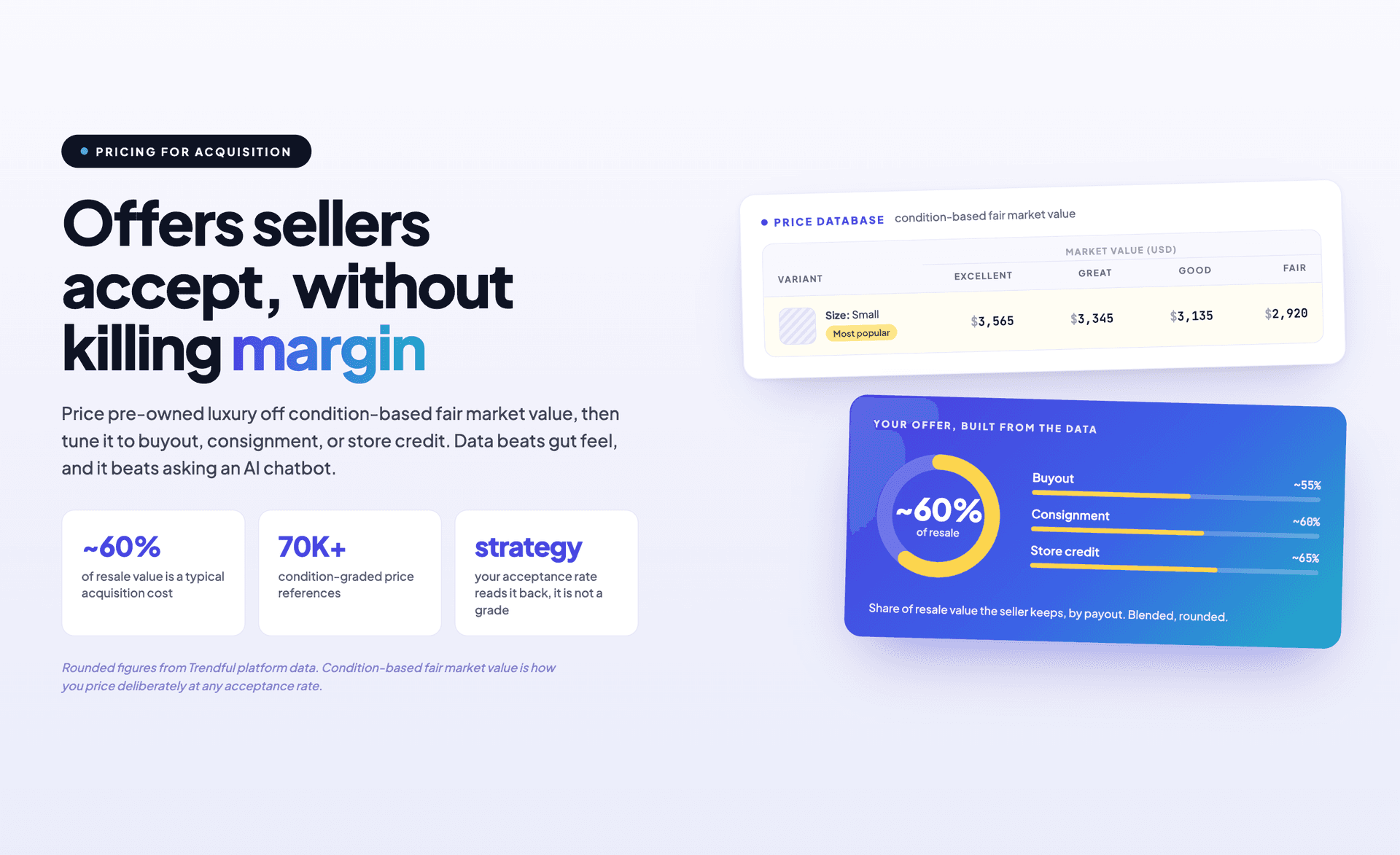
A Chanel flap lands in your submissions and the seller wants a number. Offer too little and they may take it elsewhere, so you miss the item and sometimes the seller with it. Offer too much and you win the bag with little room left to authenticate it, photograph it, list it, and still make a worthwhile sale. One number balances both, and you make that call many times a day, across brands and conditions you may not price every week. That is the everyday pricing question in resale acquisition, and gut feel is a harder way to answer it well.
Here is the better frame. Pricing for acquisition is not a guess you improve with experience. It is a repeatable decision built on condition-based fair market value and then tuned to how you pay. Get the data underneath it right and the number nearly picks itself. Just as important, the acceptance rate that follows is not a report card. It is a readout of the strategy you chose, and a 30% acceptance rate can fit your plan or point to a problem depending on what you were trying to do.
The pricing dilemma: too low and too high both have a cost
Every acquisition offer sits between two tradeoffs. Price below what the seller believes the item is worth and the deal often goes elsewhere, since many sellers compare offers across a few shops before deciding. Price above what the resale value can carry and the margin gets thin once the real costs land. The workable range between those two is narrower than it feels, which is why pricing by instinct is hard to get right. A number that feels generous can quietly eat into the margin, and a number that feels safe can be the one a seller passes on.
The way out is a reliable sense of what the item actually resells for, in the condition it is actually in, so your offer is anchored to data rather than a feel for the day. That anchor is condition-based fair market value.
Condition-based fair market value, explained
Resale value is not one number per bag. The same Chanel Classic Flap in excellent condition and in fair condition are two different items with two different markets, and pricing them off a single figure is how margin leaks. Condition-based fair market value grades the item and prices each grade separately, so your offer starts from the right line rather than an average that fits nothing.
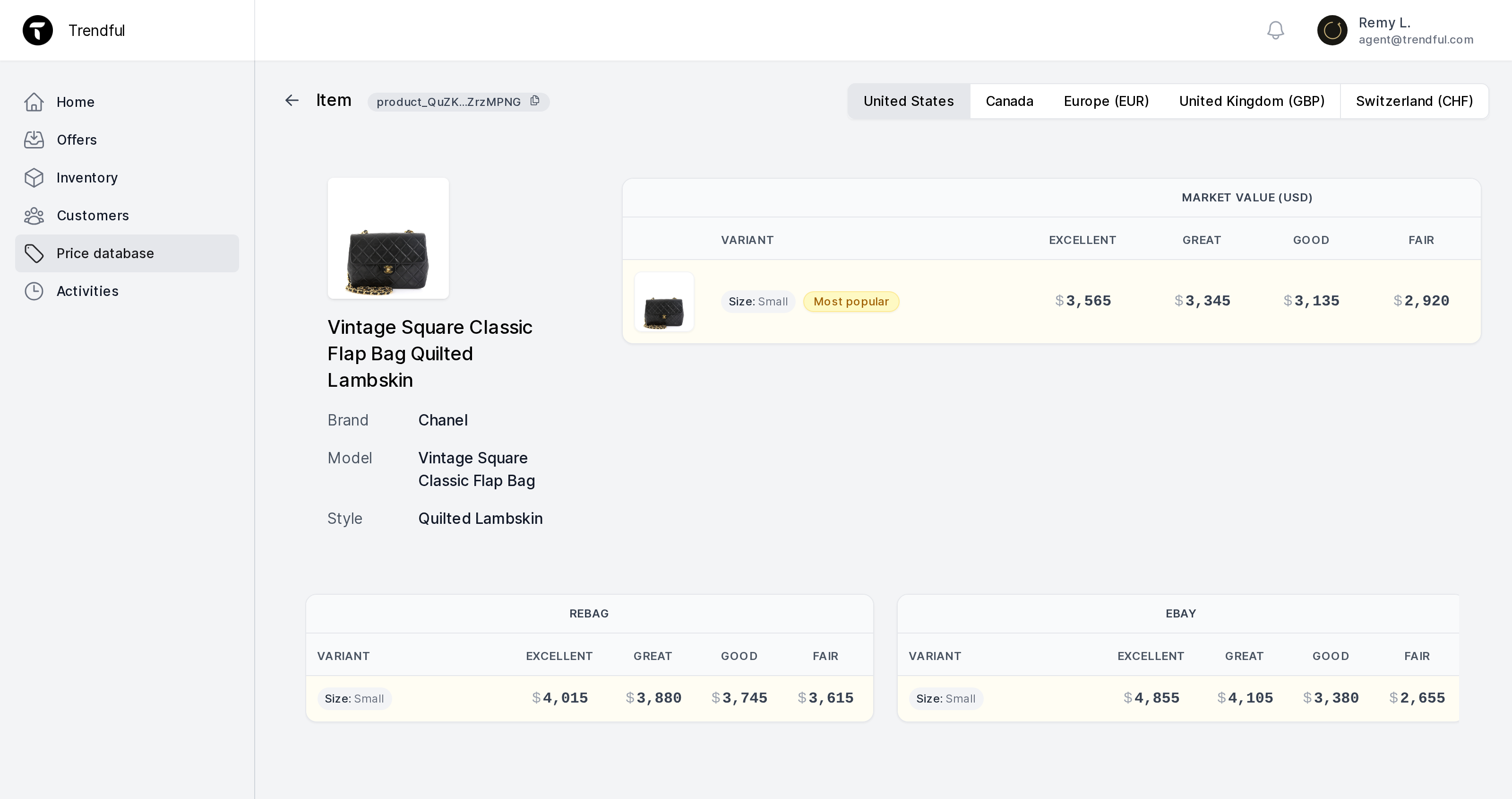
Two things make this trustworthy rather than a guess dressed up as a chart. First, it is built on sold data, cleaned and matched to a structured catalog of more than 70,000 references drawn from over 300 resale vendors, not on asking prices that may never clear. Second, it is specific: a size, a style, a condition grade, and a region, so a US buyout and a UK consignment start from different, correct numbers. When you can read excellent, great, good, and fair side by side for the exact reference in front of you, the offer stops being a debate and becomes a decision.
Data beats gut feel, and it beats an AI chatbot
It is tempting to shortcut this by typing the bag into a chatbot and taking the confident answer. The trouble is what the answer is made of. General AI tools are trained on public text, which is mostly listings, and listings are asking prices, not sales. A bag listed at 2,500 that never sells tells you nothing about resale value, yet it is exactly the kind of number a chatbot will repeat back with total confidence. The raw material is noisy, inconsistent, and missing the sold prices that actually matter, so the answer is built on sand. We walked through why in detail in accurate resale pricing needs real data, not just AI chatbots, and the short version is simple: pricing is only as good as the data under it, and sold, cleaned, condition-graded data is a different thing from a scrape of the open web.
The acquisition spread: about 60% of resale value
Once you can see resale value clearly, the next question is how much of it to pay. A common anchor is about 60% of an item's resale value, a little lower, near 55%, on a buyout. That is the share the seller keeps, and it leaves roughly 40% to cover authentication, listing, shipping, and the occasional return before any profit shows up. This describes the offers a pricing strategy actually computed, not every merchant, so treat it as a starting point rather than a rule, since cash out the door up front on a buyout is the most expensive way to acquire.
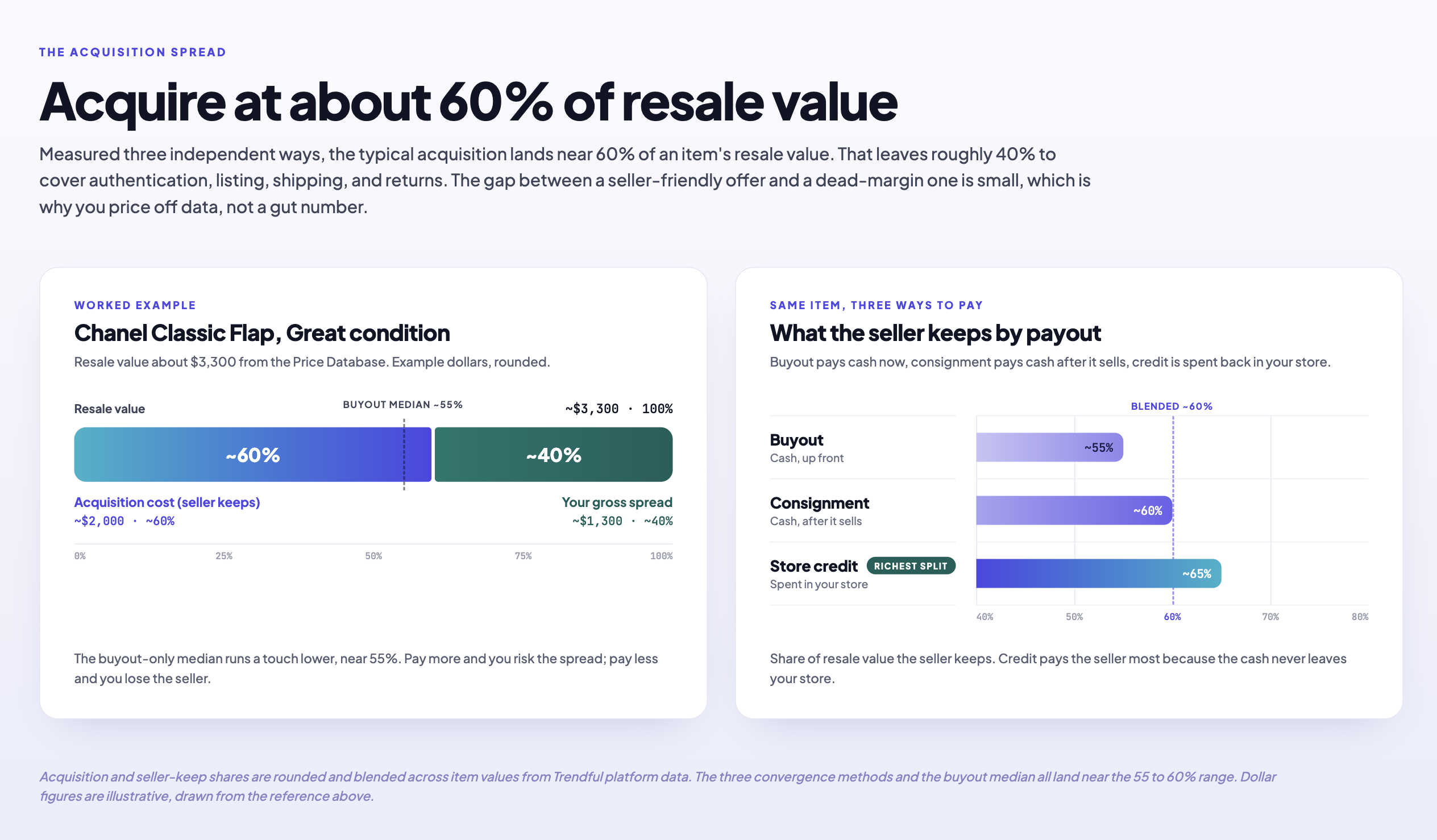
The reason the 60% line matters is that it turns a vague worry about margin into a target you can price against. If the resale value is about 3,300, an acquisition near 2,000 keeps you on plan and a seller-friendly offer and a thin-margin offer are only a few hundred dollars apart. That is a gap too small to eyeball reliably, which is the whole case for pricing off data. And because some of that 40% spread is spent on items you end up declining and returning, running a clean return process is part of protecting the margin, not separate from it.
Pricing across models: buyout, consignment, and store credit
Trendful serves merchants who run any mix of buyout, consignment, trade-in, and store credit, and the offer models are not just different timings, they are different splits. Blended across item values, a seller keeps roughly 55% on a buyout, about 60% on consignment, and around 65% on store credit. Same market value underneath, three different numbers on top, because each payout carries a different cost and risk to you. Buyout is cash now and the most expensive. Consignment is cash later, after the item sells, so you hold less risk up front. Store credit carries the most generous headline split and is, counterintuitively, the cheapest money on the platform, because it is redeemed against your retail margin rather than paid out in cash.
The practical move is to price the market value once and then decide the split by payout, rather than inventing three unrelated numbers. Our complete comparison of buyout, consignment, trade-in, and store credit lays out the tradeoffs, and if credit is the lever you want to pull harder, the case for store credit explains when the premium actually converts.
Pricing deliberately at scale: how offers get built
Here is how an offer actually gets built, because this is the product proof for pricing deliberately at scale. Your pricing strategy, your target margins and splits, tiered by item value, is applied to the condition-based fair market value to produce a buyout number, a consignment number, and a store credit number. You encode that strategy once and it does the per-item math for you, so the data and your strategy together produce the three numbers instead of a person pricing every submission from scratch.
That computed number is a starting point, not an agreement. You still quote. When you quote by hand, the buyout, consignment, and store credit numbers appear as suggested prices on the quote, and you accept them or change them before anything goes to the seller. Our guide to sending and receiving quotes walks through the flow. And the number is only ever an offer: payment always comes after the item arrives and is reviewed, so a quote never means an unchecked payout.
Your acceptance rate is a readout of your strategy, not a grade
Once your offers go out, the number everyone fixates on is the acceptance rate, and most merchants read it as a grade. It is not. It is a readout of the acquisition strategy you chose. Counting every quote you send, about 4 in 10 are accepted. Of the quotes that get a decision, about half are accepted, roughly 19% are declined by sellers, and about 30% expire without an answer, though the expiry window is set per merchant, so that share is not strictly comparable from store to store. But the average hides the real story, because across merchants the rate runs from about 15% to over 80%, and both ends include thriving businesses. The typical merchant sits in the high 40s, with the middle half of merchants between about 30% and 58%.
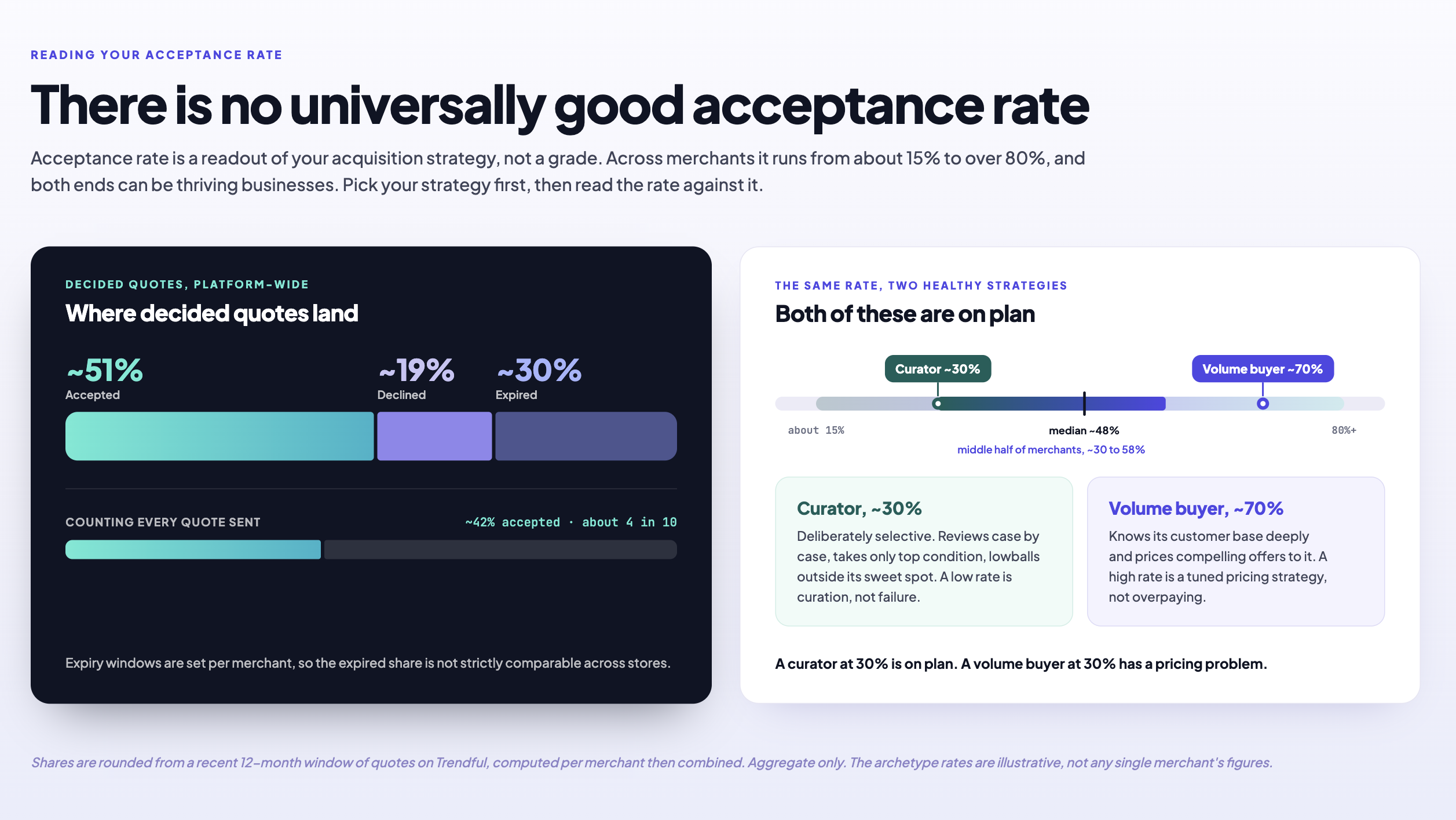
Picture two merchants with the same 30% acceptance rate. One is a curator who reviews every item case by case, takes only top condition, and deliberately lowballs anything outside a narrow sweet spot. For that merchant, 30% is curation working exactly as designed. The other is a volume buyer who meant to win most of what comes in. For that merchant, 30% is a pricing problem. The rate is identical and the diagnosis is opposite, which is why you pick the strategy first and read the rate against it, not the other way around. Condition-based fair market data is what lets you price deliberately at either end, selective or compelling, instead of drifting into a rate you did not choose.
One more thing about that spread is worth saying plainly. The declined share counts sellers turning down an offer, not merchants turning down items, since a merchant usually rejects an item before any quote is sent, so those rejections never enter this figure at all. And the roughly 30% that expire are mostly soft declines, since silence is usually the answer, with a persuadable minority that reminders can recover. The deeper mechanics of winning those sellers back live in our piece on why half your sellers do not come back, and how to fix it.
Margin targets without a single magic number
Notice what this does not give you: one flat split to paste onto every item. Margin targets move with category, brand, condition, and how fast a thing sells, and a number that protects you on a hard-to-move piece will cost you the deal on a hot one. The point of pricing off condition-based fair market value is that you can set deliberate targets and have them hold across a catalog, rather than defending a single percentage that fits nothing. Encode the targets into your strategy, let the data keep you honest on each reference, and let the acceptance rate tell you whether the strategy is landing where you aimed.
Price this way and the payoff compounds, because a fair, fast, well-explained offer is also what earns the seller back. On Trendful, up to 45% of sellers cross over into buyers and roughly half of those who accept an offer come back to sell again. Good pricing is not only about the margin on this item. It is about being the store the seller returns to with the next one. Choosing how you price is one step of our complete playbook for starting a resale business.
The takeaway
Pricing pre-owned luxury for acquisition is not a gut call you get better at. It is a decision you make off condition-based fair market value, tuned to buyout, consignment, or credit, and aimed at a deliberate margin target. A common anchor is about 60% of resale value, a little lower on a buyout, which keeps the roughly 40% spread the business actually runs on. Price the market value once and split it by payout. And stop reading your acceptance rate as a grade: pick your strategy first, whether you are a selective curator or a compelling volume buyer, then read the rate against the plan you chose. Data under the number and strategy over it, and the offer that works for the seller while protecting your margin stops being guesswork and becomes something you can repeat.
Frequently asked questions
How much should I pay to acquire a pre-owned luxury item? A common anchor is about 60% of the item's resale value, a little lower, near 55%, on a buyout. That leaves roughly 40% to cover authentication, listing, shipping, and returns. This reflects the offers a pricing strategy computed rather than every merchant, so treat it as a starting point and tune it by category, brand, and condition rather than applying one flat split to everything.
What is condition-based fair market value? It is the resale value of an item priced separately for each condition grade, such as excellent, great, good, and fair, rather than a single average figure. The same bag in excellent and in fair condition sells in two different markets, so pricing them off one number leaks margin. Trendful builds these estimates from sold data cleaned and matched to a catalog of more than 70,000 references across over 300 resale vendors, specific to size, style, condition, and region.
Can I just use an AI chatbot to price resale items? Not reliably. General AI tools are trained mostly on public listings, which are asking prices, not sales, and a bag listed high that never sells tells you nothing about its resale value. The underlying data is noisy and missing the sold prices that matter, so the confident answer is built on weak material. Pricing is only as good as the data under it, and sold, condition-graded data is a different thing from a web scrape.
How does Trendful calculate an offer? Your pricing strategy, your target margins and splits, tiered by item value, is applied to the condition-based fair market value to produce a buyout number, a consignment number, and a store credit number. You encode that strategy once and it does the per-item math, but the result is a suggested price, not an agreement: you still quote, and when you quote by hand you can accept the suggested numbers or change them before they reach the seller. Payment always comes after the item arrives and is reviewed, so an offer is never an unchecked payout.
What is a good acceptance rate for resale offers? There is no universal number. Across merchants the rate runs from about 15% to over 80%, with the typical merchant in the high 40s and the middle half between about 30% and 58%, and both ends can be healthy. A deliberately selective curator who takes only top-condition items may run near 30% and be exactly on plan, while a volume buyer running 30% likely has a pricing problem. Acceptance rate is a readout of your acquisition strategy, so decide the strategy first and read the rate against it. Counting every quote sent, about 4 in 10 are accepted; of the quotes that get a decision, about half are, with the rest declined by sellers or expired.
Get started
Want to see the Price Database, condition-based fair market value, and the offer builder behind these numbers? Create an account and pick the plan that fits how you operate today, or book a demo and we will walk you through it.
Keep reading
- Where resale inventory actually comes from: buyout, consignment, trade-in, and wholesale
Your sourcing strategy sets your cash flow, your risk, and your inventory quality. Here is how to source resale inventory from customers…
- Ditch the spreadsheet: how organized offers change a resale operation
Offers scattered across an inbox and a spreadsheet fall apart the moment a seller disputes something. Here is how putting every…
- Niche beats broad: how to position a resale business people remember
Resale spans luxury handbags, streetwear, home goods, and everyday basics, and trying to serve all of it is the fastest way to serve none…