Where resale inventory actually comes from: buyout, consignment, trade-in, and wholesale

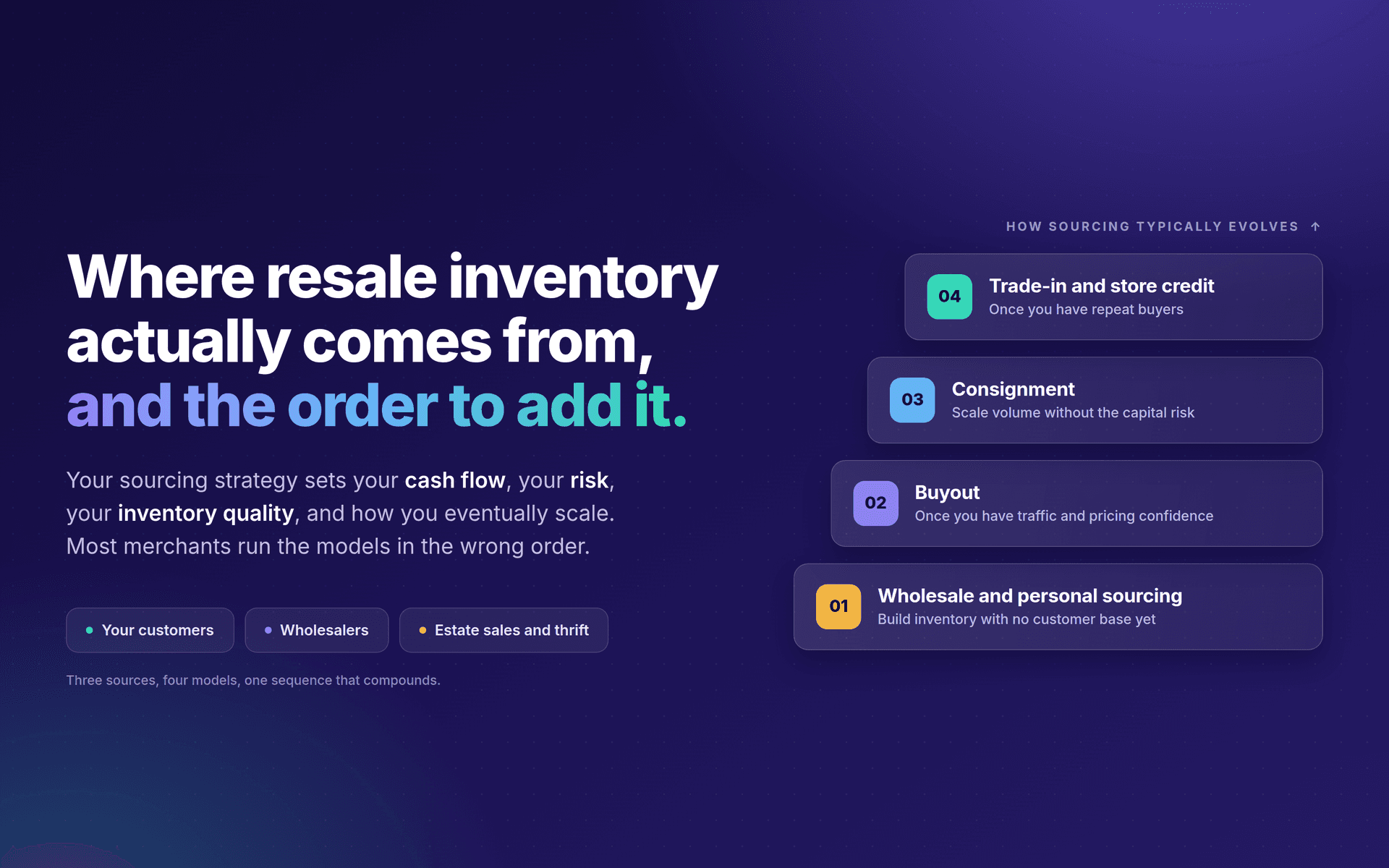
Your sourcing strategy determines everything downstream: your cash flow, your risk profile, your inventory quality, and how you will eventually scale. It is the least glamorous decision in the business and the one that quietly sets the ceiling on every other one.
This is step two of the Resale Playbook, the six step series we publish one Thursday at a time. Step one was about narrowing down what you sell and who you sell it to. This one is about where the goods come from.
There are three places to get them: your own customers, wholesalers, and estate sales or thrift. Underneath the first sit three structures, buyout, consignment, and trade-in or store credit, and most merchants eventually run more than one. What almost nobody tells you is that the models are not interchangeable at every stage. Running them in the wrong order is how merchants end up with a buyout program and no traffic, or a consignment business and no pricing confidence. The order is the part worth getting right.
From your customers
This is the highest leverage sourcing model for a growing resale business. When customers bring inventory to you, you eliminate sourcing costs, reduce acquisition effort, and build a recurring supply chain. You are not bidding against every other buyer with an account. You are the only one in the conversation.
That shift has a name, C2B acquisition, and it is the whole reason we argue that your own customers are your best suppliers. A wholesale account is flat: the same spend, the same fight, every month. A seller base compounds, because a seller who had a good experience comes back with the next item.
Three structures sit under it, and the difference between them is simply who carries the risk and when the money moves.
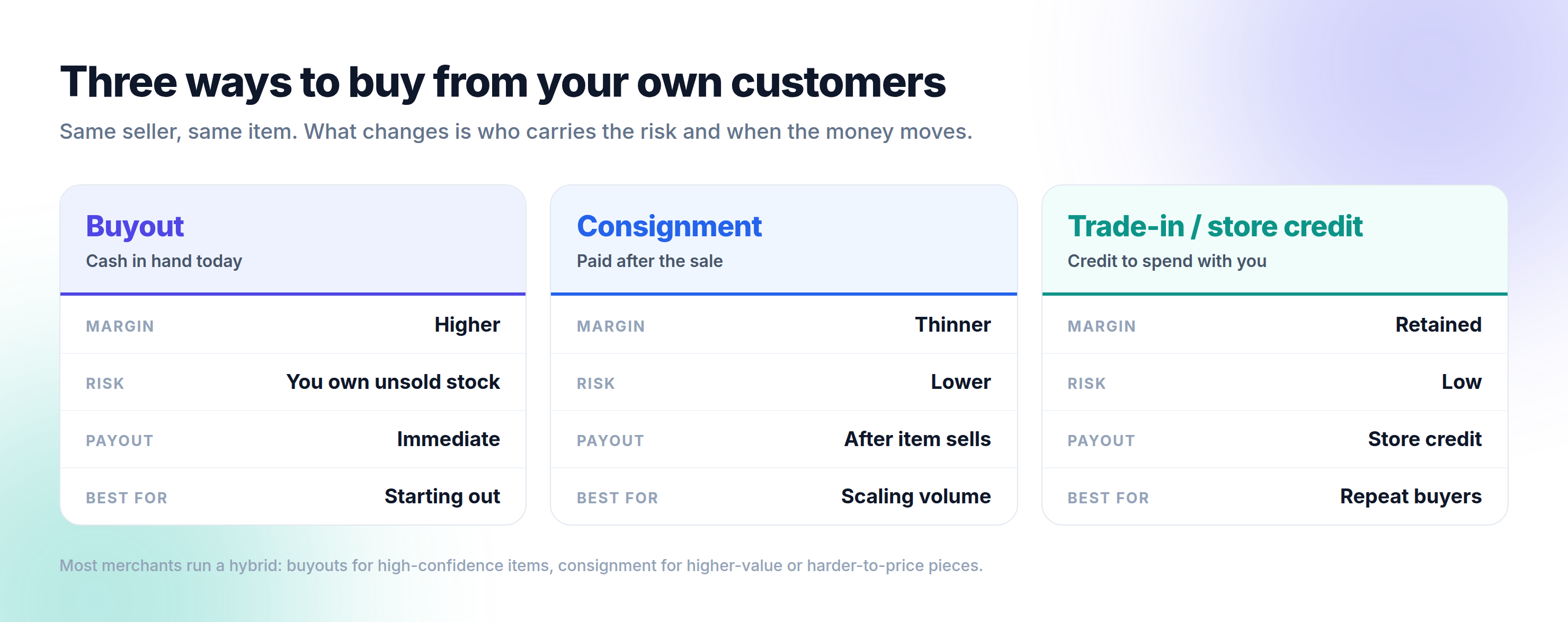
Buyout means you pay cash and own the item. The margin is higher because you took the risk, and the risk is real: unsold stock is your problem, not the seller's. It is the simplest thing to explain to a seller, which is part of why it is the first customer model most merchants launch.
Consignment means you list the item and pay the seller their share once it sells. Your margin is thinner, your risk is lower, and you can hold far more inventory than your bank balance would allow. The trade is patience, on both sides.
Trade-in and store credit keeps the margin inside the business. You pay in credit rather than cash, the risk is low, and the seller comes back to spend it. It is the least used payout on our platform and, we would argue, the most underrated.
In practice, most resale businesses run a hybrid: buyouts for high confidence items, consignment for higher value or harder to price pieces. The mix shifts over time as you build pricing expertise and traffic. If you want the full economics of each model side by side, including the fee math and the margin curve by item value, our complete comparison of buyout, consignment, trade-in, and store credit is the deep dive. This chapter is about when to run each one, not what each one is.
From wholesalers
Wholesale gives you more regular, predictable inventory, but it comes at a higher cost, which compresses your margins. You are buying from someone whose job is to extract a margin before you get the goods, and you are doing it alongside everyone else with a buyer account.
For luxury pre-owned goods, suppliers worth knowing include Le Prix, ESG Luxury, and The Brand Collector.
The honest case for wholesale is not margin. It is that inventory arrives whether or not anyone has heard of you yet. That matters enormously in month one and much less by year two, when it becomes a way to fill gaps rather than your main supply, which is exactly why it belongs at the start of the sequence rather than the end.
From estate sales and thrift shops
Estate sales and thrift shops can surface exceptional items at well below market value. The margin on a single good find can beat anything a wholesaler will quote you.
The catch is that this model is manual, unpredictable, and heavily dependent on where you live. There is no version of it that scales with a hire or a system. When Trendful first launched as an online resale business, estate sales were part of how we sourced initial inventory, and being based in Washington DC gave us access to a strong market for it. A merchant in a smaller metro running the same playbook would have come home with less.
Treat it as a supplement rather than a strategy. It is a good way to build a starting inventory and a terrible way to plan a quarter. Our older tour of the sourcing channels resale merchants actually use goes further into the auction and liquidation end of this.
How sourcing typically evolves
Here is the progression that works, and the reason each stage unlocks the next one.
1. Start with wholesale or personal sourcing. You need inventory before you have a customer base, and these are the only two channels that do not require one. The goal at this stage is not margin, it is having something to sell and learning what sells.
2. Launch buyout programs. Once you have traffic and pricing confidence, start accepting items directly from customers. Both conditions matter. Traffic means sellers know you exist, and pricing confidence means you can make an offer quickly without talking yourself into a bad one. This is the stage most merchants try to skip, and skipping it is why their first buyout program produces twelve submissions and a lot of second-guessing.
3. Add consignment to reduce inventory risk. Now you can take on more inventory without the upfront capital risk of buying everything outright. Consignment works once you have the traffic to actually sell the pieces, which is why it comes after buyout rather than instead of it. Before you have buyers, consignment is just a storage business.
4. Layer in trade-in programs. Once you have repeat buyers, trade-in credit drives loyalty and return visits. It needs an audience that wants to spend the credit, so it lands last for a reason.
Notice what each stage is actually waiting for. Wholesale waits for nothing. Buyout waits for traffic and pricing confidence. Consignment waits for sell-through. Trade-in waits for repeat buyers. You are not choosing a model so much as earning the next one, and each one you add makes the one after it cheaper to run.
None of this means retiring the earlier stages. Plenty of established merchants still buy the occasional wholesale lot, and most still run buyouts as their bread and butter. Layering in is the operative phrase.
Where does Trendful fit in
There is a clear point where managing customer acquisitions by hand stops working. Spreadsheets get messy, follow-ups get missed, payouts start slipping.
Those three failures are not equally visible, and the first one is the one that costs you inventory. Speed is the offer. Across the platform, the median time from submission to quote sent runs about two days, while the fastest merchants answer in under two hours. A seller deciding whether to part with a bag is weighing you against the shop down the street and against simply keeping it, so the shops that lose sellers mostly lose them to silence.
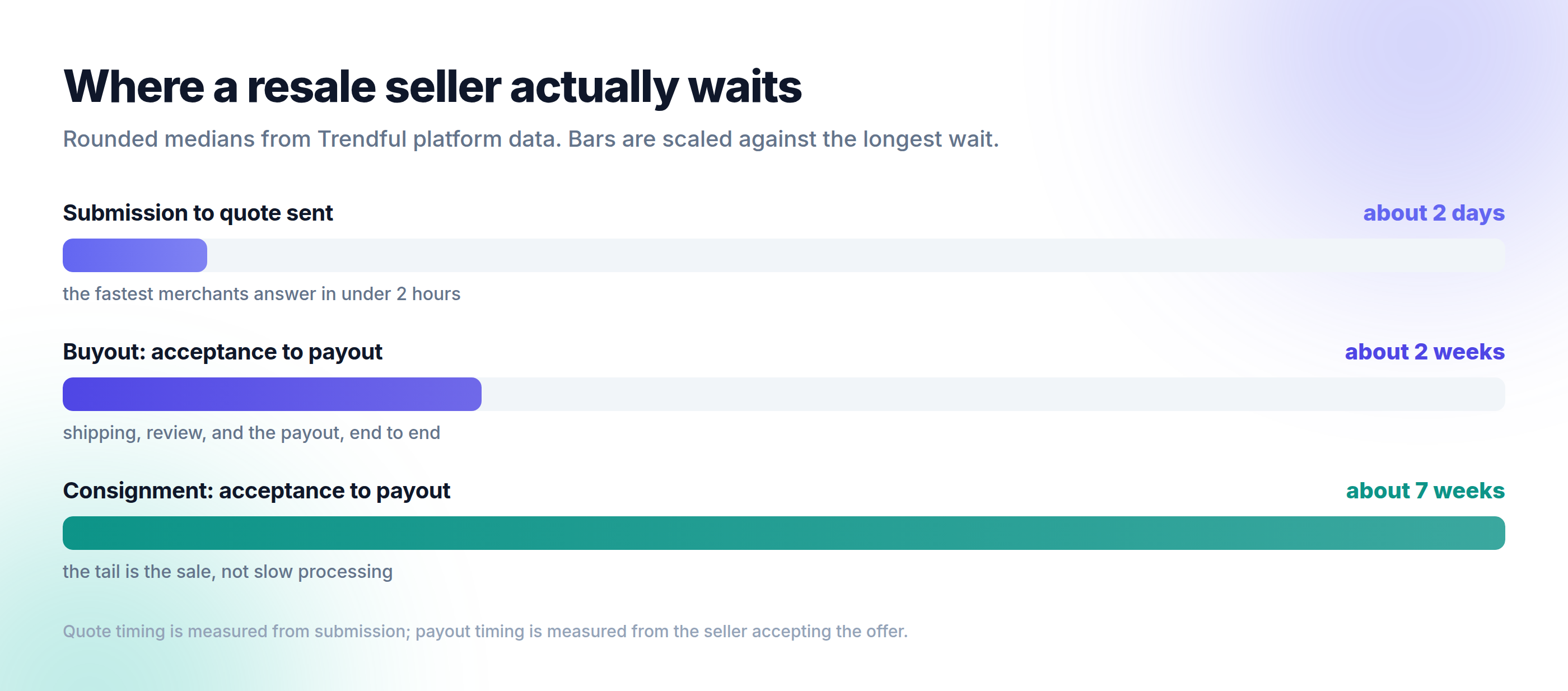
The payout side matters too, and it matters differently for each model. A buyout runs about two weeks from acceptance to payout, covering the seller shipping the item in, review, and the payment. A consignment runs about seven weeks, and the tail there is the sale rather than slow processing. That is not a flaw in either model, it is the trade-off between them, measured. What breaks is not the timing, it is not knowing where any given item sits in it.
This is the bottleneck Trendful was built to remove. The platform automates your customer intake, structures your offer pipeline, and handles payouts, so you can focus on growth rather than administration. Sellers come in through your branded Resale App, with a full account, history, and payout tracking, or through the Sell Form, a shareable no-login link that works over DM, text, or a live selling event. They are not either/or: most merchants keep the Sell Form running after adopting the Resale App, as the easiest entry point for new or occasional sellers. Behind both, that means every quote, label, message, and payout lives on one offer record instead of across an inbox, a spreadsheet, and someone's memory. If you want to see one item travel the whole route, the anatomy of a submission follows a single piece from customer photo to payout, and our guide to sending and receiving quotes covers the step that decides most of it.
The reason this chapter ends on operations rather than margin is that sourcing strategy and sourcing capacity are the same problem. You can only run the model your process can carry. Add buyout before you can quote in a day and you will lose the sellers you worked to attract. Add consignment before you can track an item through listing and sale and you will lose the item.
Frequently asked questions
How do I source inventory for a resale business? Three channels: your own customers, wholesalers, and estate sales or thrift. Buying from customers is the highest leverage of the three because it removes sourcing costs and builds a supply chain that repeats, but it needs traffic first. Wholesale gives you predictable inventory at a higher cost, and estate sales can surface exceptional items without ever scaling. Most merchants start with wholesale or personal sourcing, then move toward customer acquisition as their audience grows.
Should I start with buyout or consignment? Buyout, in almost every case. It is simpler to explain, it pays the seller immediately, and it teaches you pricing faster because you are the one carrying the risk on every call you make. Consignment makes sense once you have enough traffic to actually sell the pieces, since before that it is a storage business with extra steps.
Where do resale merchants buy wholesale pre-owned luxury? For luxury pre-owned goods, suppliers worth knowing include Le Prix, ESG Luxury, and The Brand Collector. Expect predictable inventory and compressed margin, and treat wholesale as the way to build a starting inventory rather than a long-term margin strategy.
Are estate sales and thrift shops worth it for sourcing? They can be, for exceptional individual finds well below market value. What they will not do is scale. The model is manual, unpredictable, and heavily dependent on your metro area, so it works as a supplement to a repeatable channel rather than as the channel itself.
When should I add trade-in or store credit? Once you have repeat buyers. Trade-in credit drives loyalty and return visits, which only works if the seller actually wants to spend that credit with you. It also keeps the margin inside the business, which is why it is worth adding as soon as you have the audience to support it.
How long does it take to pay a seller? It depends on the model. On Trendful, a buyout runs a median of about two weeks from acceptance to payout, covering shipping, review, and the payment itself. A consignment runs about seven weeks, because the seller is paid after the item sells. Saying which one a seller is signing up for, up front, prevents most of the follow-up questions.
Sources
- Platform figures described as ours come from aggregate Trendful data across merchants on the platform, rounded for readability.
Get started
Want to see what structured intake, offers, and payouts look like before your sourcing outgrows a spreadsheet? Create an account and pick the plan that fits how you work today, or book a demo and we will walk you through it.
Keep reading
- Ditch the spreadsheet: how organized offers change a resale operation
Offers scattered across an inbox and a spreadsheet fall apart the moment a seller disputes something. Here is how putting every…
- Niche beats broad: how to position a resale business people remember
Resale spans luxury handbags, streetwear, home goods, and everyday basics, and trying to serve all of it is the fastest way to serve none…
- Store credit: the offer type that turns sellers into buyers
Store credit is the most underused lever in resale. Merchants on Trendful add about a 10% premium for it, yet only about 4% of accepted…