Anatomy of a submission: from customer photo to payout

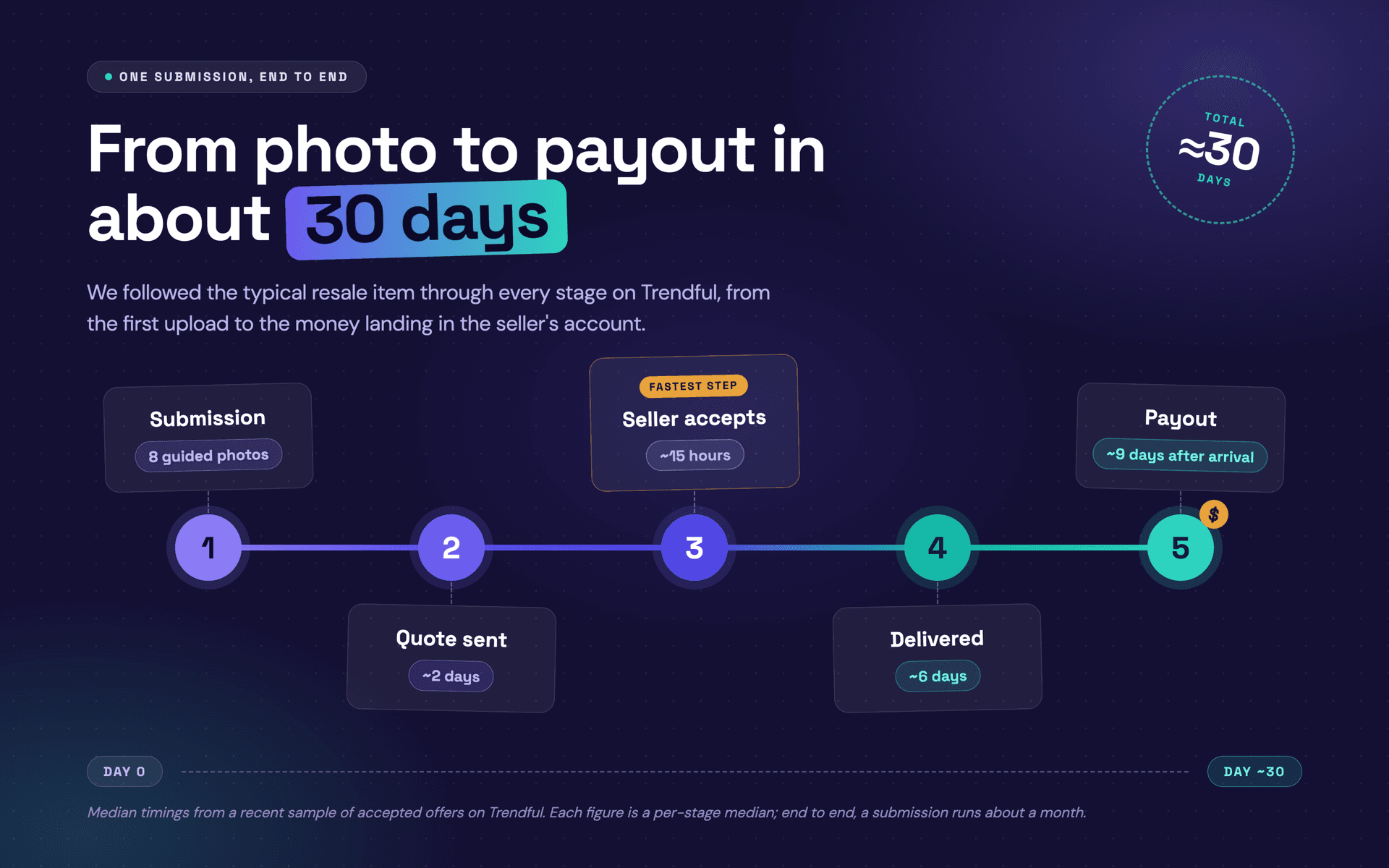
A seller snaps a few photos of a handbag and sends it off. A merchant opens their submissions queue and figures out what it is worth. Same item, two points of view, and resale is really just the story of what happens between them.
This piece walks through that story with one item, from the first photo to the seller getting paid. If you are a seller wondering how selling to a resale store actually works, this is your walkthrough. If you are a merchant, it is a close look at every deal you run. Either way, it is the on-the-ground version of the model we call C2B resale acquisition: your customer is the supplier, and every deal ends with you paying them.
It starts with a submission
Nothing happens until a seller offers up an item, and on Trendful they can do that from wherever they already are. Most submissions come through the resale app that lives on the merchant's own storefront, where a browsing customer can put an item forward in a couple of taps. Others arrive through the shareable sell form, a link a merchant drops into a social bio or an email so someone can submit without a website in the way. Merchants can also create a submission straight from admin for a walk-in, or keep an iPad open with the form running at the counter.
Whatever the door, the submission asks for the same two things: photos and details. The resale app and the sell form both ask for up to 8 photos, and most sellers add all of them, which matters more than it sounds. Those images, plus the brand, the category, and the seller's own read on condition, are the entire basis for the offer that comes next. A submission with clear photos of every angle gets a fast, confident quote. A blurry one gets questions, and questions cost days.
If a seller does not have every angle ready at first, that is fine. They can email the rest later, and because those emails are tracked against the submission, the merchant adds the new photos to the offer in one click straight from the attachment. No re-uploading, no lost threads.
The quote: fast, but never a payment
Now the merchant owes the seller a number, and this is where the most common misunderstanding about resale lives.
The quote can go out two ways. Most merchants price and send it by hand, deciding item by item what to offer, and that manual quote builder is the norm across the platform. Merchants who want to move faster can switch on instant offers, an optional feature that computes the number automatically from a condition-based fair market value estimate crossed with the merchant's own pricing strategy and commission structure, so the seller sees an offer right away. Either path fires an automatic email to the seller the moment the quote is ready.
One rule holds no matter which path you use: a quote can be instant, but the payment never is. The word "instant" describes the offer, not the money. Nothing is paid until the item arrives and is checked, which is the single fact that separates resale from every retail transaction the seller has ever done.
Speed here is not a nicety, it is the offer itself. Across a recent sample of accepted offers on Trendful, the median merchant sends a quote in about two days. Roughly 1 in 16 quotes goes out within the hour, and about a third land within a day. The best operators answer in under two hours, and they win items the six-day merchants lose, because a seller deciding whether to part with a bag is comparing you against the shop down the street and against simply keeping it.
Acceptance: the fastest yes in commerce
Here is the surprise in the data. Once a seller has an offer in front of them, the decision is quick. The median time from quote sent to accepted is about 15 hours, and a large share say yes within the hour. Acceptance is the quickest step in the whole journey.
That tells you something useful: hesitation lives before the quote, not after it. Sellers are not agonizing over a fair offer, they are waiting for one to show up. Get the number in front of them quickly and momentum does the rest. Quote speed sets the pace of the whole deal.
At acceptance the seller has also locked in how they want to be paid, choosing among buyout, consignment, and store credit (also called trade-in). That choice does not change what happens next to the item, it only changes when the money moves, which we will come back to at payout.
The label and the trip in
An accepted offer becomes a shipping label, usually the same day. The seller gets a prepaid label and live tracking, and the item begins its trip to the merchant. Across the platform this leg runs about six days from label created to delivered, and it is the first of the two long stretches in the timeline.
It is also a quiet trust moment. The seller has said yes to an offer and handed their item to a carrier, and nothing has been paid yet. Prepaid labels, real tracking, and clear handling are how a merchant keeps that stretch from feeling like a leap of faith. We went deep on this in our piece on how resale merchants handle inbound shipping, because the shipping experience is where a lot of otherwise-good deals wobble.
Arrival and evaluation
The box lands, and the merchant does the job a buyer always has to do: look at what they are buying. Every item is inspected on arrival, and this is a big part of why the model is operationally heavy. The merchant confirms the item matches the submission and runs authentication using whatever approach they trust, whether a third-party service such as Real Authentication (a Trendful partner) or Entrupy, or their own in-house process.
It is worth being precise about Trendful's role here. Items ship directly to the merchant. Trendful is the workflow layer: it never takes possession of inventory or provides authentication services, and the merchant's authentication step, third-party or in-house, slots directly into the flow.
Most items pass, and what happens next depends on the offer. A buyout heads straight to payout. A consignment takes a small detour first: the item gets listed for sale, and the seller is paid once a buyer takes it, so the merchant needs a way to track it through listing and sale, which is exactly what our inventory management system is for.
When an item does not pass, because it fails authentication or its condition does not match the submission, its processing status moves to rejected, the merchant can add notes explaining why, and a return is created automatically. How gracefully that return is handled decides whether the seller ever comes back, which is the whole subject of our guide to handling declined items.
Payout, or a graceful return
For approved items, the last stop is the money, and the timing depends entirely on the offer type the seller chose back at acceptance.
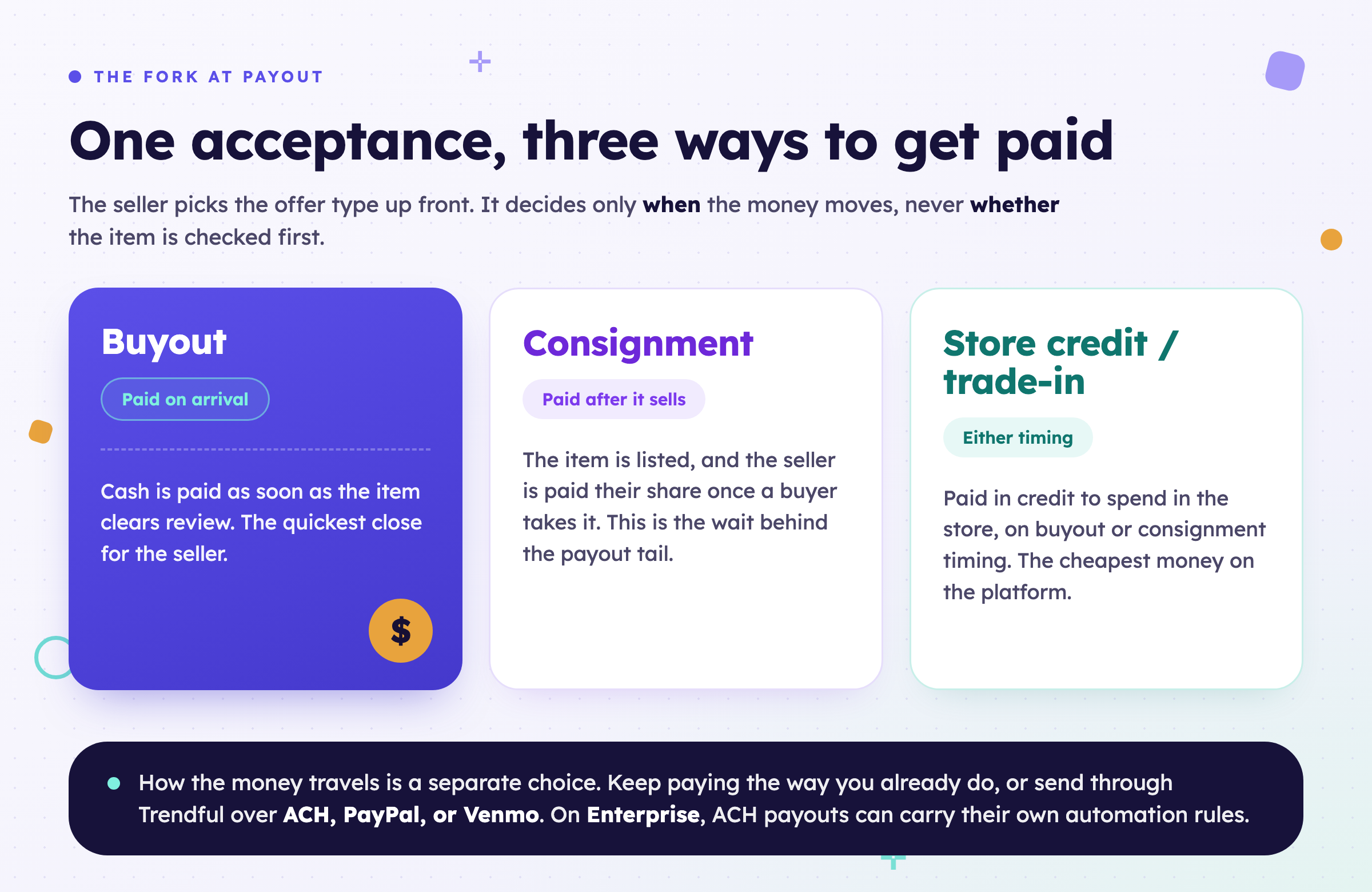
A buyout pays cash on arrival, as soon as the item clears review. A consignment pays the seller their share after the item sells, which can be days or weeks later depending on the item. Store credit rides on either timing, paying the seller in credit to spend in the store rather than cash. The median from delivery to payout is about nine days, and that number is longer than it looks because it blends fast buyouts with consignments waiting for a buyer. The tail is the sale, not slow processing, and it helps to say so to sellers up front. For the full economics of each option, see our comparison of buyout, consignment, trade-in, and store credit.
How the money actually travels is a separate decision from all of this, and it is not all ACH. A merchant who already has a payout process can keep it, pay the seller their own way, and just mark the item paid in admin. A merchant who wants Trendful to move the money can send over ACH, PayPal, or Venmo, and they choose which methods to offer sellers in the first place, so a seller may also pick something like a check, Zelle, an e-transfer, or store credit and be settled outside the platform. On Enterprise, ACH payouts can carry their own automation rules on top. Either way the work is the same in admin: filter the sold or completed items and pay out in a few clicks, with bulk sends running over ACH.
Where the month actually goes
Put the stages end to end and a typical item runs about 30 days from the first photo to the payout. But that month is not spread evenly, and knowing where it pools is how a merchant finds the time worth saving.
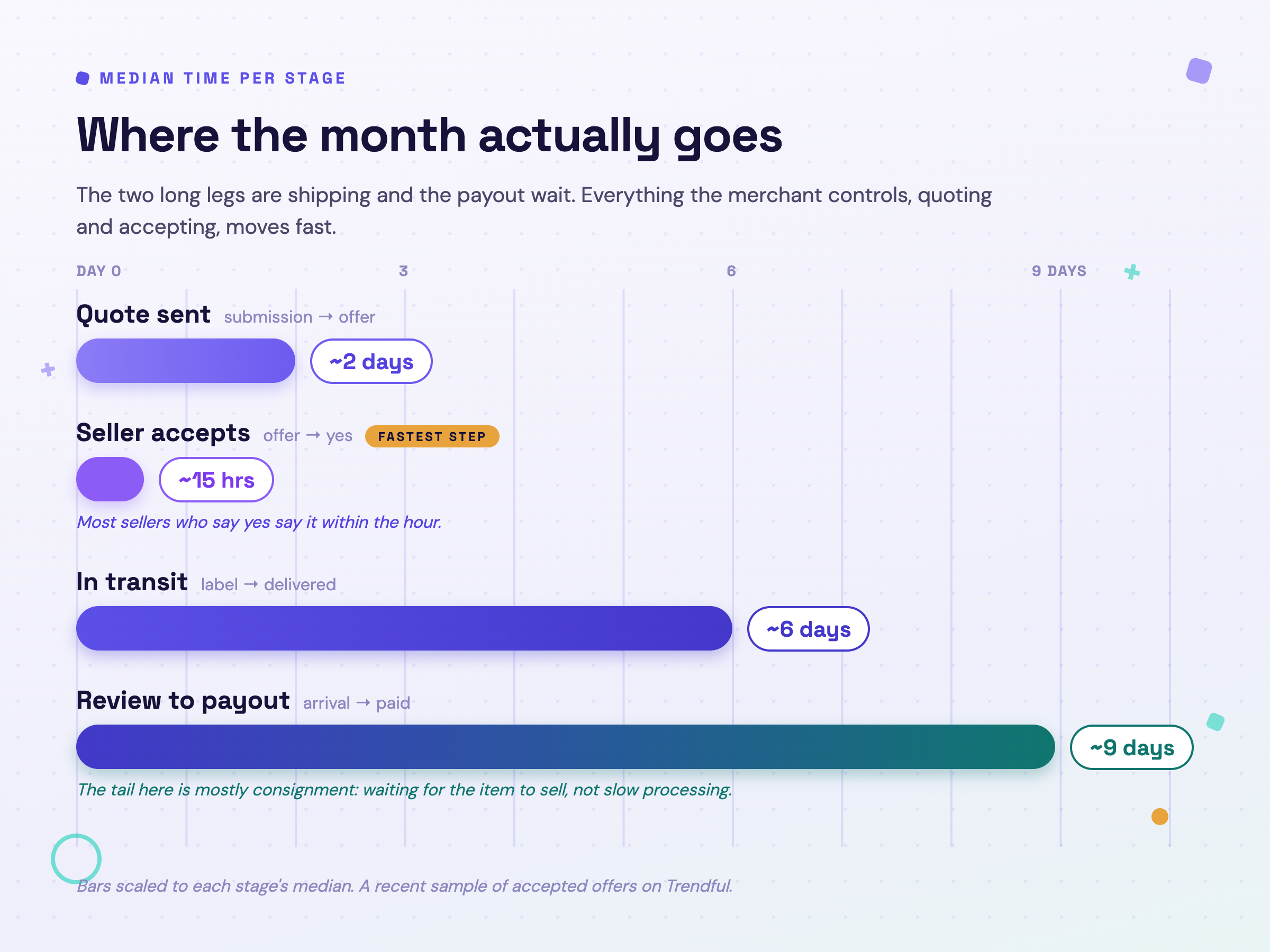
The two long legs are shipping and the payout wait, and both are mostly out of the merchant's hands: a carrier moves the box, and a buyer decides when a consignment sells. The steps the merchant does control, quoting and accepting, are quick, which is exactly the point. The clock a merchant can actually beat is the quote, and shaving days off it is the highest-leverage move in the whole pipe, because a fast, fair offer is what turns a one-time seller into the repeat supplier at the heart of the resale flywheel.
The takeaway
One item, one month, five stops: submission, quote, acceptance, the trip in, and payout or return. Seen whole, the anatomy of a submission is really the anatomy of the C2B model at ground level. The merchant is the buyer, so every item gets a fresh decision and a real inspection, which is why the quote can be instant but the payout never is. Master the one stage you control, the quote, and the rest of the pipe runs on trust you have already earned. Unlike a wholesale lot or an auction win, a seller you paid quickly and fairly comes back with the next item, and the pipe fills itself.
Frequently asked questions
How does selling to a resale store work, start to finish? You submit your item with photos and details, the store sends you a quote, and if you accept you ship the item in on a prepaid label. The store inspects and authenticates it on arrival, and then pays you. On Trendful the whole path runs about 30 days from your first photo to the payout, though a straight cash buyout is faster than a consignment that waits for the item to sell.
How many photos do I need to submit? The sell form asks for 8 photos, and most sellers complete all of them. Clear photos of every angle, including any flaws, are the basis for your offer, so more and better images usually mean a faster, more confident quote.
How long does it take to get paid after I send my item in? The median time from delivery to payout is about nine days, but it depends on your offer type. A buyout pays cash on arrival once the item clears review, while a consignment pays after the item actually sells, which is what stretches the average.
Does an "instant offer" mean I get paid instantly? No. Instant offers are an optional feature, and most merchants price and send quotes by hand. When instant offers are on, "instant" describes the offer, not the payment. You are only paid after the item ships in and passes authentication and review.
What happens if my item does not pass authentication? The merchant marks the item rejected, can add notes explaining why, and a return is created so the item ships back to you. A good merchant treats the return as carefully as a payout, because how it is handled decides whether you sell to them again.
Who authenticates the item, Trendful or the merchant? The merchant. Items ship directly to the merchant, and Trendful is the workflow layer: it never takes possession of inventory or provides authentication services. The merchant runs authentication with a third-party service such as Real Authentication or Entrupy, or with their own in-house process, and that step slots directly into the flow.
Get started
Want to see the submission flow, the quote builder, and the platform data behind every stage? Create an account and pick the plan that fits how you operate today, or book a demo and we will walk you through it.
Keep reading
- Where to sell pre-owned inventory: marketplace fees vs your own storefront
Most operators pick a sales channel on audience fit and never run the math on what a typical sale nets. Here is where to sell pre-owned…
- Authentication is not optional: how to authenticate pre-owned luxury
One undetected fake can undo months of trust building. Here is what the leading authentication providers cost, how to build authentication…
- Pricing pre-owned luxury for acquisition: offers sellers accept without killing margin
Price a resale offer too low and you can lose the sale; too high and the margin gets thin. Here is how condition-based fair market value…