Your customers are your best suppliers: the data behind the resale flywheel

Every traditional retailer knows exactly where their next unit of inventory comes from. A resale merchant wakes up every morning not knowing.
Wholesale lots are scarce and picked over. Auctions mean bidding against every other reseller in the country. Rework-heavy sourcing eats the margin it was supposed to create. Meanwhile the best supply source most merchants already have is walking through their door and browsing their site: their own customers. This is the thesis behind everything Trendful builds, and the platform data backs it up.
Why traditional supply is broken for resale
In resale, supply is the constraint, not demand. Demand for pre-owned luxury keeps climbing. The merchant who solves supply is the one who wins. And the classic ways to solve it all fight the same headwinds.
- Wholesale comes in two flavors, and neither is easy. Bulk lots and pallets are cheaper per unit, but you take what arrives with little control over condition or mix. Curated wholesale sites, common in luxury, let you pick individual pieces, but that control costs more. Source either one from abroad and you also have to price in tariffs, which can move faster than your margins.
- Auctions and liquidation can occasionally land a piece cheap, and that is the appeal. The catch is they are time-boxed bidding wars: you have to be available at the right moment, hold your discipline so you do not overpay, and accept condition surprises when the hammer falls.
- Peer-to-peer marketplace arbitrage can turn up the occasional treasure, but you pay for it with stacked fees on both sides and a crowd of resellers chasing the same listings.
- Thrifting, estate sales, and local sourcing can deliver unique finds and strong margins, but they are time-intensive and hard to scale. Great for a curated drop, tough to build a business on.
Each of these channels resets to zero every month. You spend the same effort, fight the same competition, and start over. Worse, none of them build anything you own. The pallet is gone once it sells, the auction house keeps the relationship, and the marketplace keeps the seller. Put the channels side by side and the pattern is hard to miss.
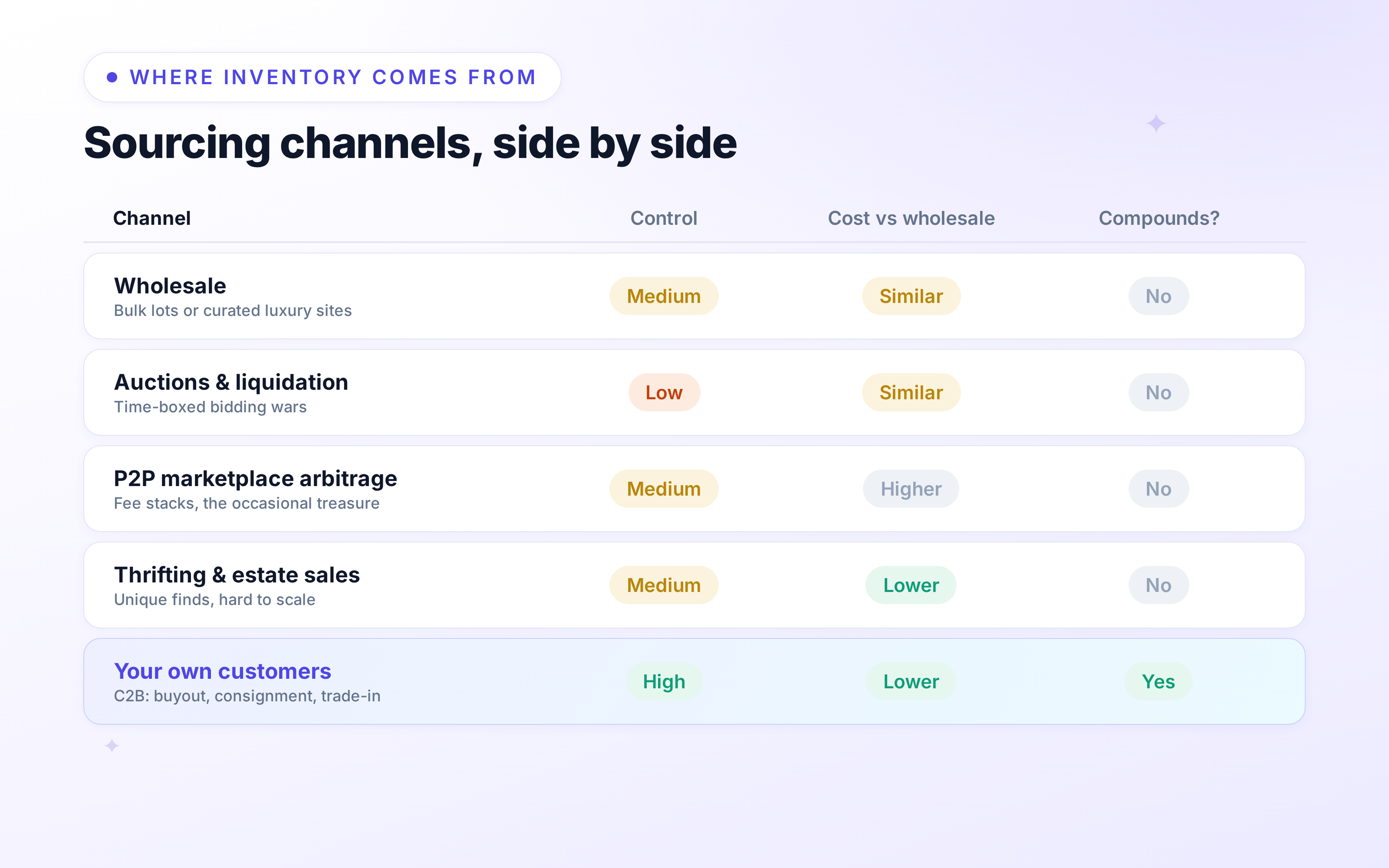
For a fuller tour of these options, our earlier guide on how resale merchants source inventory walks through each one. The short version: the channel in the bottom row is the only one that gets easier over time.
Your customers are your suppliers
Here is the insight the whole model turns on. The people who buy pre-owned luxury also own pre-owned luxury. Your buyer of today has a closet that is your inventory of tomorrow.
Acquiring from your own customers flips every disadvantage of traditional sourcing. You set the offer instead of chasing a price. You inspect the item before or on arrival instead of hoping a pallet is clean. There is no bidding war, and the acquisition cost typically lands below wholesale. This is C2B acquisition: the customer sells to the business, whether through buyout, consignment, trade-in, or store credit. It works for any merchant running any mix of those models, not just consignment shops.
The flywheel
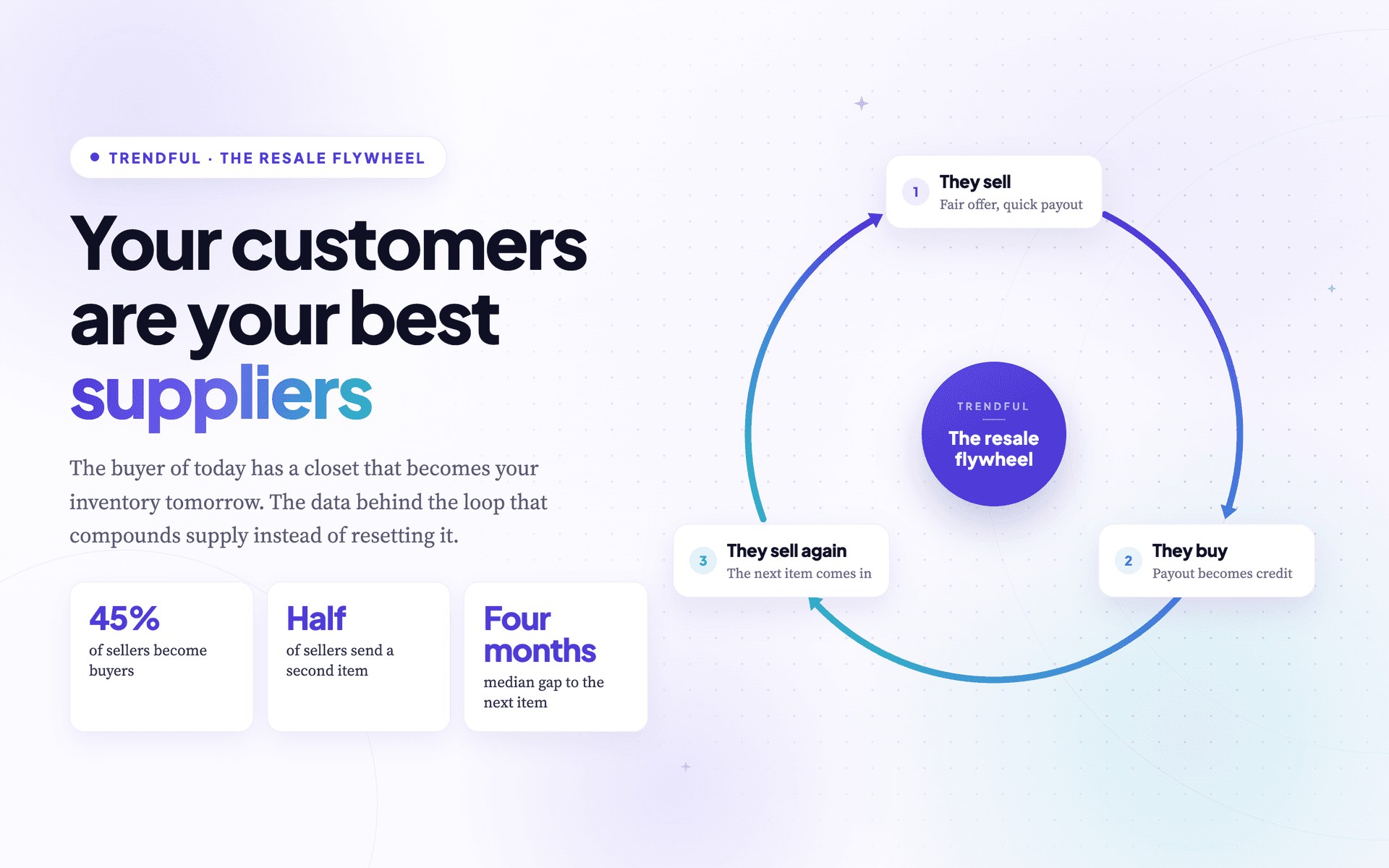
The reason this beats every other channel is that it compounds. It is a loop, and each turn makes the next one easier.
- A customer submits an item and gets a fair offer.
- The experience is smooth, from quote to shipping label to tracking to payout, so trust gets built.
- That seller comes back with the next item, and often buys from the store while they are there.
- More inventory means more buyers, and more buyers means more future sellers.
Every cycle the loop tightens. A wholesale account never does that. And this is not a whiteboard theory. It is what shows up in the numbers across Trendful's platform: roughly 80,000 seller accounts and close to 200,000 items submitted all time, with more than 4,200 new items coming in every month.
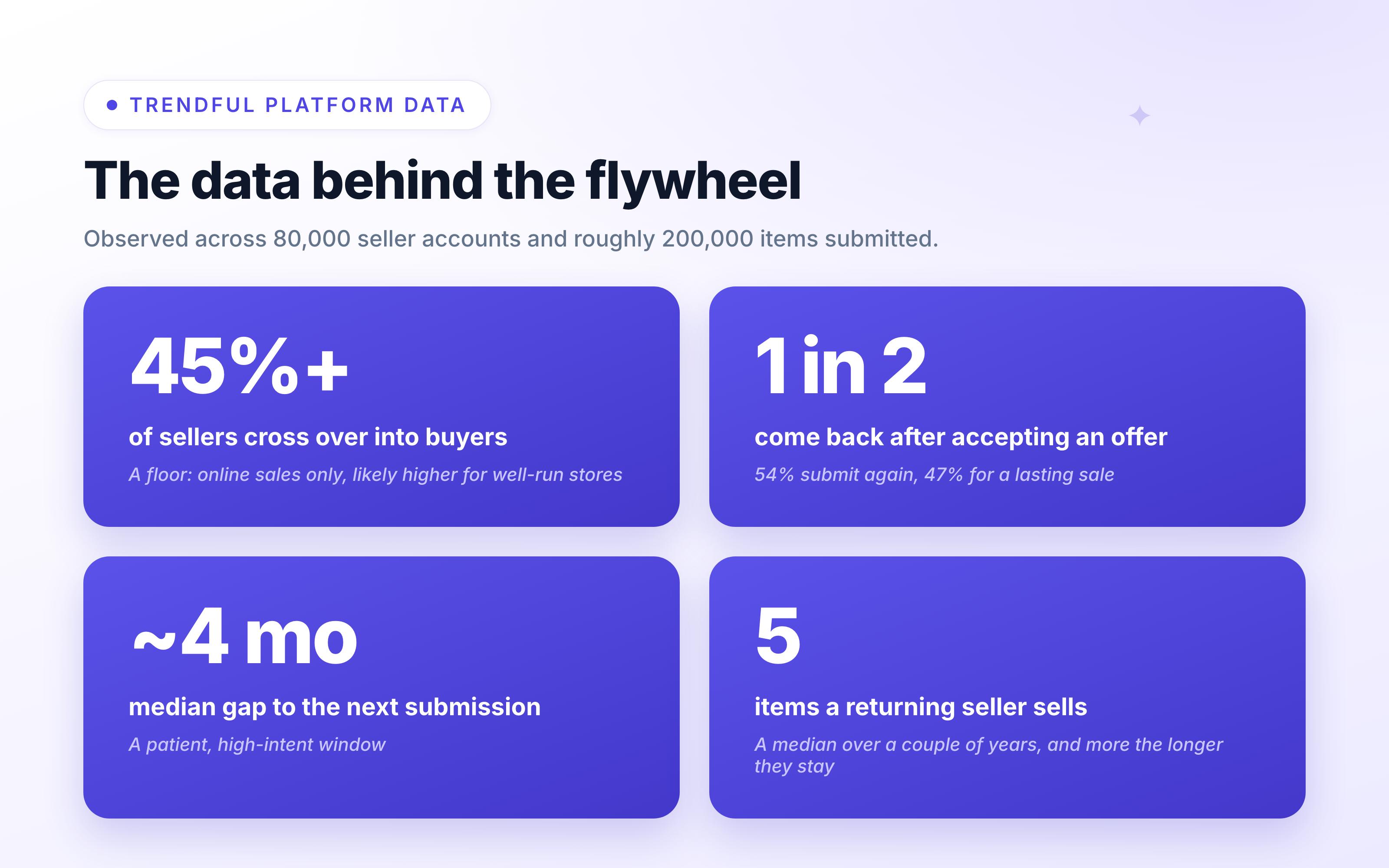
A few figures stand out, all of them Trendful platform data:
- Up to 45% of sellers cross over into buyers when operations and satisfaction are strong, and that is a floor. We can only measure online sales on a subset, so 45% is what we actually saw, not a ceiling, and for well-run stores it is likely higher. The person who sold you a bag becomes the person buying the next one.
- When a seller accepts an offer and goes through the whole process, roughly 1 in 2 come back. About 54% submit again and 47% return for a lasting repeat sale. That is the flywheel in one number: complete the experience and close to half your supply reorders itself. Sellers who never finished, because they were ghosted or turned away, return at less than half that rate.
- When they do come back, it is rarely the next week. The median gap before a second submission runs to about four months for sellers who accepted an offer, so this is a patient, high-intent relationship, not an impulse rebuy.
- And it seldom ends at one more item. A seller who returns sells a median of 5 items over a couple of years, and more the longer they stay, which is exactly how supply compounds instead of resetting to zero each month.
- The average submitted item carries a resale value around $2,300, so each returning seller is meaningful supply, not a rounding error.
Store credit is the accelerant here. A seller paid in credit is already your next buyer, which is exactly why merchants who lean on trade-in and store credit see the loop spin faster.
Why this compounds and marketplace sourcing does not
The difference between a customer base and a sourcing channel is ownership.
A marketplace relationship belongs to the marketplace: the seller is theirs, the data is theirs, and the fees are theirs to raise. A seller relationship belongs to the merchant. Every returning seller has effectively zero acquisition cost the second time, because you already earned their trust, and over enough cycles your brand becomes "the place I sell to and buy from," a moat no wholesale account can hand you.
Contrast the two shapes. Traditional channels are flat: the same spend and the same fight, month after month. A customer base is a curve: it grows, because every satisfied seller is a future seller and a possible buyer. One resets. The other accumulates.
The timing is where this gets practical. A returning seller rarely reappears the next week; the median gap before the next submission runs to about four months. Treat that as a feature: the relationship is patient and high-intent, so the job is to nurture sellers across months, not chase an impulse rebuy. Stay in touch across that window and the same person keeps feeding your shelves. Go silent and you hand the next item to whoever asks first.
What it takes to run this
The flywheel only spins if the operational experience earns the return visit. That means intake from anywhere the seller is, whether web, social, or in store, plus fast quotes, tracked shipping in both directions, reliable payouts, and communication that stays organized on a single thread. Trendful is the infrastructure that runs all of it end to end, from the first inbound shipment to the return that keeps a declined seller coming back. Get that experience right and sourcing stops being a monthly scramble and starts being a base that grows on its own. If you are building the whole operation from scratch, our complete playbook for starting a resale business lays out the six steps in order.
Frequently asked questions
How do resale stores get their inventory? Mainly three ways: wholesale lots, auctions and liquidation, and increasingly direct from their own customers. Wholesale is scarce and inconsistent, auctions turn into bidding wars that compress margin, and customer acquisition gives the merchant control over price and condition while building a relationship that brings the seller back.
What is a resale flywheel? It is the loop where a customer sells an item to the store, has a smooth enough experience to return with more items, and often becomes a buyer along the way. Each turn adds inventory and buyers, so supply compounds instead of resetting every month.
Is buying inventory from customers cheaper than wholesale? Generally yes. There is no bidding war, the merchant sets the offer, and the relationship is direct with no middle platform taking a cut, so the acquisition cost typically lands below wholesale while giving the merchant far more control over quality.
What percentage of resale sellers become buyers? Up to 45% on Trendful's platform when operations and customer satisfaction are strong, and that is a floor rather than a ceiling. It reflects only the online sales we can track across a subset of roughly 80,000 seller accounts, so the true number is likely higher for well-run businesses. It is a platform observation, not an industry universal, but it shows how directly a good selling experience feeds future demand.
Get started
Want to see the offer view, the seller experience, and the platform data behind the flywheel? Create an account and pick the plan that fits how you operate today, or book a demo and we will walk you through it.
Keep reading
- Niche beats broad: how to position a resale business people remember
Resale spans luxury handbags, streetwear, home goods, and everyday basics, and trying to serve all of it is the fastest way to serve none…
- Store credit: the offer type that turns sellers into buyers
Store credit is the most underused lever in resale. Merchants on Trendful add about a 10% premium for it, yet only about 4% of accepted…
- How to start a resale business: the complete playbook
Secondhand is on track for about $393 billion by 2030 and growing twice as fast as apparel retail. The opportunity is not the hard part…