Buyout vs consignment vs trade-in vs store credit: the complete comparison

Ask ten resale operators how they acquire inventory and you will hear the same three words traded around like rival teams: buyout, consignment, store credit. Pick one, the story goes, and build your business around it.
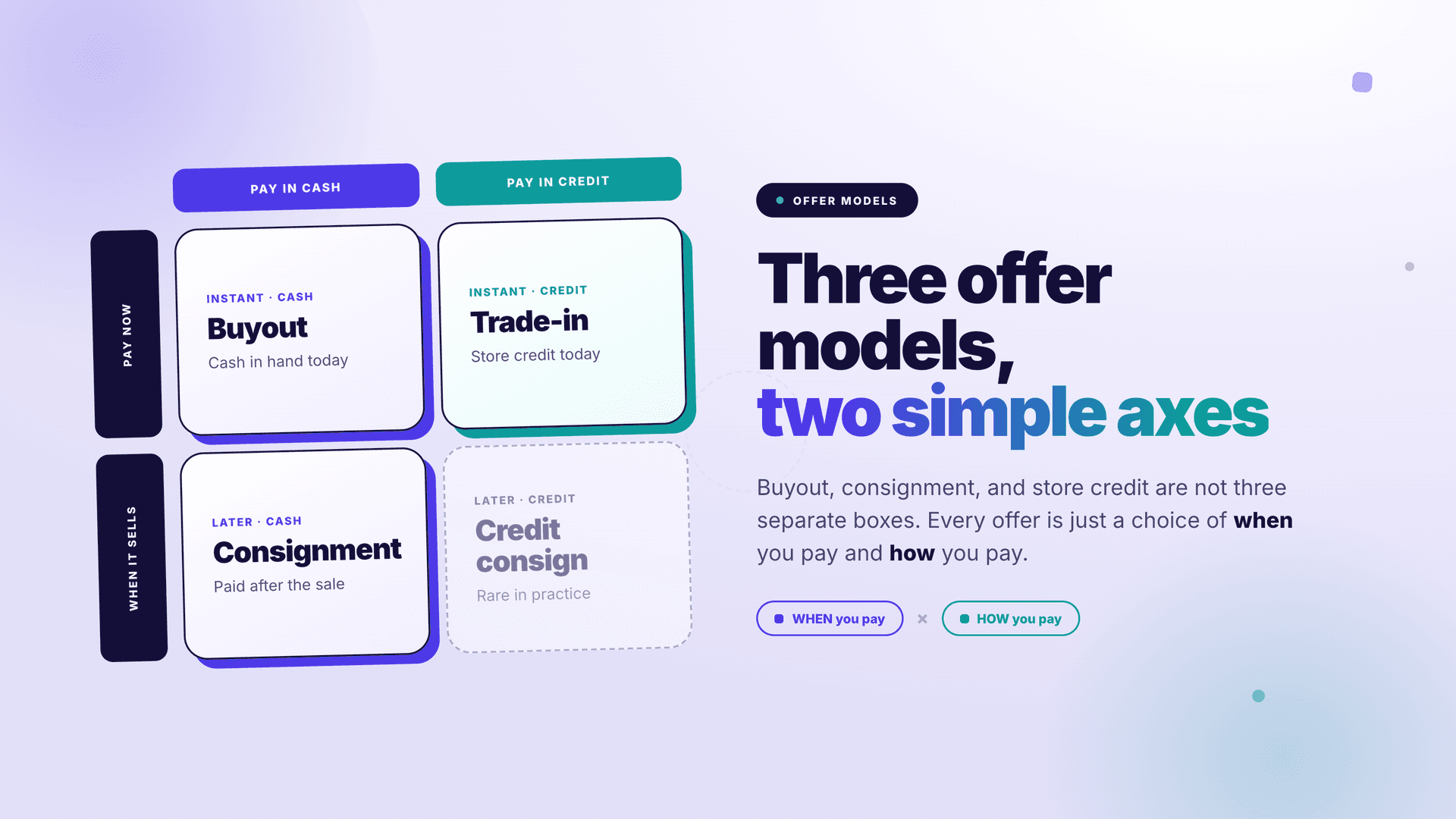
That framing is wrong, and the data behind every offer says so. An accepted offer is not a bucket you pick. It is two small decisions: when you pay the seller, and how you pay them. Get those two axes straight and buyout, consignment, and store credit stop being a personality quiz and start being levers you can pull item by item. To ground the whole thing in reality, we pulled what merchants on Trendful actually did across a recent sample of around 10,000 accepted offers. This is the one article where the offer models themselves are the subject, and where the platform data does the arguing.
The two axes hiding inside every offer
Every offer answers two independent questions.
The first is timing. Do you pay the seller once the item arrives, or only after it sells? Pay on arrival and it is a buyout. Pay after the sale and it is consignment. That is the entire difference between the two words most people treat as opposites.
The second is tender. Do you pay in cash, or in credit to spend in your store? Cash is cash. Credit is store credit, which watch resellers call trade-in and handbag resellers call store credit, the same mechanism wearing a vertical-specific name. Trade-in is store credit wearing a watch.
Those two axes are independent, which means store credit is not a third sibling next to buyout and consignment. It cuts across both of them. You can pay credit on a buyout, or you can pay credit after a consigned item sells. Most of the industry talks about three separate models. The offer, mechanically, is a two-by-two.
One clarification before the money talk: "instant" describes the offer, never the payout. Trendful's instant offers compute the buyout, consignment, and store credit amounts for you, from a condition-based fair market value estimate crossed with your pricing strategy and commission structure, so the seller sees real numbers right away. The money moves later: the item ships in, clears authentication and review, and only then does a payout run. Nobody is wiring funds to a bag that has not been authenticated yet.
Each model, defined
Buyout. You make an offer, the seller accepts, the item ships in, you review it, and you pay cash. You own the piece the moment the offer is accepted, and its upside and downside are now yours. This is where most merchants start, because it is the simplest to reason about.
Consignment. You take the item, list it, and pay the seller their share once it sells. The seller keeps ownership until that moment. You carry no acquisition cost up front and can hold far more inventory, at the cost of a longer and less certain path to payout.
Store credit (trade-in). Instead of cash, the seller receives credit to spend with you. It can be paid on a buyout or on a consignment, so it stacks on top of either timing. The seller you just paid is now, by definition, a customer with a balance to spend.
Which model wins depends on who you count
The same three models look completely different depending on whose numbers you use. On Trendful, where merchants skew toward established, higher-volume operations, about two thirds of accepted offers are buyouts. Across the wider resale field, where so many secondhand and luxury shops are consignment-first by design, consignment leads instead.
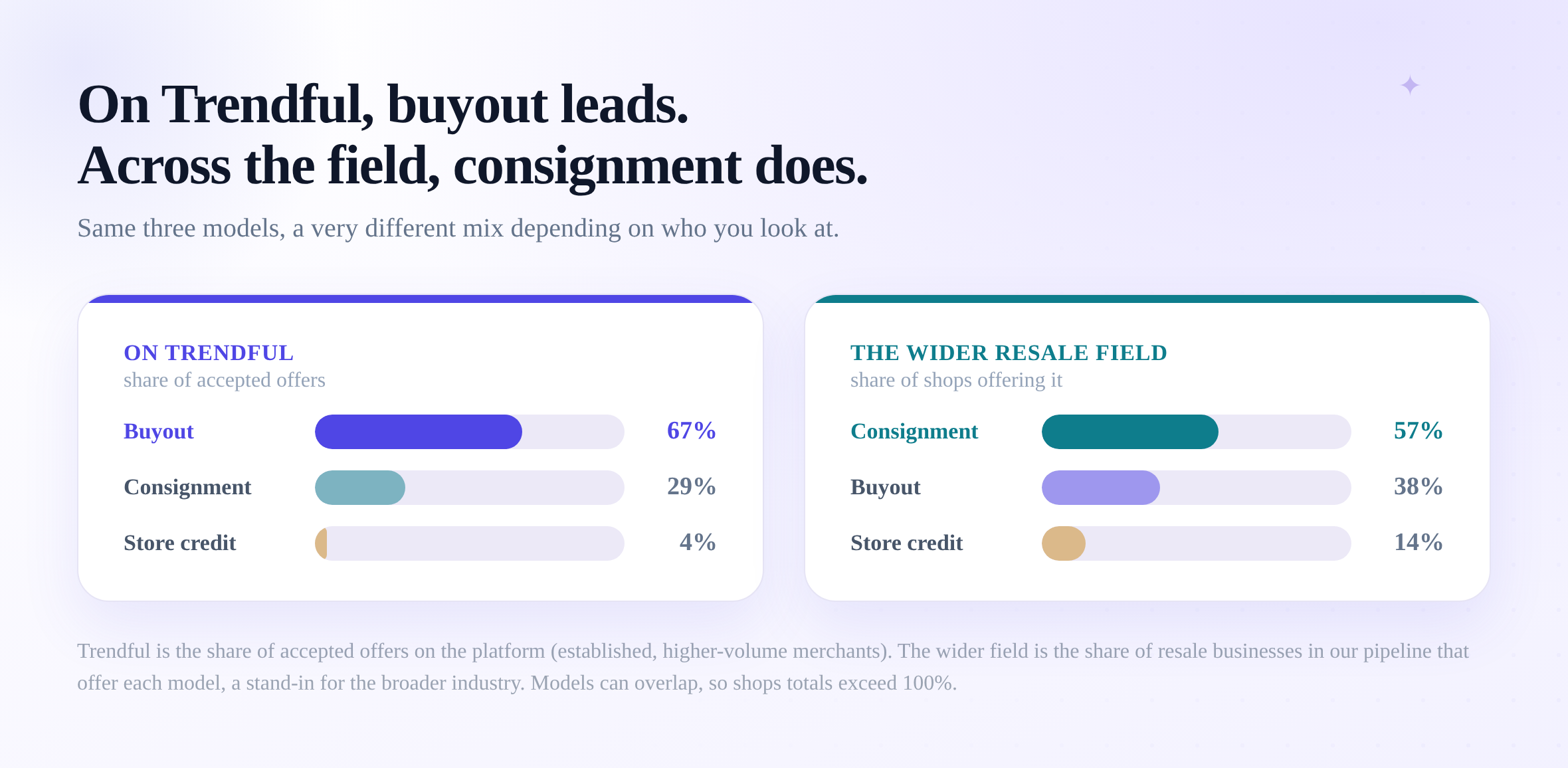
So read the platform numbers as what established Trendful merchants do, not an industry census, and treat the rest of this comparison as your menu rather than a vote for one lane. Store credit stays the small slice on both sides, and, as we will see, the most underused.
Merchants pick a lane, and the data shows it
The two thirds buyout figure describes the platform. It does not describe almost anyone on it. When we place each merchant by how much of their accepted volume was consignment, they do not cluster around the average. They pile up at the two ends.
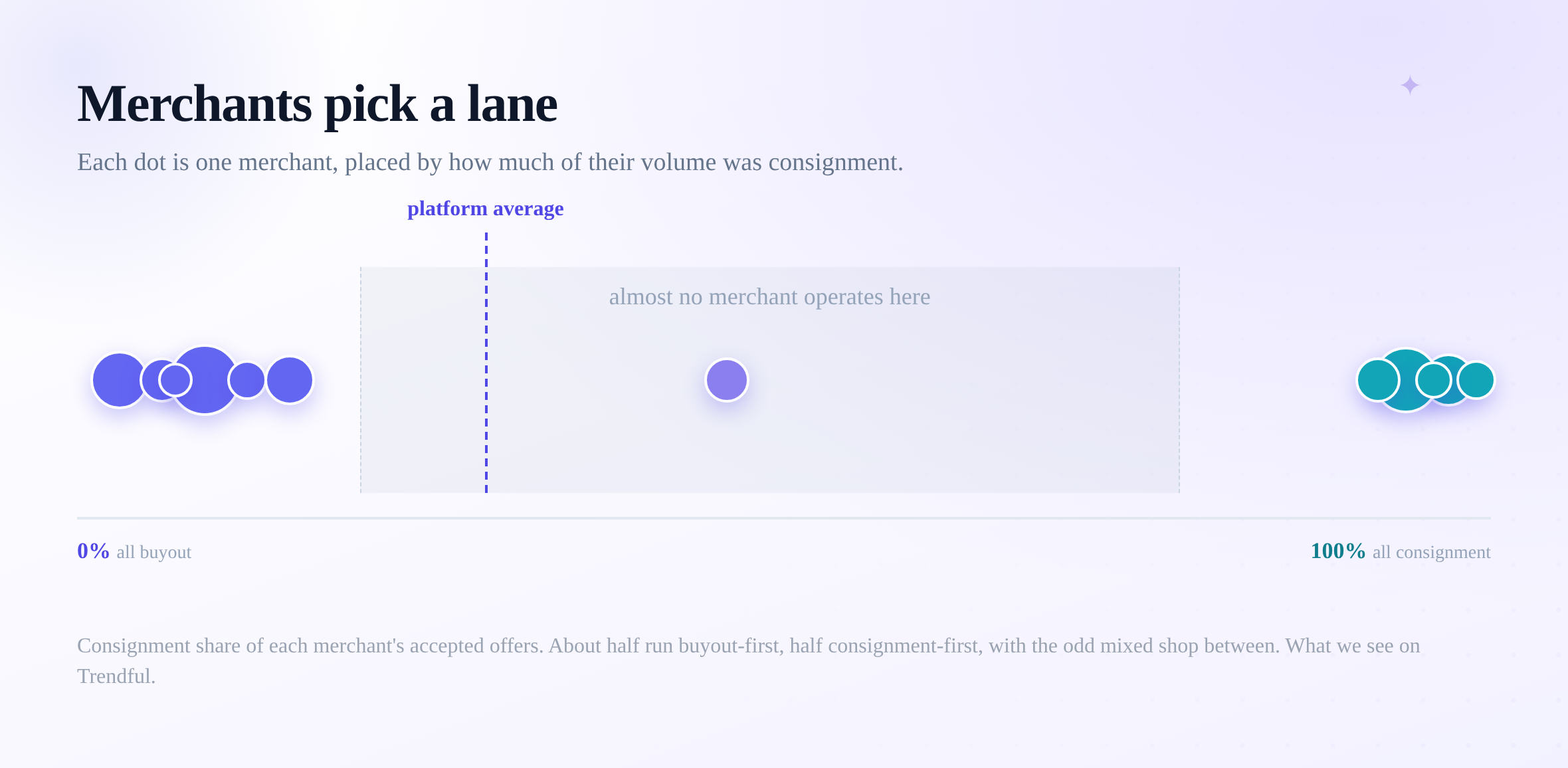
Across the merchants we can measure, roughly half ran buyout-first and half ran consignment-first, with a single genuinely mixed operation in the middle. The platform average, under a third, is real arithmetic that describes a merchant who does not exist in the data.
Why the split? In a word, operations. Running one model is simpler to execute and far simpler to teach. A buyout-first shop has one script for sellers, one cash-flow rhythm, and one set of steps to train a new hire on. A consignment-first shop has its own single playbook. Standing up a new team member on one clean workflow is a lot easier than onboarding them on three at once, so many merchants understandably plant a flag on one side and stay there.
Here is where the software matters, and where the choice is less binary than it looks. Trendful is built to present buyout, consignment, and store credit together on a single quote and let the seller choose, so offering more than one model does not mean running more than one system. The pricing engine computes each option, the consignment sold-detection and payouts run automatically, and the whole thing lives on one offer. The complexity that pushes merchants into a single lane is mostly operational, and it is exactly the complexity the platform absorbs. You can keep the simplicity of one workflow and still hand sellers more than one answer.
How much extra makes a seller wait?
When you send an offer, the seller can often see two numbers on the same item: a cash buyout they can lock in today, or a bigger consignment amount they collect after the item sells. Which one they pick comes down to how much bigger that consignment number is.
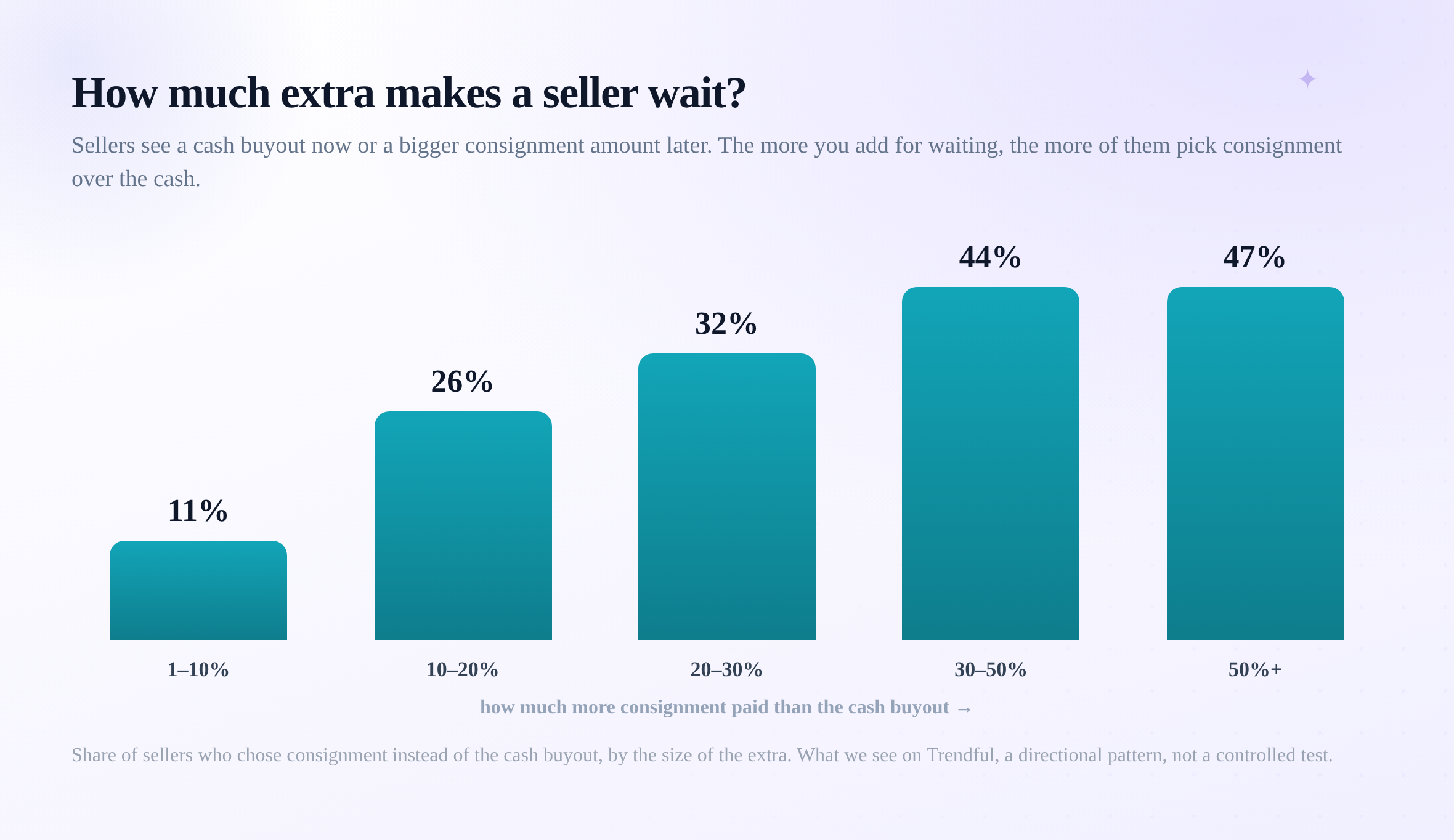
When consignment pays only a little more, almost everyone takes the cash. Bump it 10% to 20% higher and about a quarter wait for consignment instead. Make it 30% to 50% higher and closer to half do. Past that the effect flattens, so paying even more barely moves anyone. In plain terms, the size of the consignment offer is your lever: raise it to push sellers toward consignment, keep it modest to keep them taking the cash buyout. On Trendful the typical consignment offer runs about 20% above the buyout, which is why roughly a quarter of sellers choose to wait.
Your cut shrinks as the item gets better
Margin is not flat across the catalogue. Measured as the share of an item's value the merchant keeps, buyout holds the biggest cut: around 50% on most items, slipping toward 30% only on the priciest pieces. Consignment hands the seller more from the start, opening near 50% on the cheapest items but stepping down to about 30% as value climbs. Store credit sits in between, running from roughly 45% down to 25%.
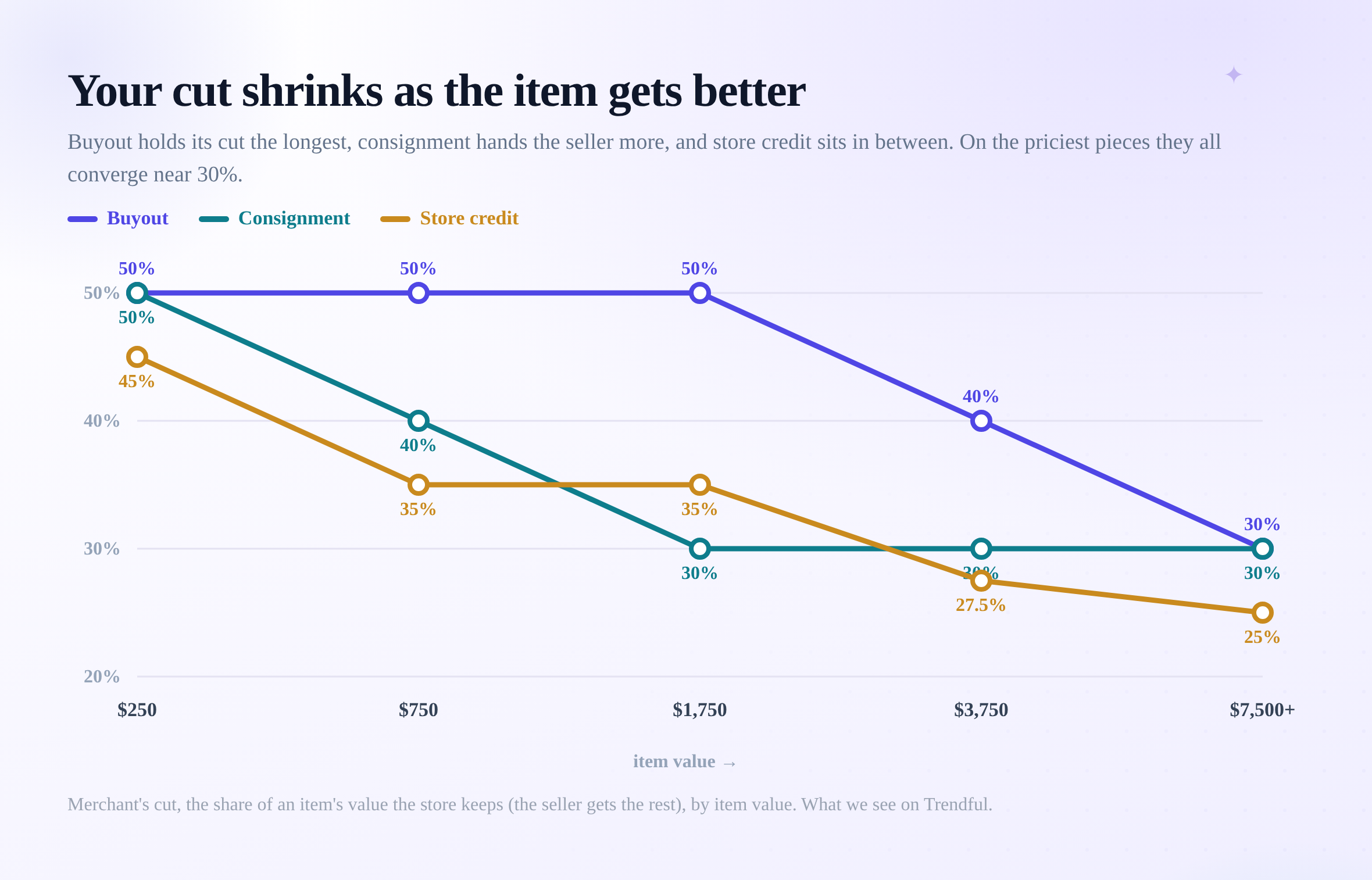
Two things fall out of this. First, a merchant quoting one blanket split is overpaying on cheap items and underpaying on the expensive ones that matter most, which is a good argument for letting a pricing strategy tier the offer by value instead of guessing. Second, at the very top of the catalogue all three models converge near 30%. On a five-figure handbag the choice stops being about margin and becomes purely about cash and risk. (This margin read is implied from each item's estimated value, so treat it as a strong signal rather than a precise ledger.)
Buyout pays in two weeks. Consignment pays you in seven.
Which brings us to cash, the most concrete difference between the models and the one sellers feel most. Measured end to end, from the seller accepting the offer, through shipping the item in and authentication, to the payout landing, buyout is fast and consignment is patient.
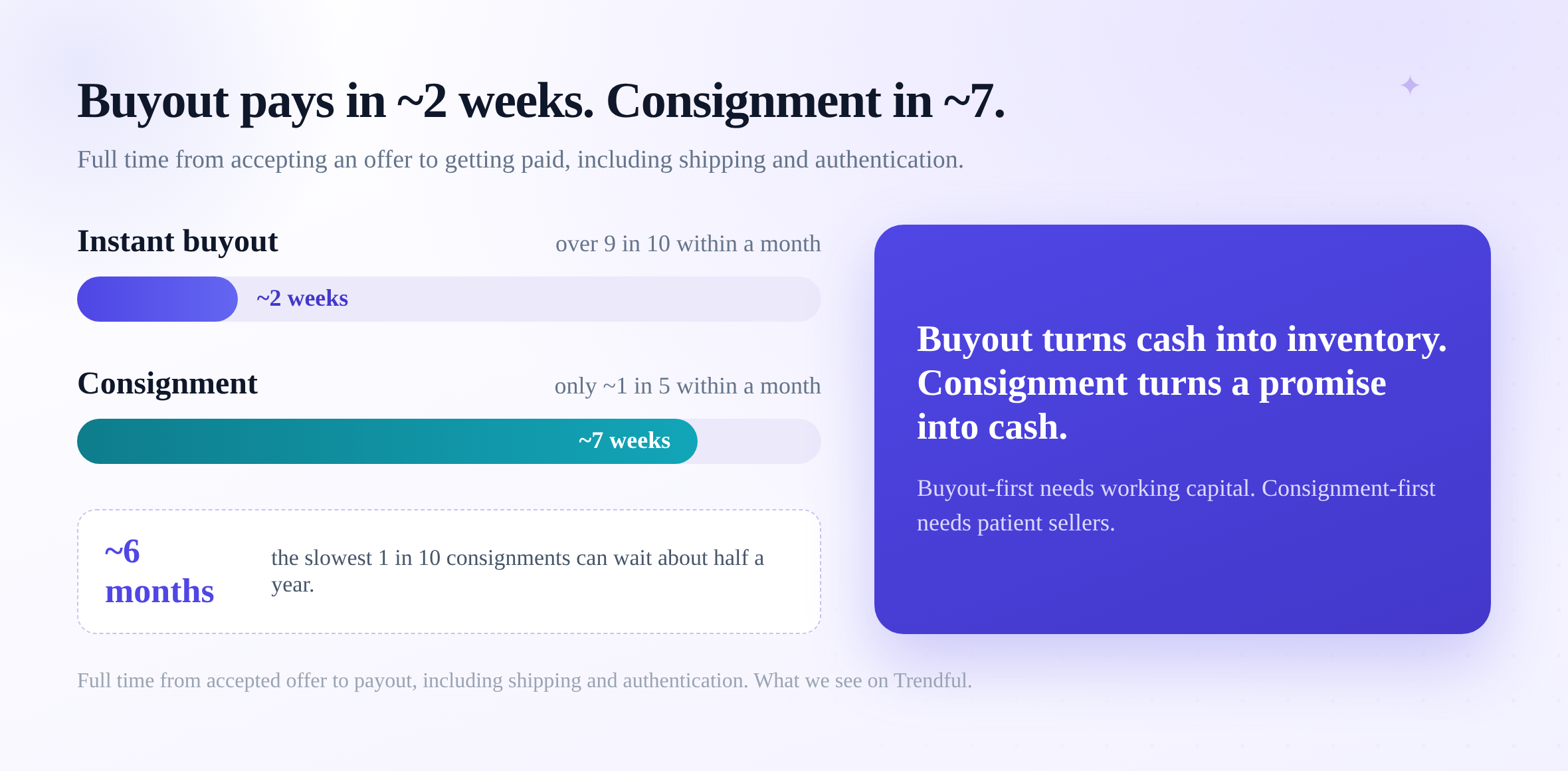
A buyout reaches payout in about two weeks, and more than nine in ten are done inside a month. That two weeks is the whole journey, not just the bank transfer: it covers the seller shipping the item in, authentication and review, and then the payout. Consignment takes about seven weeks, with only about one in five settled inside a month, and the slowest one in ten still open near six months. That gap is not a flaw in either model. It is the trade-off between them, measured. A buyout-first merchant needs working capital, because they are converting cash into inventory every couple of weeks. A consignment-first merchant needs patient sellers and a plan for the one item in ten that sits for months. (These figures cover the full time from acceptance to payout for offers settled on Trendful.)
Store credit is the cheapest money on the platform, and half of merchants skip it
Store credit is the quiet winner in this comparison, and almost nobody leans on it. It pays the seller the most generous headline split of the three models, yet because it is redeemed against your own retail margin rather than paid out in cash, its real cost to you is the lowest of the three. It is the one option where paying the seller more can actually cost you less. And a seller paid in credit is, by definition, your next buyer, which is the entire logic of the resale flywheel: the payout comes back as a sale.
Despite that, store credit was only about 4% of accepted offers, only about half of active merchants presented it at all, and no single merchant leaned on it for more than roughly one in nine of their offers. If there is a clear opportunity hiding in this data, it is here. Merchants who lean into trade-in and store credit are buying inventory with dollars that never fully leave the business, and most of the field is not doing it.
How to run more than one model, without more work
Because timing and tender are independent, you can present several offers on the same item and let the seller pick the trade-off that fits their week. In Trendful, the payout options sit right on the quote: buyout, consignment, and store credit, each with its own amount. Check the ones you want to offer, set the numbers, and the seller sees one clean choice.
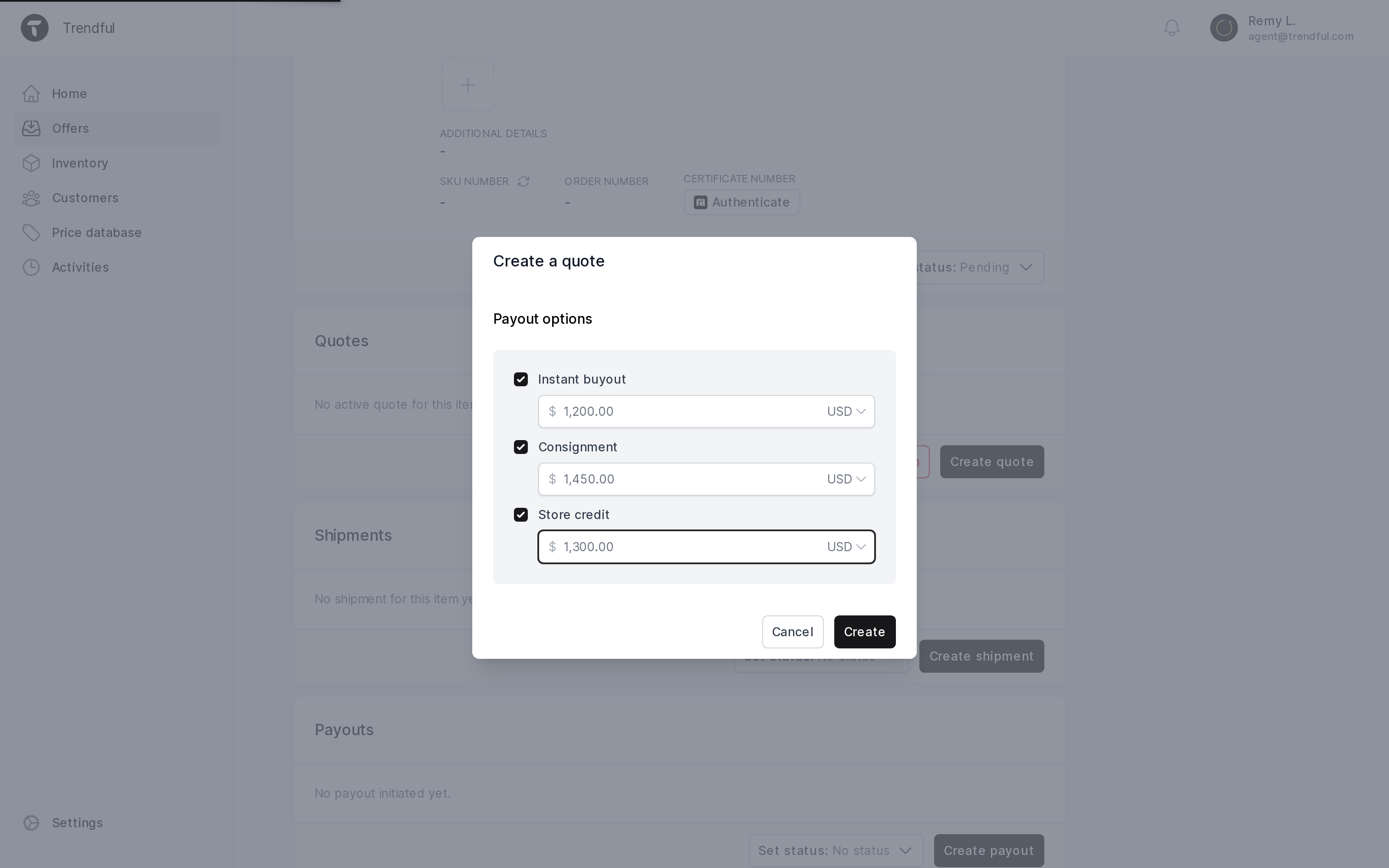
The amounts can come from your automated pricing strategy rather than manual guesswork: turn on instant offers and all three are computed from condition-based value estimates and your own commission structure, which is what lets you tier the offer by item value instead of quoting one flat split. Every item still passes authentication and review on arrival before a buyout pays out, so an instant offer never means an unchecked one. And consignment's one extra moving part is handled for you: with the inventory management add-on syncing to your store, an order for a consigned product triggers an automatic sold notification to the consignor, and you then release the payout yourself. You choose how: keep paying the way you already do and mark the item paid, or send through Trendful over ACH, PayPal, or Venmo by filtering for sold items and paying out from admin in a couple of clicks.
That is the point of the software. The reason most merchants pick a lane is operational, and the platform is what removes the operational cost of not picking one.
Cash flow and risk, side by side
Read the table across a single row to see how the same decision plays out under each model.
| Buyout | Consignment | Store credit / trade-in | |
|---|---|---|---|
| Seller is paid | After it arrives and clears review | After it sells | Either timing |
| Seller receives | Cash | Cash | Store credit |
| Who owns it | You, on acceptance | Seller, until it sells | You |
| Your cash flow | You pay up front | You pay once it sells | Little to none out |
| Merchant's cut | ~45% (seller keeps ~55%) | ~40% (seller keeps ~60%) | ~35% (seller keeps ~65%) |
| Speed to payout | ~2 weeks | ~7 weeks | Follows its timing |
| Best for | Control and margin | Volume, no upfront cash | Loyalty and repeat sales |
The merchant's cut is the share of the item's value the store keeps; the seller gets the rest. Blended across all item values, buyout keeps the most at about 45%, consignment about 40%, and store credit about 35%, so buyout runs roughly 5 points richer than consignment while store credit is the most generous to the seller. None of these is a flat rate, though: the cut runs near half on affordable pieces and compresses toward 30% on the priciest, where all three converge, which is why a single flat commission rarely fits every price point.
The takeaway
Stop asking whether you are a buyout shop or a consignment shop. The data says most merchants answer that question once and never revisit it, and the reason is almost always operational simplicity rather than economics. But the economics are a two-by-two: cash when the seller wants certainty, consignment when they want the ceiling, credit when they want to keep shopping with you. Because the platform absorbs the operational cost of running more than one, you can keep your simple workflow and still meet every seller where they are. That is how a single lane quietly turns into a moat. Choosing between these models is step two of our complete playbook for starting a resale business.
Frequently asked questions
What is the difference between buyout and consignment? Timing. A buyout pays the seller cash after the item arrives and clears review, in a median of about two weeks on Trendful. Consignment pays the seller only after the item sells, in a median of about seven weeks. With a buyout you own the item on acceptance and carry the risk; with consignment the seller keeps ownership until the sale and you front no capital.
Is trade-in the same as store credit? Yes. They are the same mechanism, paying the seller in credit to spend in your store rather than in cash. Some verticals, like watches, tend to say "trade-in," while others, like handbags, say "store credit." Mechanically there is no difference.
Should a resale store offer one model or several? Most established merchants we see on Trendful run one model, mainly because a single workflow is easier to operate and to train new staff on. It is a defensible choice, but it leaves sellers who wanted a different trade-off unserved. Since the software can present buyout, consignment, and store credit on one quote and automate the busywork behind each, offering a second model no longer means running a second system.
Why is a consignment offer higher than a buyout offer for the same item? It is the price of liquidity. On Trendful the consignment offer runs a median of about 20% above the buyout on the same item, and our data shows that premium works like a dial: the bigger the gap, the more sellers choose to wait. Buyout sellers accept a lower number to get paid fast; consignment sellers are compensated for their patience.
Why offer store credit at all? Because it is the cheapest money on the platform. Store credit pays the seller the most generous headline split of the three models, but since it is redeemed against your retail margin rather than in cash, its real cost is the lowest, and the seller becomes your next buyer. It is also the least used option, offered by only about half of active merchants, so it is where the clearest upside sits.
Get started
Want to see the quote builder, the payout options, and the platform data behind each model? Create an account and pick the plan that fits how you operate today, or book a demo and we will walk you through it.
Keep reading
- Authentication is not optional: how to authenticate pre-owned luxury
One undetected fake can undo months of trust building. Here is what the leading authentication providers cost, how to build authentication…
- Pricing pre-owned luxury for acquisition: offers sellers accept without killing margin
Price a resale offer too low and you can lose the sale; too high and the margin gets thin. Here is how condition-based fair market value…
- Where resale inventory actually comes from: buyout, consignment, trade-in, and wholesale
Your sourcing strategy sets your cash flow, your risk, and your inventory quality. Here is how to source resale inventory from customers…