Ditch the spreadsheet: how organized offers change a resale operation

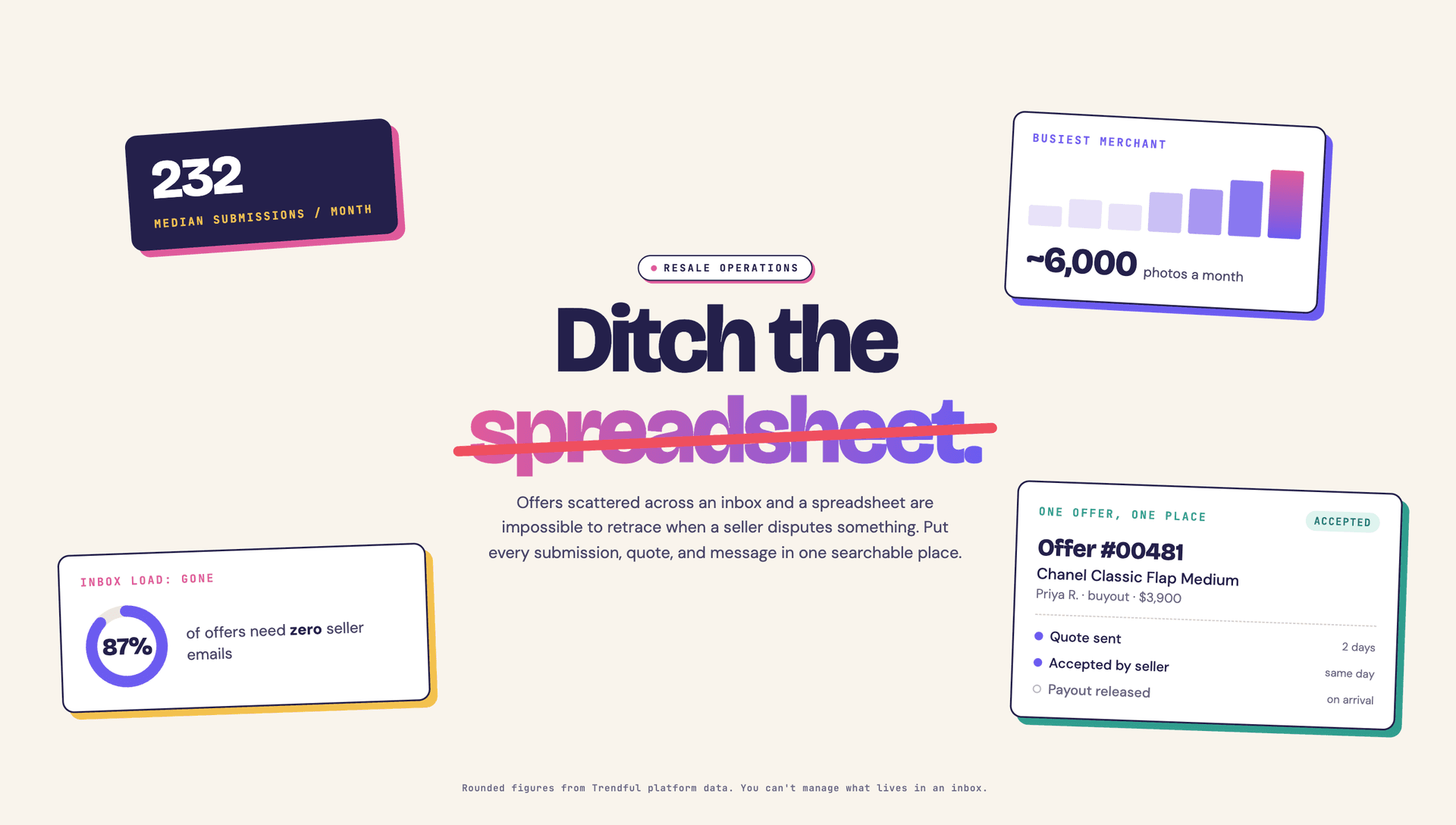
A seller emails you on a Tuesday. "Hey, what happened to the Chanel flap I sent in a few weeks ago?" Simple question. Answering it means opening your inbox to find the original quote, cross-checking a spreadsheet for the status, digging through your texts for the photos she sent, and checking a bank tab to see whether the payout ever went out. Fifteen minutes later you have a rough answer and a nagging feeling you missed something. Multiply that by every seller, every week.
That is the real cost of running offers out of an inbox and a spreadsheet. It is not that any single tool is bad. It is that the item, the money, the conversation, and the proof all live in different places, and none of them know about each other. The chaos that makes resale hard to run has always lived outside any system, in email threads and text messages, which is exactly why so many merchants can never measure it or retrace it. You cannot manage what lives in an inbox.
The mess: offers in email, items in a spreadsheet, proof nowhere
Picture the usual setup. Quotes go out from your email. A spreadsheet tracks who sent what and where it is. Photos arrive over text or as email attachments. Shipping lives in a carrier portal, and payouts live in your bank. Every one of those is a separate island, and the seller's item is quietly split across all of them.
It works right up until it does not. A seller disputes a condition note, or asks why the payout was lower than the quote, or simply wants an update, and now you are the detective reassembling a story from five sources. Janice Fernetti, CEO of Poshbag Boutique, put the old world plainly: "We used to handle everything manually: quotes, shipping labels, client correspondence, payouts. Now we manage every step of the consignment, selling, and trade process in one place." The move that changed her operation was not a better spreadsheet. It was getting rid of the spreadsheet.
An offer is a handful of clean state changes
Here is the reframe that makes the mess go away. On Trendful, an offer is not a sprawling, open-ended conversation you have to summarize later. It is a short, clean sequence of states: submitted, quoted, accepted, shipped, paid. Each state change is timestamped, and all the context, the item, the photos, the numbers, the messages, is attached to the offer itself. Instead of reconstructing what happened, you read it off one page.
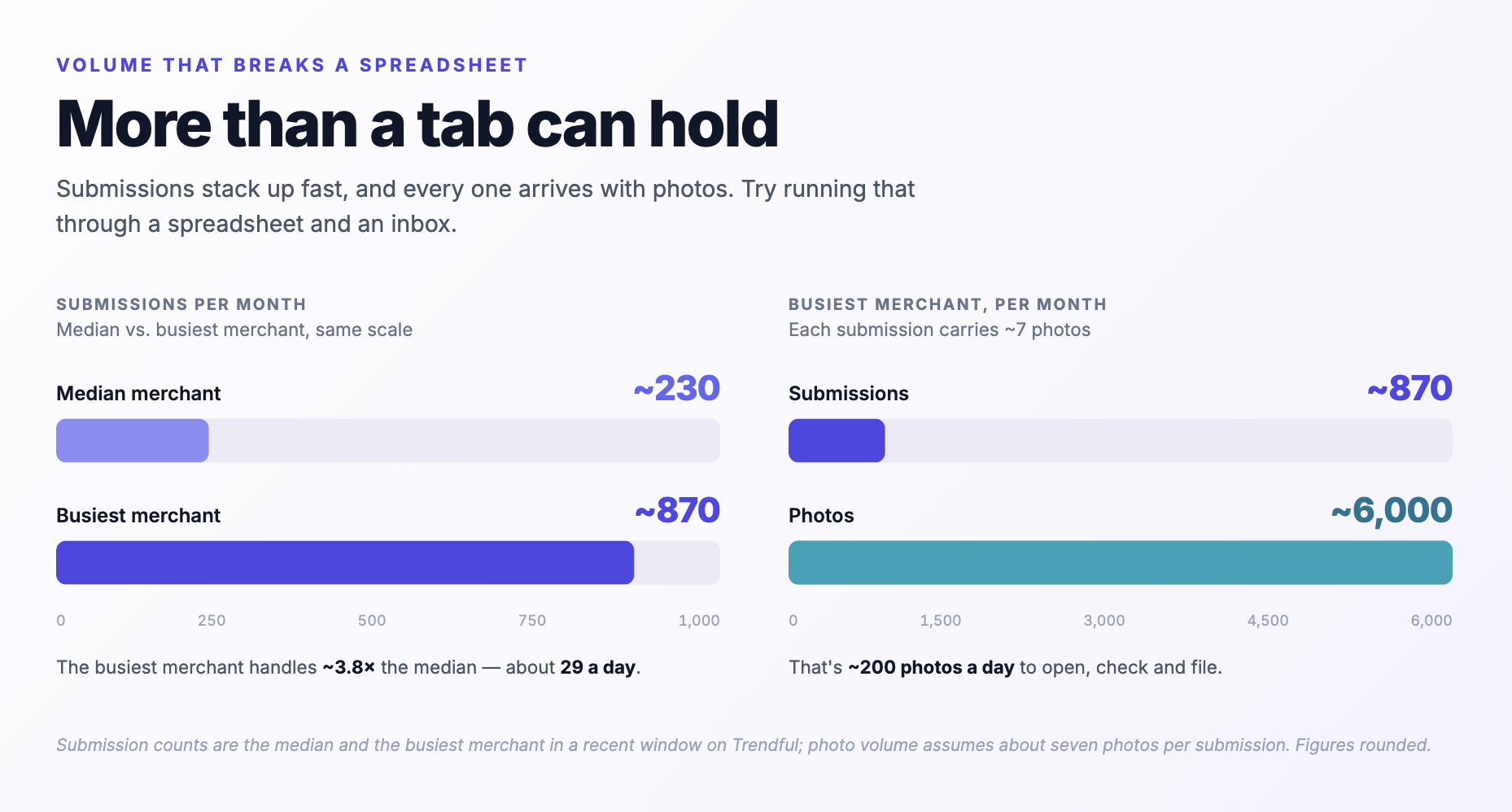
That structure matters more as you grow, because volume is what actually breaks a spreadsheet. The median merchant on Trendful processes about 230 submissions a month, and the busiest handles closer to 870. Every submission arrives with photos, usually around seven of them, so the busiest merchant is fielding roughly 6,000 images a month. Try running that through a spreadsheet and an inbox.
Searchable offers: find any item by product or customer
The first thing that changes is that you can actually find things. Every offer lives in one list you can search by product or by customer name, so "the Chanel flap from Priya a few weeks ago" is two words in a search box, not an archaeology project. On top of search, you can filter the whole book by status: open or archived, quote status, shipping status, processing status, payout status, and a created date range. The item you need is always a couple of clicks away.
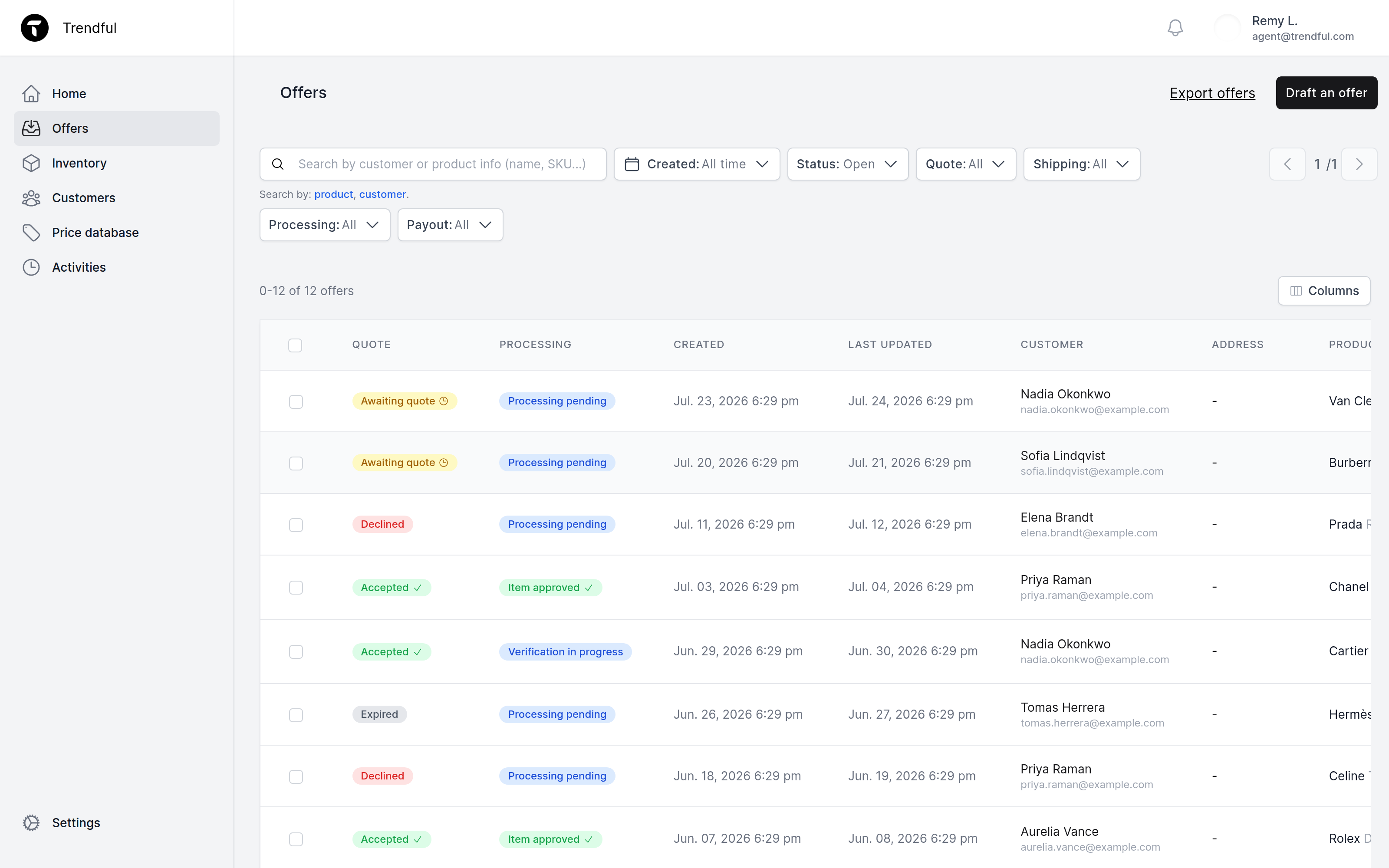
Recent updates to the offers view make this faster still, with quicker search and columns you can turn on or off so the table shows exactly the fields your team works from. None of this is consignment-only, either. Whether you run buyout, consignment, trade-in, or store credit, or some mix of all four, every offer sorts and searches the same way.
Everything on one offer
Open a single offer and the whole story is on one screen. You see the customer and their contact details, the item with its brand, model, style, size, and condition, and the payout option and amount. A status bar across the top shows exactly where the deal stands: quote accepted, shipment delivered, processing, listing, payout. Below that sits the quote itself, with the buyout, consignment, and store credit amounts you offered, and a timeline that records when the quote was created, sent, and accepted, with tracking and payout details in the same place.
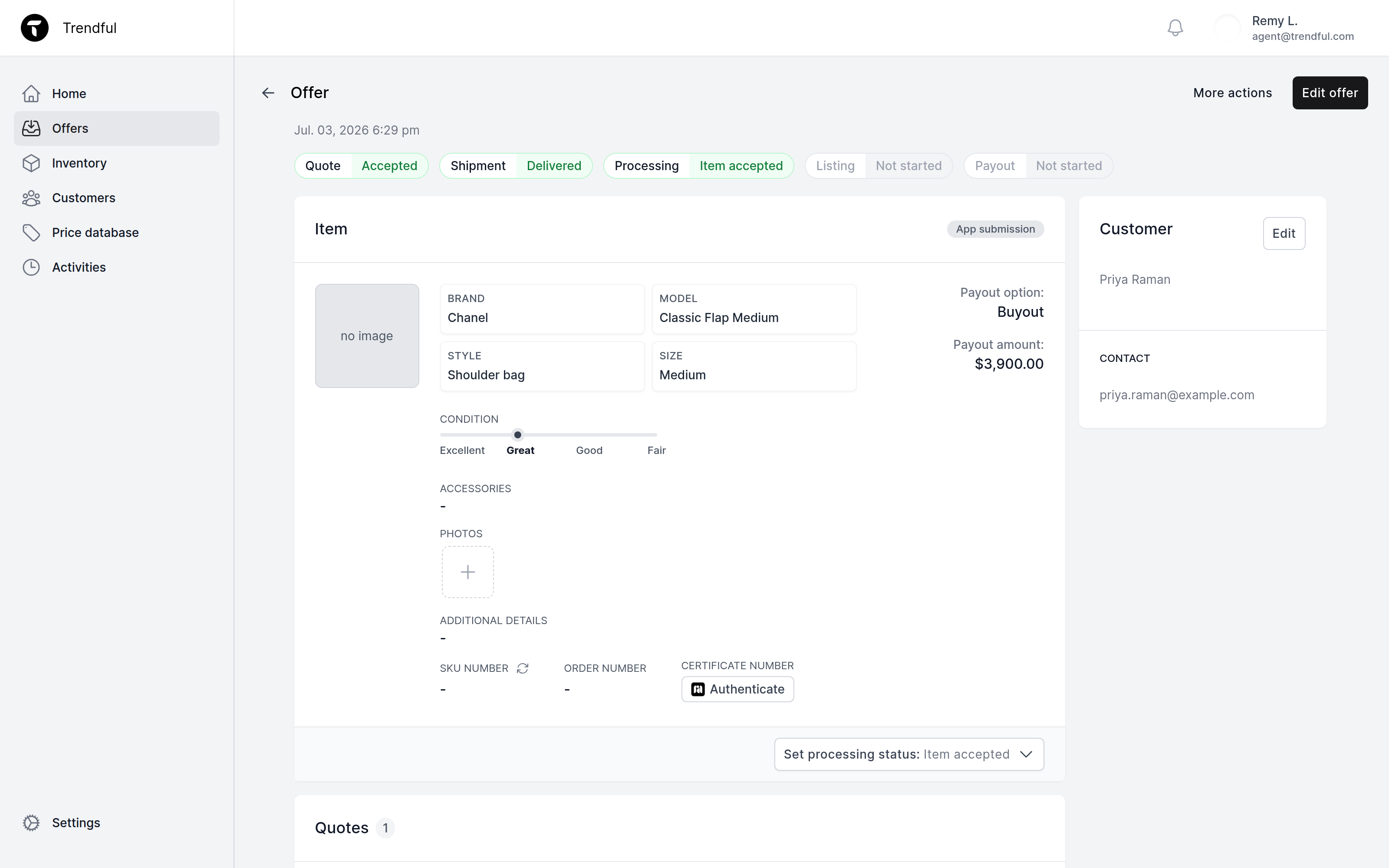
This is where the state-change idea pays off. There is no "let me check the spreadsheet, then my email, then the carrier site." The quote lives with the item, the item lives with the customer, and the timeline ties them together. If you want to see how the quote gets built in the first place, our guide to sending and receiving quotes walks through it, and our piece on the full life of a submission, from photo to payout follows one item across every one of these stages.
A note on speed, since it comes up. Most merchants price and send each quote by hand, item by item, and that manual quoting is the norm across the platform. If your volume climbs high enough that hand-pricing slows you down, you can switch on instant offers, an optional feature that computes the numbers automatically from a condition-based estimate and your own commission structure. It is an accelerator you turn on, not the default, and the payment is never instant regardless. Nothing is paid until the item arrives and clears review.
The per-offer thread: the whole conversation in one place
Every message about an item lives on that item's offer. When a seller emails to add a photo or ask a question, it is tracked against the submission, so you add the new photos to the offer in one click and never lose the thread. That sounds small until you see how the communication load actually breaks down.
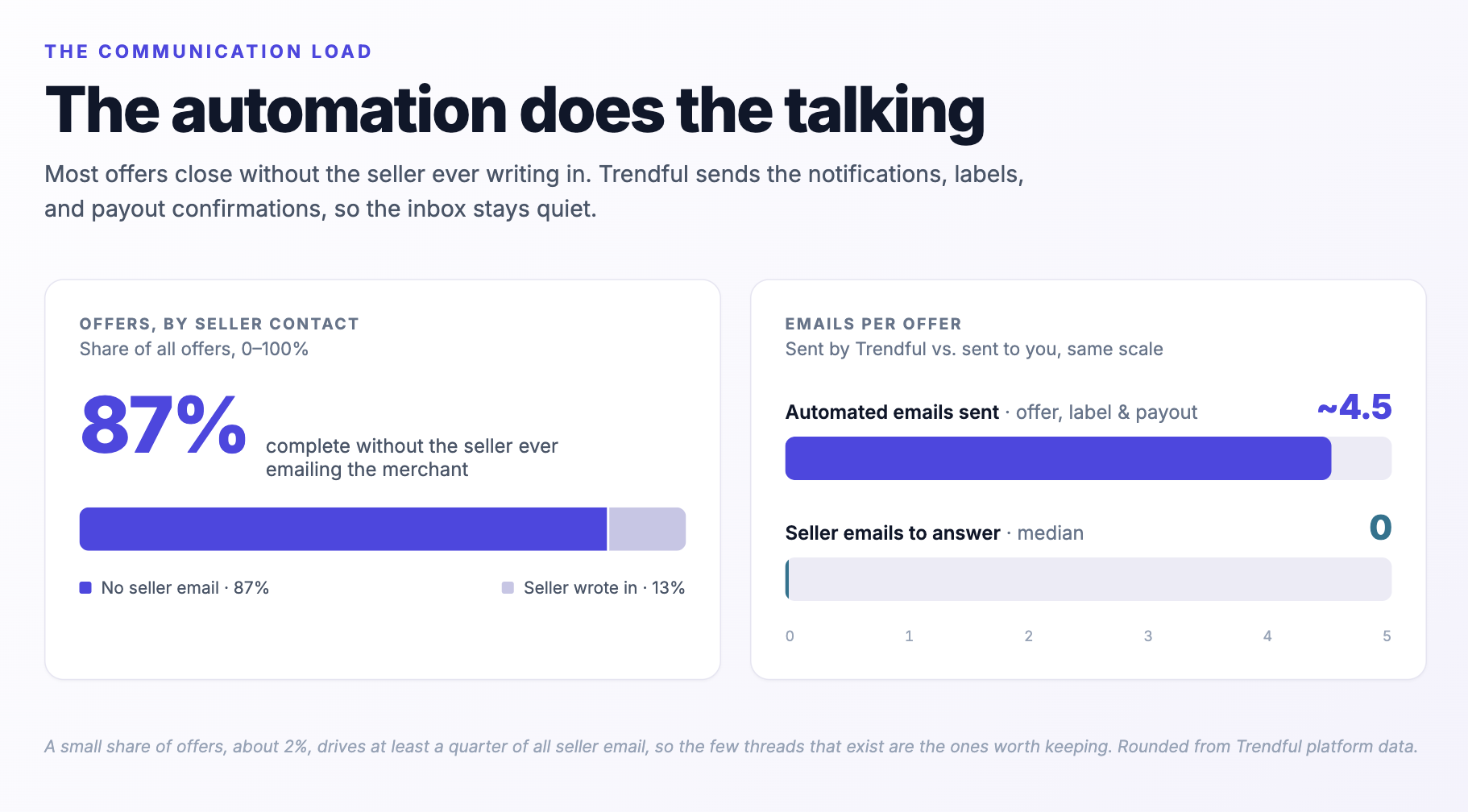
Around 87% of offers complete without the seller ever needing to email the merchant. The median number of seller emails per offer is zero. That is not because sellers are ignored, it is because the automation does the talking: across roughly 788,000 emails all-time, about 688,000 were automated notifications like offer alerts, shipping labels, and payout confirmations, roughly 4.5 automated messages per submission. The system keeps sellers informed so they do not have to ask.
The emails that do come in are telling. They cluster on the winners: on accepted offers, about 1 in 4 sellers writes in, versus well under 1 in 10 on declined or expired ones. Consignors follow up more than buyout sellers, naturally, since they are waiting to hear whether their item sold, which is exactly what the listed, sold, and payout notifications are for. And the load is concentrated: a small slice of very chatty offers, about 2%, accounts for at least a quarter of all seller email. It is a long tail of silence with a handful of busy threads. Those busy threads are precisely the ones you cannot afford to lose in an inbox, which is the whole argument for keeping every conversation on its offer.
The trend line makes the same case on its own. Seller email volume has stayed roughly flat for two years while submissions grew about 40%, so the communication load per submission keeps falling as the automation carries more of it.
Proof and documentation in one click when disputes happen
Now go back to that Tuesday email. With everything on the offer, answering a dispute is not detective work. You open the offer and see the quote you sent, the exact amount, the timestamp when the seller accepted, the photos that came with the submission, the tracking that proves delivery, the payout that went out, and the full message history, all on one page. The answer that used to take fifteen minutes takes about thirty seconds, and it is backed by a record rather than your memory.
That is what "organized" actually buys you: not tidiness for its own sake, but a defensible, retraceable account of every deal. Hunter Swain, CEO of Redeluxe, described the shift as Trendful helping "bring structure and organization to areas that were previously difficult to manage at scale, while significantly improving the experience we deliver to our customers." Structure is what turns a pile of messages into evidence.
What organized offers unlock
When the operation runs on structured offers instead of scattered tools, two things happen. Your team stops spending its day reassembling context, and your sellers get a smoother experience that brings them back. That return visit is the engine of the whole business: on Trendful, up to 45% of sellers cross over into buyers and roughly half of those who accept an offer come back to sell again. It is hard to earn that loyalty while ghosting people because their item got lost in a spreadsheet.
The growth follows. Merchants on the platform have grown up to 10x in their first year, and early-stage merchants have seen roughly 30% month-over-month growth across customers, inventory, and sales as sellers convert into buyers. None of that requires a bigger team. It requires an operation that does not fall apart at 230 submissions a month. If you are building the whole thing from the ground up, our complete playbook for starting a resale business lays out the steps in order, including how to run the return when you decline an item.
The takeaway
The spreadsheet is not the villain. It is just the wrong tool for something that is really a sequence of state changes with a conversation, a shipment, and a payment attached. Put every offer in one searchable place, keep the whole thread on the item, and a dispute becomes a thirty-second lookup instead of an afternoon lost. The data shows how calm a well-run offer really is: most complete without a single seller email, and the few noisy threads are the ones you most need to keep. Ditch the spreadsheet, and you stop managing what lives in your inbox and start running an operation you can actually see.
Frequently asked questions
What does it mean to organize resale offers in one place? It means every part of a deal lives on a single offer record: the customer, the item and its condition, the quote with its payout options, the shipping and tracking, the payout, and the full message history. Instead of an item split across your inbox, a spreadsheet, your texts, and your bank, you open one page and see the whole story, timestamped from submission to payout.
How do I find a specific past offer quickly? Every offer sits in one list you can search by product or by customer name, so you can pull up a specific item in seconds. You can also filter the list by status, quote status, shipping status, processing status, payout status, and created date, which makes it easy to work a whole segment, like everything awaiting a quote, at once.
Does this only work for consignment stores? No. Offers work the same whether you run buyout, consignment, trade-in, or store credit, or any combination of them. Each offer can carry its own payout options, and they all sort, search, and track in the same place.
How does keeping messages on the offer help with disputes? Because the conversation is attached to the item, you can pull the quote you sent, the acceptance timestamp, the submission photos, the tracking, the payout, and the message history in one click. That turns a dispute from a hunt across several tools into a quick, documented answer.
Do sellers email a lot when I run offers this way? Usually not. About 87% of offers complete without the seller ever emailing, and the median number of seller emails per offer is zero, because automated notifications for offers, labels, and payouts keep sellers informed. The emails that do come tend to cluster on accepted offers, which is exactly where you want the full thread saved.
Get started
Want to see the offers list, a single offer end to end, and the platform data behind it? Create an account and pick the plan that fits how you operate today, or book a demo and we will walk you through it.
Keep reading
- Niche beats broad: how to position a resale business people remember
Resale spans luxury handbags, streetwear, home goods, and everyday basics, and trying to serve all of it is the fastest way to serve none…
- Store credit: the offer type that turns sellers into buyers
Store credit is the most underused lever in resale. Merchants on Trendful add about a 10% premium for it, yet only about 4% of accepted…
- How to start a resale business: the complete playbook
Secondhand is on track for about $393 billion by 2030 and growing twice as fast as apparel retail. The opportunity is not the hard part…