When manual resale operations break, and what to automate first

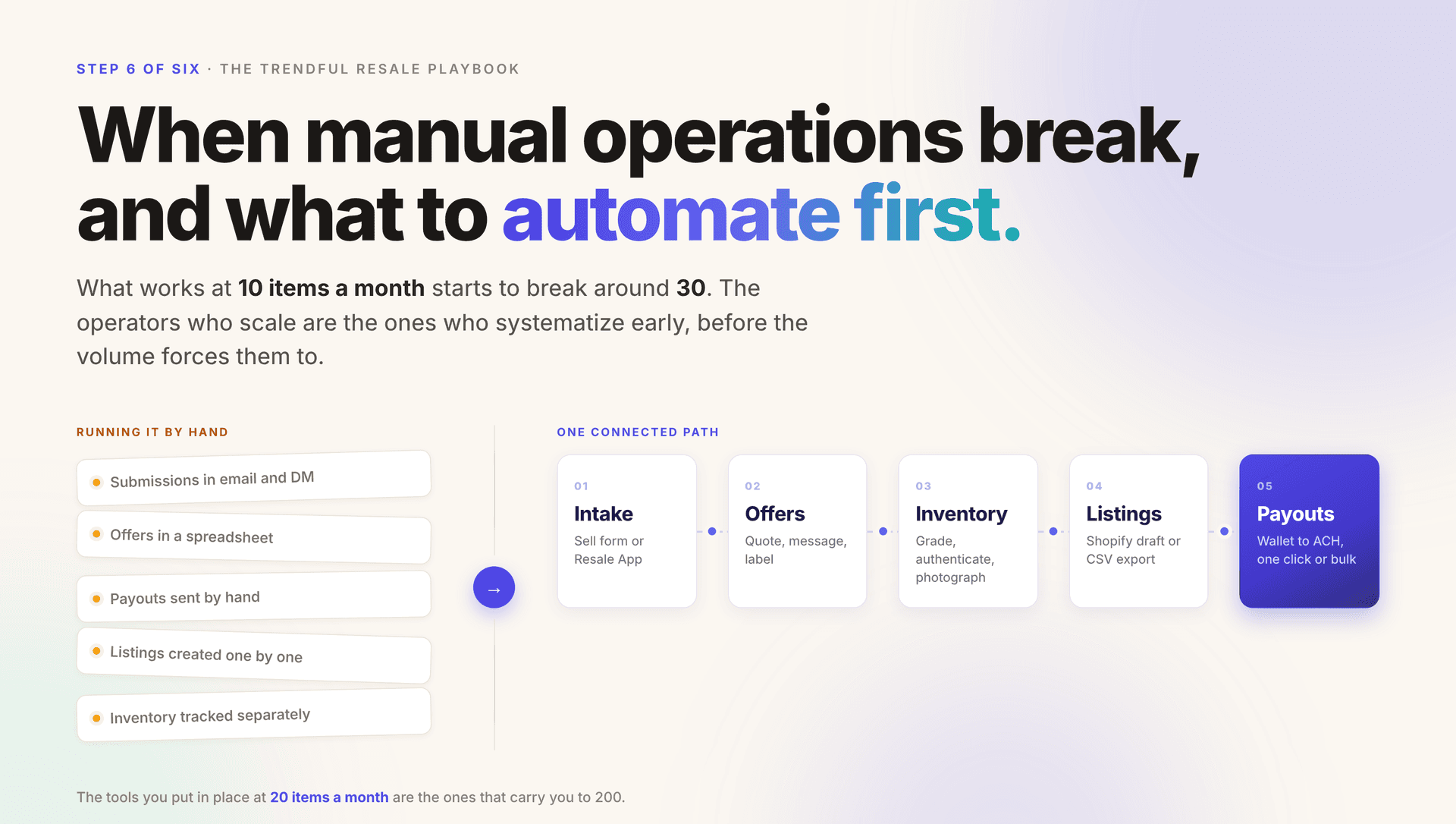
Growth creates complexity. What works at 10 items a month starts to break around 30, and the operators who scale successfully are the ones who systematize early, before the volume forces them to.
This is step six of the Resale Playbook, the six step series we publish one Thursday at a time. Step five was about how people find you. This one is about what happens after they do, when the back office has to hold.
Where manual processes break down
The typical resale operator hitting a growth ceiling is managing customer submissions by email or DM, offers tracked in a spreadsheet, payouts sent manually, listings created one by one, and inventory tracked separately, or not at all.
None of that is wrong at low volume. A spreadsheet is a perfectly good system for ten items a month, and most operators start there for good reason. The problem is that each piece fails independently and quietly. The spreadsheet does not tell you an offer has gone unanswered for four days. The inbox does not tell you an item arrived last week and never got graded. You find out when a seller asks.
Offers scattered across an inbox and a spreadsheet are usually where it surfaces first, because an offer is the one record a seller is actively waiting on. And when it breaks, it damages customer relationships: missed payouts, duplicate listings, lost items, delayed responses.
What systematized operations look like
The flow runs in one direction: customer entry, offer management, inventory management, listings pushed to Shopify or exported as a CSV, and payouts. Each stage hands off to the next, so nothing is retyped between them.
Customer entry. The sell form is the no login entry point: shareable, and useful over DM, over text, or during a live selling event. The Resale App is the full account experience, with submission history and payout tracking for sellers who come back. These are not either/or. Most businesses keep the sell form running even after adopting the full Resale App, because it remains the easiest way for a new or occasional seller to start.
Offer management. Review, quote, and communicate from one view, with quotes, emails, and shipping labels issued from the same place. Every offer lives on one record regardless of where it came in, from the first quote through to the payout. The anatomy of a submission walks a single item through that loop end to end.
Inventory management. Receive, assess, and list. Condition grading, authentication, and photos happen against the item record, and the accepted item moves into inventory in one step rather than being re-entered. From there it pushes to Shopify as a draft listing, syncing automatically on acceptance, or exports as a CSV for any other platform. Sold items are detected automatically, and the consignor is notified without anyone remembering to do it.
Payouts. The Trendful Wallet is funded by ACH and pays sellers out of that balance, one click at a time or several items at once. Sellers add their own bank details in the app, so you never handle their financial information. On Enterprise, payouts can run automatically on sale, which is what makes a consignment heavy operation practical at volume.
Pricing. The pricing engine carries current fair market values for more than 70,000 product references, updated weekly. It is what an offer a seller accepts without killing your margin is built from. Search by keyword or by image, get a fair market value based on the item's specific size and condition, and see it compared side by side across major platforms.
Expanding your sourcing and categories
As you grow, you can expand by shifting more volume toward consignment. It lets you increase intake without the upfront capital risk of buying everything outright, which is the constraint that usually caps a buyout heavy operation.
The work of adding a category then sits mostly in sourcing and authentication rather than in rebuilding how items move through your business. Once your core operations are systematized, expanding into new product categories becomes easier, because your back office is already in order.
Start small, build systematically
The resale operators who build durable businesses are not the ones who started with the most capital, the best inventory access, or the largest audience. They are the ones who got the fundamentals right: a clear brand, consistent processes, and the right tools in place before they needed them.
Six steps, which is the whole playbook in order:
- Define your brand before you source a single item.
- Choose your sourcing model based on your risk tolerance and capital.
- Build your authentication process before your first sale.
- Choose your sales channels based on where your customer already shops.
- Market your process, not just your products.
- Systematize early. The tools you put in place at 20 items a month will carry you to 200 and more.
Starting small is not a limitation. It is how you learn what works, before the stakes are high enough to hurt.
Where does Trendful fit in
Automated intake, structured offer management, inventory management with Shopify and CSV listing, payouts, and pricing intelligence are one platform here rather than a stack you assemble, with one record per item running through all of them. If you want to see whether that fits the way you already work, start a free trial of Trendful and run your next few submissions through it.
Frequently asked questions
When does a resale business need automation? Around 30 items a month is where manual processes usually start to break. What works at 10 items a month, submissions in an inbox and offers in a spreadsheet, stops working as volume climbs, and the operators who scale successfully systematize early rather than waiting for the volume to force it.
What should a resale business automate first? Intake and offers, because they are what a seller is actively waiting on. Submissions arriving through one form and every offer living on one record removes the failure that costs you the most: a seller who never got answered. Inventory, listings, and payouts follow from there.
What is resale automation software? It is the system that connects intake, offer management, inventory, listings, and payouts so an item moves from a customer photo to a payout without being retyped at each stage. The alternative is a spreadsheet, an inbox, and a separate listing tool, each of which fails independently.
What breaks first in a manual resale operation? Customer relationships, through missed payouts, duplicate listings, lost items, and delayed responses. The underlying causes are submissions spread across email and DM, offers tracked in a spreadsheet, payouts sent by hand, listings created one by one, and inventory tracked separately or not at all.
Do I need both a sell form and a resale app? Most businesses run both. The sell form is the no login entry point that works over DM, text, or a live selling event, and it stays useful for new and occasional sellers. The Resale App gives repeat sellers an account with submission history and payout tracking.
How do resale payouts work without handling seller bank details? Sellers add their own bank details in the app, and payouts are sent from a wallet balance funded by ACH, one at a time or in bulk. The merchant never touches the seller's financial information.
How do I expand a resale business once operations are systematized? Shift more volume toward consignment, which raises intake without the upfront capital risk of buying everything outright, then add adjacent product categories. Both are easier once the back office is in order, because the item flow does not have to be rebuilt.
Sources
- The failure patterns, the systematized operations flow, the expansion path, and the six step summary are as published in the Trendful Resale Playbook. Product capabilities reflect Trendful as of publication, and plan availability can change.
Get started
Ready to stop running your operation out of a spreadsheet? Create an account and pick the plan that fits how you work today, or book a demo and we will walk you through it.
Keep reading
- Consistency beats volume: how to market a resale business
Three posts a week you can sustain beats seven you burn out on. Here is how to market a resale business organically: which platforms do…
- Where to sell and source pre-owned inventory: your channel options and what each costs
Every channel you use to sell or source resale inventory has a price. Here is a plain look at marketplaces, your own storefront, and where…
- Where to sell pre-owned inventory: marketplace fees vs your own storefront
Most operators pick a sales channel on audience fit and never run the math on what a typical sale nets. Here is where to sell pre-owned…