How rejecting (and ghosting) sellers impacts your resale supply

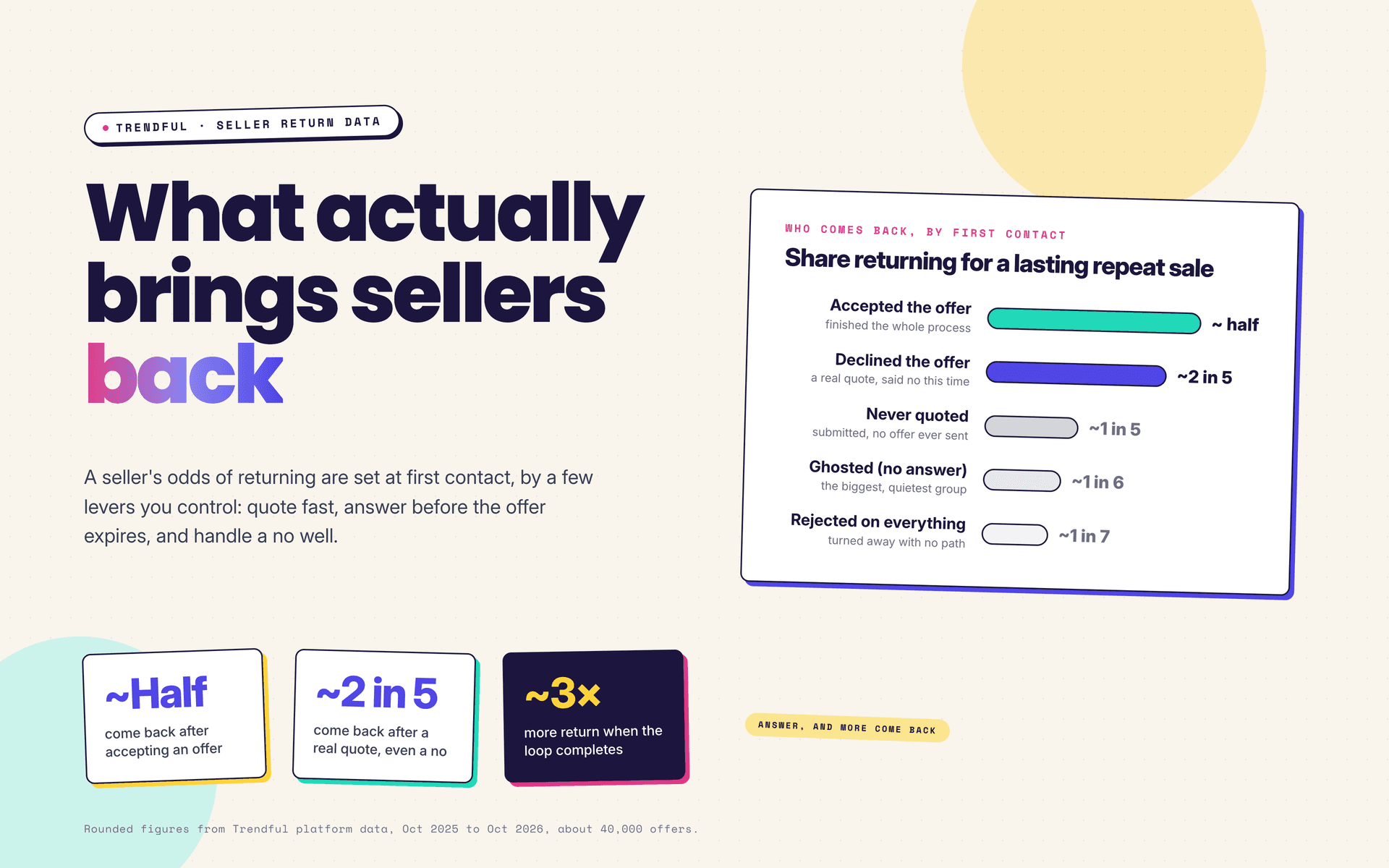
How often your sellers come back is not luck, and it is not mostly about your prices. It is set by a handful of operational choices you make in the first few days of contact. The platform data makes the pattern clear, and the useful part is that almost every lever is one you already control. This is a practical look at what moves the odds a seller returns, and how to improve each one. For the bigger picture on why returning sellers are worth this much attention, our piece on why your customers are your best suppliers makes the case; this one is about the dials.
What moves the odds a seller comes back
Sort sellers by what happened on their first submission, then look at how many came back for a genuine repeat sale. The order is consistent.
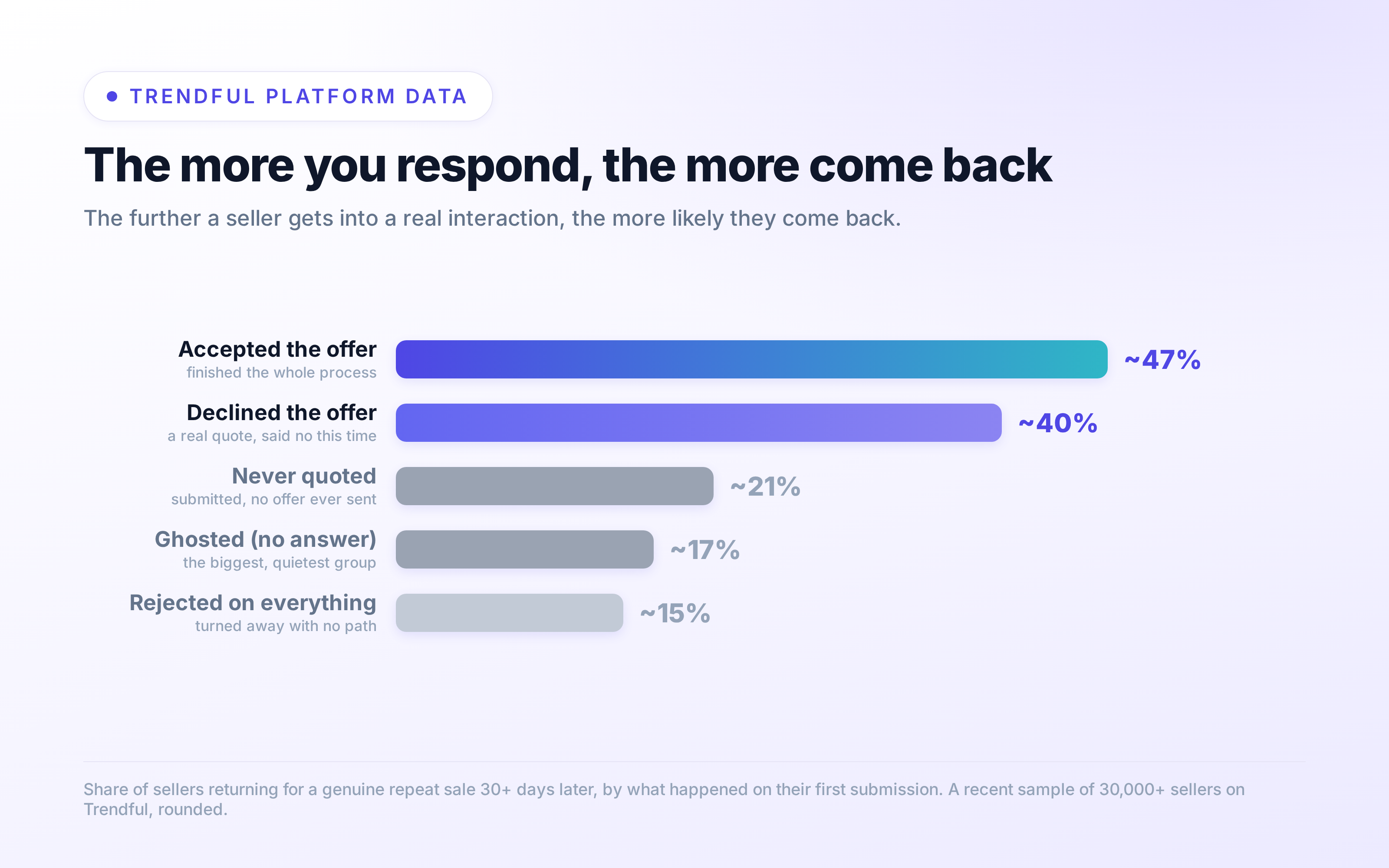
Two things stand out:
- Finishing the process is the strongest driver. A seller who accepts an offer and goes all the way through comes back about half the time. That is effectively your ceiling, and later we will look at how to lift it.
- A real interaction almost holds the line. A seller who got a genuine quote and declined it still comes back at roughly 2 in 5. It is worth being precise about what that is not: it is not proof the seller rejected you. In most cases they passed on the number, but some were shopping around, and some simply were not ready to decide yet. What they share is a real exchange with your store, and that keeps the door open.
Where the odds drop is when there was no real interaction at all: a seller who was never quoted (about 1 in 5), ghosted on an open offer (about 1 in 6), or turned away on everything with no next step (about 1 in 7). Getting a seller to a real interaction roughly doubles to triples the odds they come back, and getting there is almost entirely about operations, not about the size of your offers.
So the practical question is simple: how do you get more sellers to a real interaction, and keep more of the ones who finish? Here are the levers, in the order they tend to matter.
Lever 1: Quote every seller, and quote fast
The quote is the entry to the whole loop, so a seller who never gets one has nothing to come back to. Across the platform, submissions that never receive an offer return at some of the lowest rates. Speed matters alongside coverage: a seller weighing whether to part with a bag is still deciding, and that interest fades if the offer takes days to arrive.
What to do: price each item and send the number yourself from the admin, which is how most merchants work. If your volume ever makes pricing by hand a bottleneck, you can turn on instant offers to have the number computed and sent automatically, but that is an accelerator you opt into, not the default. Either way, the goal is a fair number in front of the seller while their interest is still warm. Our guide to sending and receiving offers walks through it.
What to watch: the share of submissions that ever get an offer, and your typical time to first offer.
Lever 2: Respond before the offer expires
The largest single group of sellers is the ones whose offer went out and was never answered, and they come back at one of the lowest rates. Most of that is recoverable, because a lot of those sellers were simply busy, not gone.
What to do: set a clear offer window, usually one to two weeks, and turn on offer reminders so a seller who went quiet gets a friendly nudge before the offer lapses. An offer that does expire is not a dead end either: you can send a fresh one at today's price, which also protects your margin if the market has moved. We covered exactly where these sellers slip away in how to win back the sellers who do not return.
What to watch: your offer expiry rate, the share of offers that lapse unanswered.
Lever 3: Handle the no so it stays a real interaction
A no does not have to end the relationship, and there are two kinds to handle well, because they are not the same.
When a seller declines your offer, nothing ships back: the item never left their hands, so there is no return to run. What keeps that seller is that the quote was a real, no-pressure interaction and that the door stays open. Let the offer expire cleanly, and send a fresh one later if they resurface or prices move. Declined-offer sellers come back at roughly 2 in 5, close to the rate of sellers who accepted.
When you reject an item that already arrived, the return is the moment that decides whether the seller submits again. Give a clear reason and send the piece back with tracked, insured returns, so the seller always knows where their property is. A rejection handled that way keeps a seller far closer to the declined-offer rate than to the roughly 1 in 7 floor of sellers who are turned away and left in the dark.
What to watch: whether every rejected item goes back with a written reason and a tracked return, and whether expired offers get re-sent instead of dropped.
Lever 4: Make submitting effortless
Easy submission is the floor under everything else. A frictionless way to submit recovers some sellers even when the offer stage is slow, which is why a couple of stores in our data with low offer rates still post solid overall return.
What to do: let sellers submit from wherever they are, whether web, social, or in store, and keep the path from photo to payout and the shipping in both directions smooth and predictable.
What to watch: your submission completion rate, how many started submissions actually finish.
Then lift the ceiling: keep more of the sellers who finish
The four levers above get more sellers to a real interaction. The other half of the job is raising how often the sellers who do finish come back, so that "about half" becomes more over time. That accepted-offer return rate is not fixed, and a few things move it:
- Store credit is the strongest lever. A seller paid in store credit is already your next buyer, so the return trip is half-booked before they even leave.
- Reach out on the seller's clock. The typical gap before a second submission runs about four months, so a friendly check-in around that window lands right when the next item is on their mind, rather than the day after payout.
- Pay fast and communicate clearly at every step. A quick payout and on-brand emails that always name the next step are what turn one good first sale into a default habit.
What to watch: your repeat rate among accepted-offer sellers over time, and your share of payouts taken as credit.
Size does not move return. Responsiveness does.
One more thing the data rules out: this is not about being a big store.
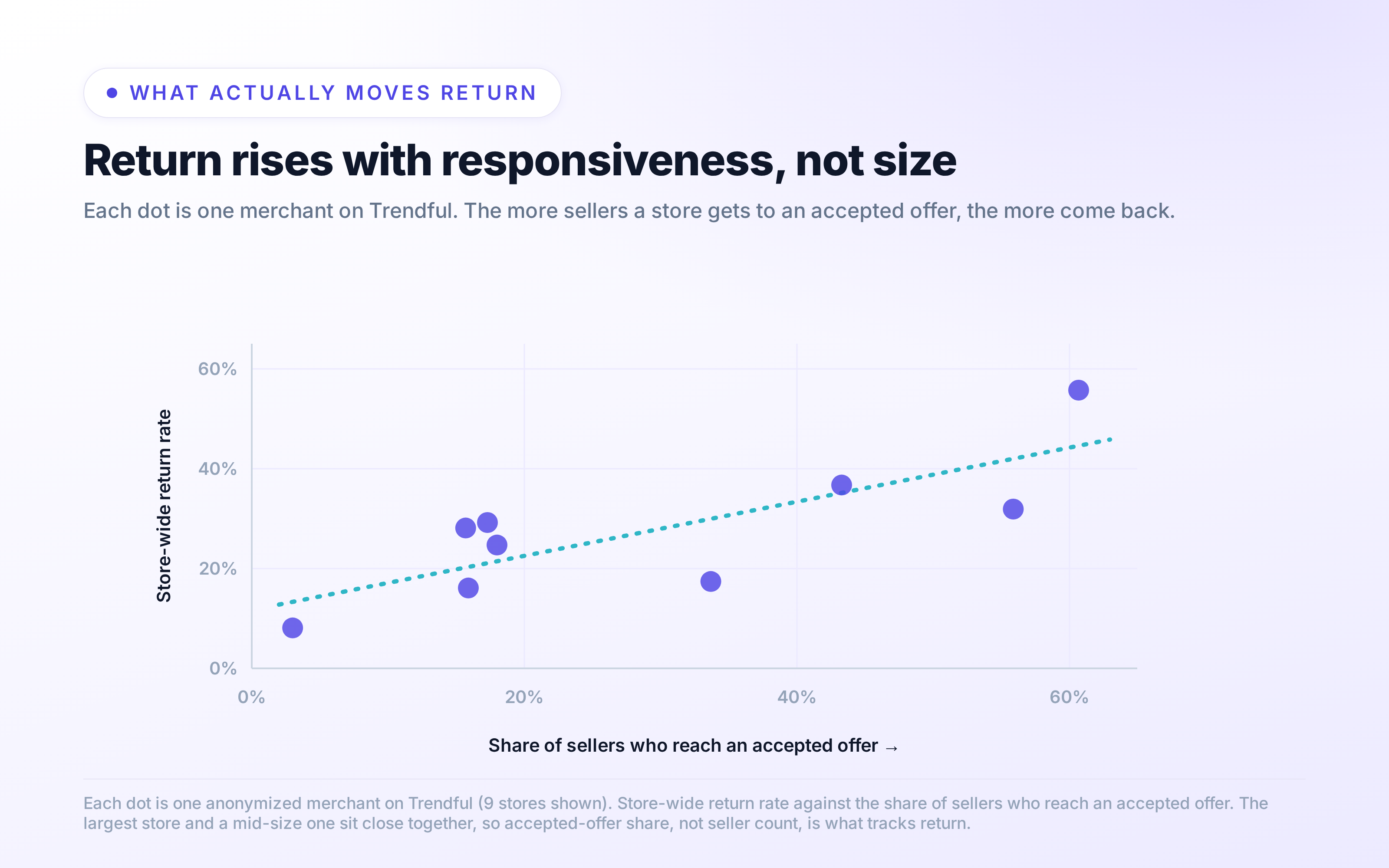
Plot each merchant's store-wide return rate against the share of its sellers who reach an accepted offer, and the relationship is clear and positive. Seller count is not: the largest store in the set and a mid-size one sit close together, while a merchant that rarely makes an offer sits well below both. The single number that best predicts your return is your accepted-offer share, how many of your sellers actually get to a yes. Raise that with the levers above and return follows.
Where to start
You do not have to pull every lever at once. Find where you leak the most, which for most stores is the unanswered offer, and start there: turn on reminders and tighten your time to first offer. Then make sure declined offers get re-sent later, and every rejected item goes back with a clear reason and a tracked return. Then smooth the path to submit, and start steering payouts toward store credit. The cheapest supply you will ever source is a seller you already won once and gave a clear reason to come back.
Frequently asked questions
What raises the chance a resale seller comes back? Mostly first-contact operations, not price. On Trendful, sellers who reach an accepted offer come back about half the time, and even sellers who got a quote and declined it return at roughly 2 in 5. The way to lift your own return rate is to get more sellers to a real interaction: quote everyone quickly, answer open offers before they expire, send every rejected item back with a clear reason and tracked shipping, and keep submitting easy.
Does telling a seller no stop them from coming back? Much less than most merchants expect, as long as you handle it well, and the two cases are different. If the seller declines your offer, nothing shipped, so there is no return to run; they still come back at roughly 2 in 5, close to the rate of sellers who accepted, and a declined offer is not necessarily a no to you, since some passed on the number while others were shopping around or just not ready to decide. If you reject an item that already arrived, a tracked, insured return with a clear reason is what keeps that seller near the declined rate instead of the 1 in 7 floor.
What is the biggest source of lost sellers? Unanswered offers. The single largest group of sellers is the ones whose offer went out and was never answered, and they return at one of the lowest rates. Because that group is both the biggest and one of the lowest-returning, turning on offer reminders is usually the highest-leverage fix a store can make.
How do I get more than half of my accepted sellers to come back? Lift the ceiling with retention, not just acquisition. Lean on store credit, since a seller paid in credit is already your next buyer; reach back out around the four-month mark, when the next item tends to surface; and keep payouts fast and communication clear so the first good experience becomes a habit.
Do bigger resale stores keep more of their sellers? No. Store-wide return does not track seller count on Trendful. What predicts it is the share of sellers who reach an accepted offer, so a store that quotes and closes well returns more sellers than one that rarely makes an offer, regardless of size.
Get started
Want to see the offer view, offer reminders, store credit, and the return flow that keep your sellers coming back? Create an account and pick the plan that fits how you operate today, or book a demo and we will walk you through it.
Keep reading
- When manual resale operations break, and what to automate first
What works at 10 items a month starts to break around 30. Here is where spreadsheet driven resale operations fail first, what systematized…
- Consistency beats volume: how to market a resale business
Three posts a week you can sustain beats seven you burn out on. Here is how to market a resale business organically: which platforms do…
- Where to sell and source pre-owned inventory: your channel options and what each costs
Every channel you use to sell or source resale inventory has a price. Here is a plain look at marketplaces, your own storefront, and where…