Store credit: the offer type that turns sellers into buyers


Here is a small puzzle from the platform data. When merchants on Trendful send a quote that offers both cash and store credit, they usually make the credit the better deal, adding roughly a 10% premium on top of the cash number. And sellers still take the cash almost every time. Store credit was only about 4% of accepted offers, roughly 1 in 25.
That is a strange result. The merchant is paying more, and the seller is picking less. Most articles about store credit skip straight to "credit is great, offer more of it," but that advice runs headfirst into this wall. So this is the honest version. Store credit really is the cheapest, most powerful money in resale, and the premium alone does almost nothing to move sellers. The point of this piece is to explain why both things are true, and what actually has to be in place before credit converts.
The offer almost nobody uses
Start with how rare it is. Across a recent window of accepted offers on Trendful, store credit came in at about 4%. Cash, whether through a buyout or a consignment, took the other 96%. And it is not that sellers are seeing credit and rejecting it: only about half of active merchants present a store credit option at all. No single merchant we can measure leaned on it for more than roughly one in nine of their offers.
So credit is not losing a fair fight. Half the time it is not even on the ballot. If you have read our complete comparison of buyout, consignment, trade-in, and store credit, you already know credit is the small slice on both the platform and across the wider resale field. This article is about why that slice is so small, and why the merchants who grow it are quietly buying inventory with money that never fully leaves the business.
Store credit is just another way to pay
Do not overthink this one, because the fear of complexity is what stops most merchants from trying it. Store credit is not a separate business to run alongside your buyouts and consignments. It is simply how you pay the seller at the end, and you can attach it to a buyout or a consignment exactly the same way. The item still comes in, still gets checked, still moves through your process the way it always has. The only thing that changes is what the seller walks away with: credit to spend with you instead of cash.
So offering credit is not a new workflow, a new team, or a new system to learn. It is one more option on the same offer, and the seller picks the one they want. Nothing about your day to day changes except the kind of payout that lands, which is exactly why it is such an easy lever to pull. Watch resellers tend to call it trade-in and handbag resellers tend to call it store credit, but it is the same thing, just paying the seller in credit instead of cash.
The margin math: why credit is the cheapest money
Now the part that makes credit worth caring about. Measured by the headline split, the share of an item's value the seller keeps, store credit is the most generous of the three payouts. Blended across item values on Trendful, a seller keeps roughly 55% on a buyout, about 60% on consignment, and around 65% on store credit. On paper, credit looks like the option that costs you the most.
It is actually the one that costs you the least.
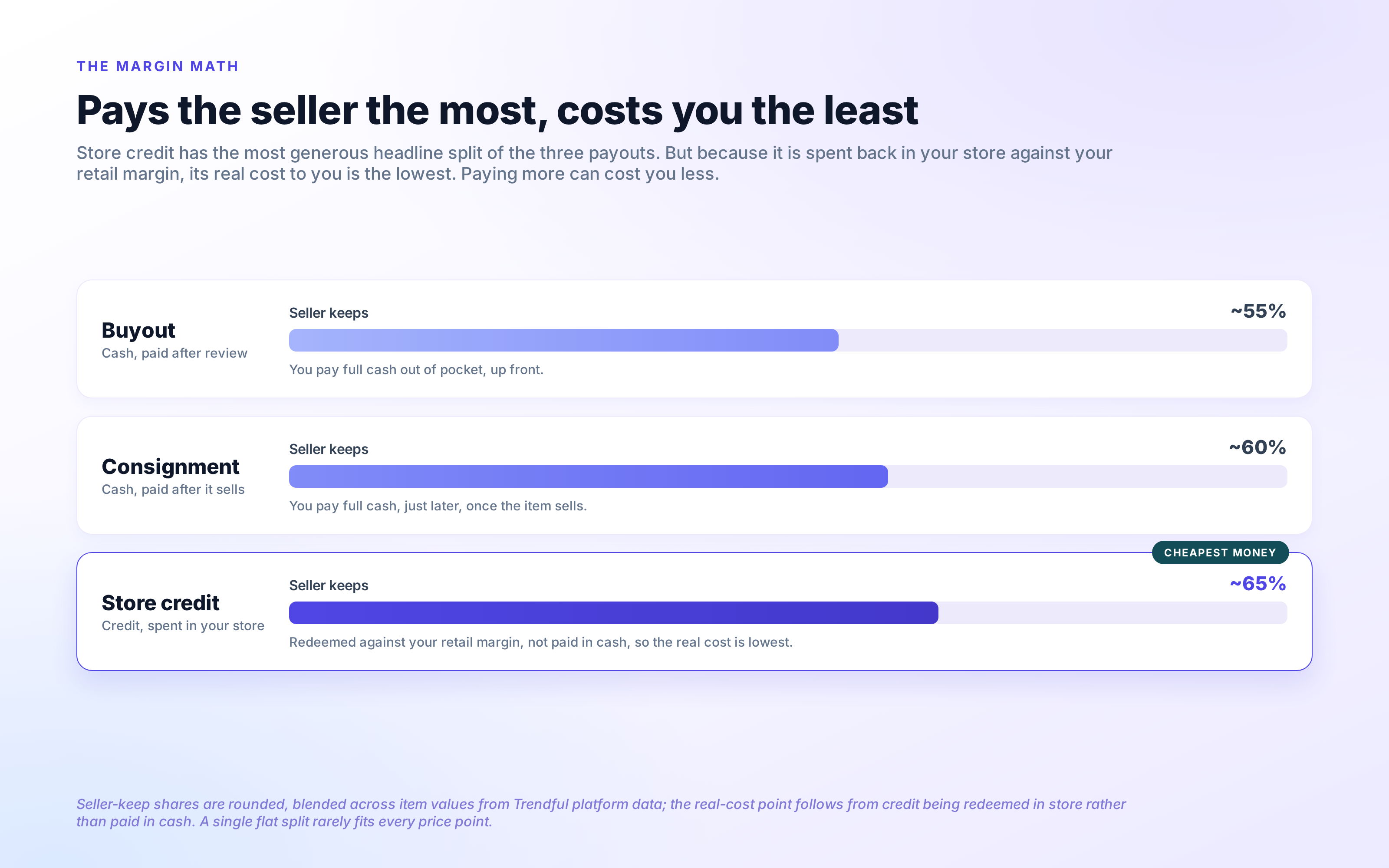
The reason is the redemption. A cash buyout or a cash consignment sends real dollars out of your business. Store credit does not. It comes back to you as a purchase, redeemed against your retail margin rather than paid out at face value. When a seller spends a $1,000 credit in your store, you are not out $1,000. You are out the cost of whatever they buy, which is your wholesale cost plus the margin you were already willing to give up on a sale. That is why credit can pay the seller the most generous split and still be the cheapest money on the platform. Paying more can genuinely cost you less.
Two industry patterns push the same direction, and they are worth citing carefully because they come from research on gift cards and store credit rather than from Trendful. A meaningful share of credit never gets redeemed at all, with industry estimates of unredeemed balances commonly landing in the 10 to 19% range, which is pure upside to the issuer. And of the credit that does get spent, a majority of holders spend beyond the balance, so the credit tends to pull a larger basket along with it. We do not measure redemption ourselves, because it happens in the merchant's own store rather than inside Trendful, so treat those two as directional context from the wider gift card world, not as platform figures.
Why sellers accept richer offers in credit, and mostly don't
If credit is the cheapest money and merchants know it, they should be able to buy sellers into it with a premium. And they try. On Trendful, when both options appear on the same quote, the credit offer runs a median of about 10% above the cash offer, which lines up with how trade-in programs usually price, in the 10 to 20% range.
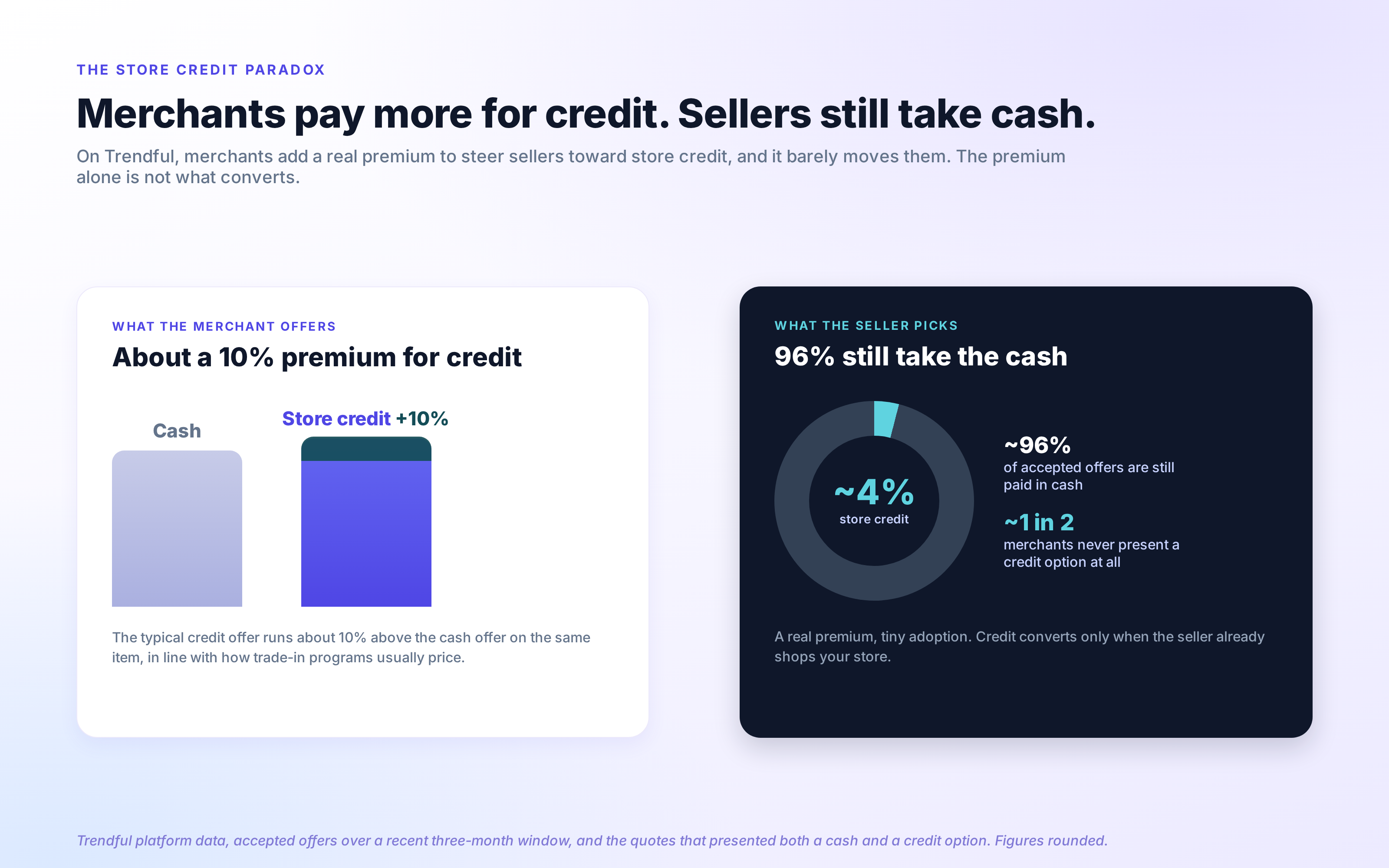
Here is the wall. That 10% premium barely moves anyone. About 96% of sellers still take the cash. The premium is real money the merchant is offering, and it is not converting sellers, which tells you something important: the thing standing between a seller and store credit is not the size of the offer. It is whether the credit is useful to them at all.
Think about it from the seller's side. Cash spends anywhere. Store credit only spends with you. A 10% bump does not close that gap for a seller who has no plans to shop with you again, because credit they will never use is worth zero to them, not 110% of cash. Credit only becomes attractive when the seller already wants to buy from your store. And that is the same population as our flywheel finding: up to 45% of sellers on Trendful cross over into buyers when the experience is good. For those sellers, credit is not a discount on their payout, it is a head start on their next purchase. For everyone else, it is a coupon for a store they were not going to visit.
So the premium is not useless. It is just not sufficient on its own. It works on the sellers who were already halfway to being buyers, and it does nothing for the rest.
The honest tradeoff: credit is a liability on your books
Before the how-to, the part the cheerful version leaves out. Store credit is cheap money, but it is not free, and it is not simple accounting.
Every credit you issue is a promise to deliver goods later, which means it sits on your books as a liability until the seller spends it. That is genuinely different from a cash buyout, where the transaction closes when the payout lands. With credit, you are carrying an obligation, and you need enough inventory and selection that the seller can actually find something worth their balance. Issue a lot of credit against a thin catalog and you have made promises you cannot easily let people keep.
There is also the redemption itself, which happens in your storefront, not in Trendful. That is a feature, since it keeps your buying and selling in one place, but it means the loop only closes if your store is somewhere the seller wants to spend. Store credit rewards merchants who have built a real shopping experience and quietly punishes those who have not. It is a lever, not a magic trick.
Configuring store credit in Trendful
Offering credit is the easy part, because it lives right on the quote. When you build an offer, the payout options sit together on a single item: buyout, consignment, and store credit, each with its own amount. Check the store credit box, set the number, and the seller sees it as one clean choice next to the others.
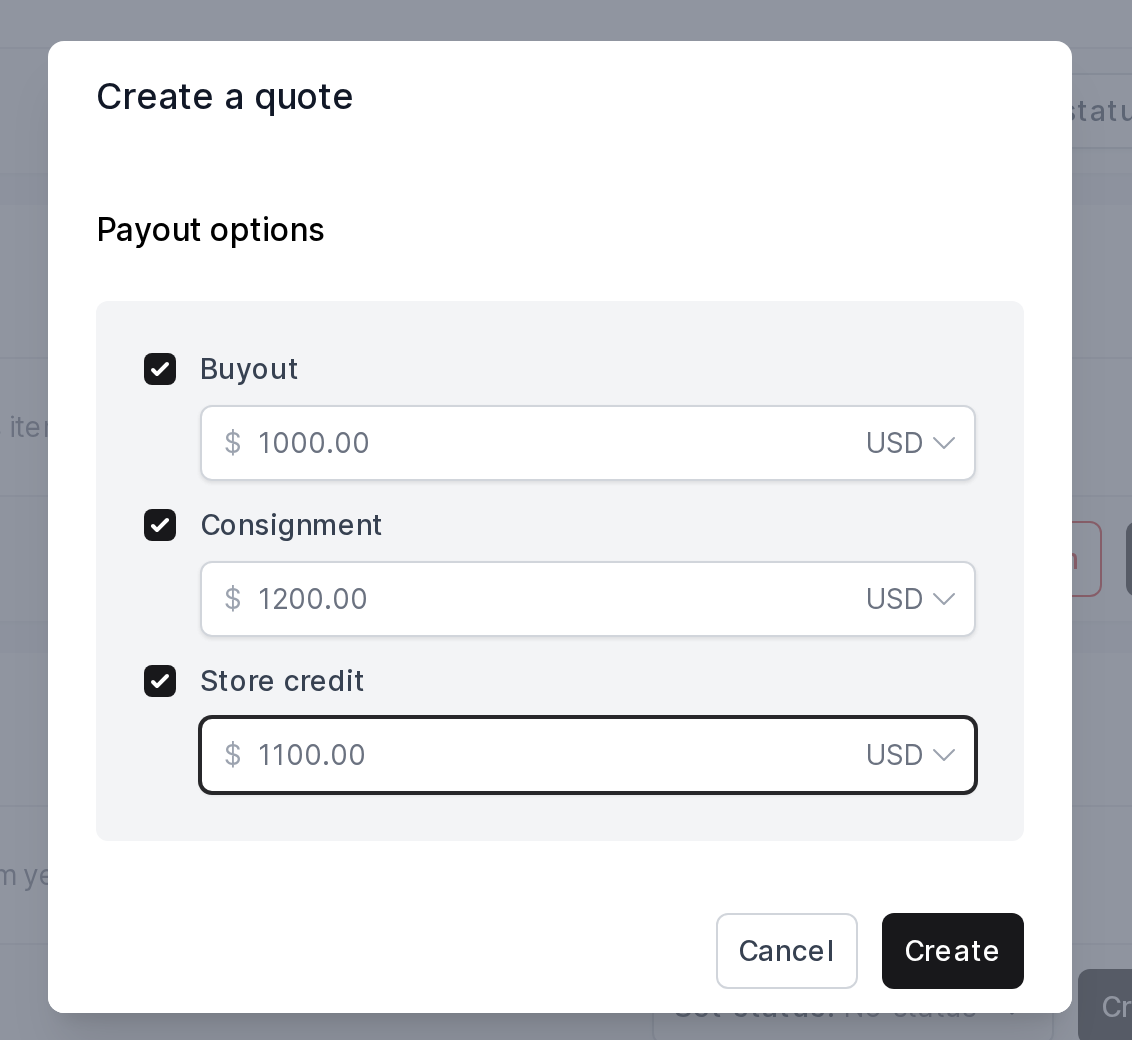
Most merchants quote by hand, pricing the item and entering the numbers themselves right from this form, and that manual quoting is how most of the platform works. If your volume climbs high enough that pricing every item by hand slows you down, you can switch on instant offers to have the buyout, consignment, and credit amounts computed automatically from a condition-based value estimate and your own commission structure. That is optional, an accelerator you turn on, not the default, and it is also what lets you tier the credit premium by item value instead of guessing a flat number. Our guide to sending and receiving offers walks through the whole quote flow.
A couple of settings make credit land better. You can write your own description for the store credit option, so the seller sees plainly what the credit is and where it spends, rather than a bare number. And because store credit is just a way of paying, it works with whatever timing you pick, so you can offer credit on an instant-style buyout or hold it against a consignment that pays out after the sale. None of this is a second system. It is the same quote, with one more box checked.
When store credit actually works
Put it together and the recipe is specific. The premium is necessary but not sufficient. Credit converts when three things are true at once: the offer is a little richer than cash, the credit is genuinely easy to redeem, and the seller already had a reason to shop with you. Miss the third and no premium saves it. Hit all three and credit becomes the accelerant on the whole resale flywheel, because the payout you just made is your next sale, and the seller you just paid is already your next buyer.
That is also why credit rewards the merchants who are already doing the rest of the job well. If your buying experience is smooth, your store is worth shopping, and your sellers are the kind who come back, store credit turns each acquisition into a customer with a balance to spend. It is the least used option on the platform and, for the right merchant, the highest leverage one.
The takeaway
Store credit is the paradox of resale payouts. Merchants pay about 10% more for it, sellers take it only about 4% of the time, and half of merchants never offer it. Yet it is the cheapest money on the platform, because it is redeemed against your retail margin instead of paid out in cash, and it is the one payout that hands you your next buyer. The lesson is not "offer more credit and add a bigger premium." It is that credit converts only when the seller already wants to shop with you, so the work is building the store and the relationship that make credit worth having. Do that, and store credit stops being a rounding error and starts being the fuel that closes the loop. It is the clearest upside sitting untouched in the data. Choosing how you pay sellers is one step of our complete playbook for starting a resale business.
Frequently asked questions
What is store credit in resale? It is paying a seller in credit to spend in your store instead of in cash. Some verticals call it trade-in and others call it store credit, but it is the same thing. It is just a way of paying, not a separate business to run, so it works on a buyout or on a consignment just the same. Nothing else about how you operate changes.
Why is store credit cheaper for the merchant than cash? Because it is redeemed against your retail margin rather than paid out at face value. A cash buyout sends real dollars out of the business, while a store credit comes back as a purchase, so your real cost is only what the redeemed item costs you, not the full credit amount. That is why credit can carry the most generous headline split for the seller and still be the least expensive money on the platform.
Why do so few sellers choose store credit? On Trendful only about 4% of accepted offers are paid in credit, even though merchants typically offer about a 10% premium for it. The premium alone does not convert sellers, because credit only spends with you. It becomes attractive when the seller already wants to shop with your store, which is the same group that crosses over into buyers, so credit works best layered on a good buying and shopping experience rather than sold on its discount.
Is store credit a liability for my business? Yes, and it is worth planning for. Every credit you issue is a promise of goods later, so it sits on your books until the seller redeems it, and you need enough inventory and selection for them to spend it. Redemption happens in your own storefront rather than inside Trendful, so the loop only closes if your store is somewhere sellers want to shop.
How do I offer store credit on Trendful? It is a checkbox on the quote. When you create an offer you can present buyout, consignment, and store credit together on a single item, each with its own amount, and the seller picks. You can quote the credit amount by hand or, if you turn on instant offers, have it computed automatically from a value estimate and your commission structure. You can also customize the description the seller sees for the credit option.
Get started
Want to see the quote builder, the payout options, and the platform data behind store credit? Create an account and pick the plan that fits how you operate today, or book a demo and we will walk you through it.
Keep reading
- How to start a resale business: the complete playbook
Secondhand is on track for about $393 billion by 2030 and growing twice as fast as apparel retail. The opportunity is not the hard part…
- Half your resale sellers come back. Here's how to win the rest
About half the sellers you win come back to sell to you again, all on their own. The other half slip away at two simple moments. Here is…
- Anatomy of a submission: from customer photo to payout
Follow one resale item end to end, from the first customer photo to the final payout. Here is how selling to a resale store actually…