Where to sell and source pre-owned inventory: your channel options and what each costs

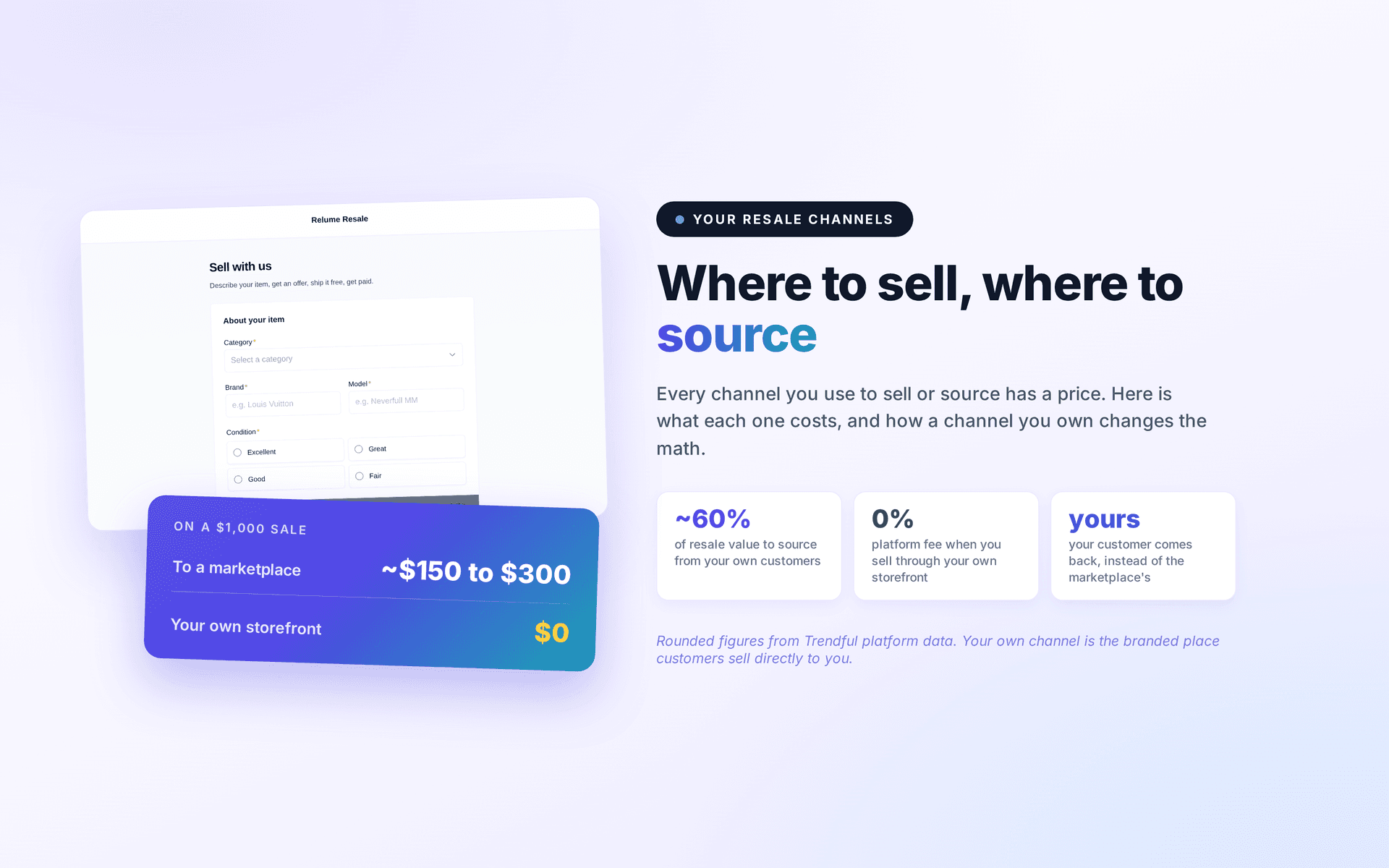
Running a resale business comes down to two jobs: finding good inventory to sell, and getting it in front of people who will buy it. Simple to say, and almost every hour of the week goes into one or the other. What is easy to miss is that both are channel choices. Where you sell and where you source are each decisions with a real price attached, and the channels you pick quietly decide how much of every sale you actually keep.
Most merchants put a lot of thought into where they sell, and a little less into where they source, even though sourcing is where the margin is won or lost before an item is ever listed. So here is a plain look at the options on both sides, what each one costs, and how adding a channel you own changes the whole picture.
Selling: the channels that bring you buyers
When you have an item ready to move, you are really choosing who brings you the buyer.
Marketplaces like eBay, Poshmark, Vestiaire Collective, and The RealReal are demand machines. They already have the buyers, they handle the payment, and they stand behind the sale, which is genuinely valuable. In exchange, they take a cut of every sale. That is the deal: you rent their audience and you pay for it at checkout.
Your own storefront is the other option. You keep the full price of the sale, but you have to bring the buyer yourself, through your site, your social, and your reputation. Nobody hands you the traffic.
Neither one is simply "right." Marketplaces are great for reaching people you never could on your own and for moving stock quickly. Your own storefront is where you keep the most on each sale. Most merchants end up using both, and the ones who do it well are deliberate about which channel does which job.
What selling on a marketplace actually costs
The cut is easy to wave off as a cost of doing business, right up until you add it up across a year. Here is roughly what the main platforms keep when your item sells. These are current published rates and they change, so check each platform before you build a quarter around them.
eBay keeps about 13% of the sale on most items and around 15% on handbags, plus a small per-order fee. Poshmark takes a flat 20% on anything that sells for 15 dollars or more. Vestiaire Collective charges about 12% plus roughly 3% for payment processing, so you are near 15% all in. The RealReal works on consignment and pays you a sliding share, so on a typical mid-value item the platform keeps somewhere around 30% to 45%, and more on cheaper pieces.
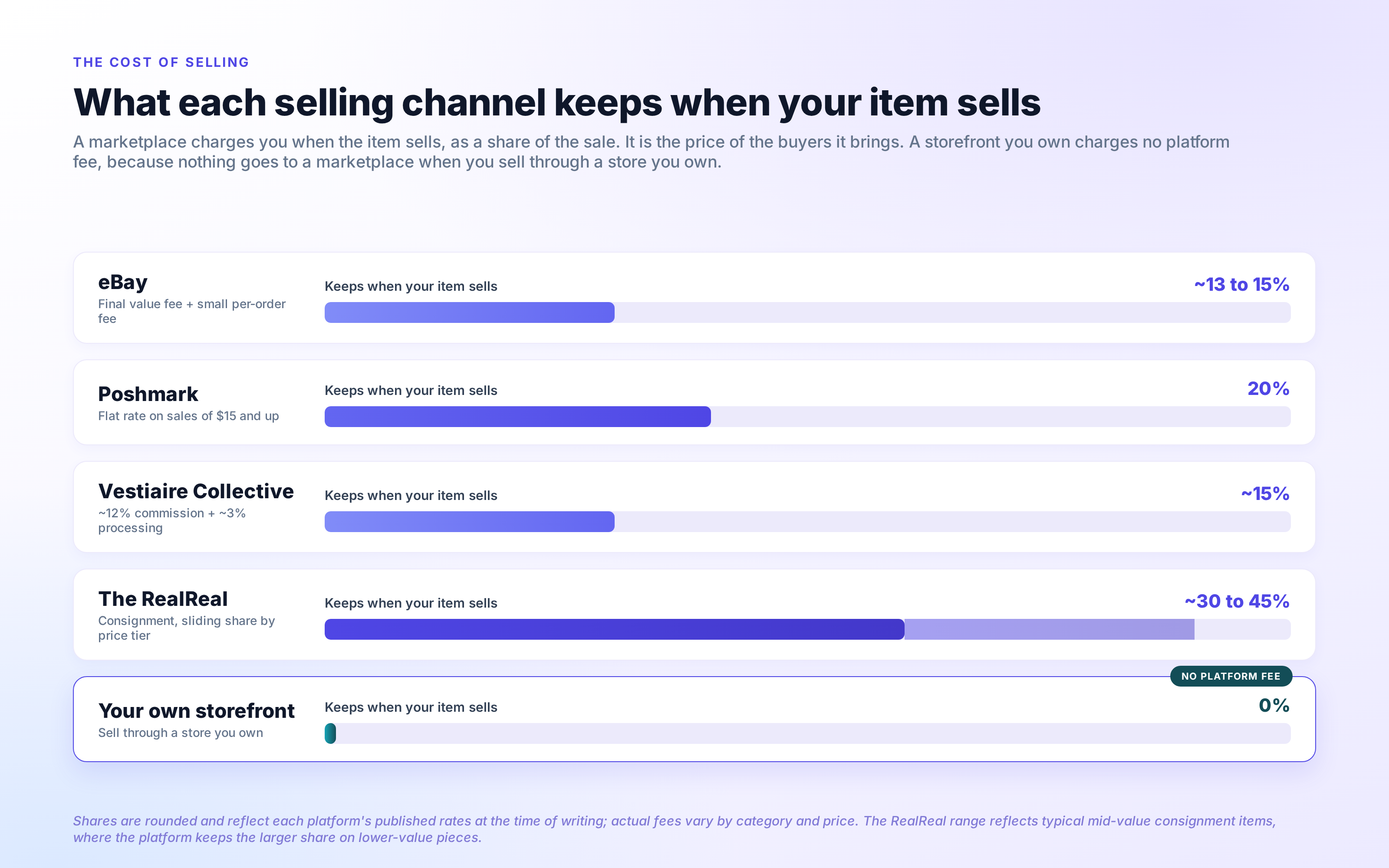
Put plainly: selling through a marketplace costs you somewhere between roughly an eighth and a third of each sale. Selling through a storefront you own costs you nothing at checkout, but you have to earn the traffic yourself. That is the real tradeoff, and we have broken down the pricing and fees across eBay, Vestiaire, and Poshmark and the wider peer-to-peer versus managed marketplace picture if you want to go deeper.
The half that gets less attention: where your inventory comes from
Now flip to the side that usually gets less of your time. Your stock comes from somewhere, and that somewhere has a cost too.
The usual sourcing channels are wholesale lots, auctions and liquidation, estate sales and thrift, and your own customers. Wholesale is predictable but you pay someone else's markup before you add yours. Auctions turn into bidding wars that compress the margin. Estate sales can turn up a treasure but never really scale. We lay all of these out in where resale inventory actually comes from.
Then there is the channel sitting inside your own customer base. When the people who buy from you also sell their pre-owned pieces back to you, you source at a cost you set, with no bidding war and no middle platform taking a slice. On our platform that acquisition typically lands around 60% of an item's resale value, which means your customer keeps about 60% and you hold the rest to cover authentication, listing, shipping, and the occasional return. We go deep on how that number is set, and how it holds across conditions and payout types, in pricing pre-owned luxury for acquisition.
This is what people mean by "your own acquisition channel": a branded place your customers sell directly to you. It is a sourcing channel first, and it happens to be the cheapest and most repeatable one most merchants have.
How your own channel changes the math
Here is where the two sides meet. Source through your own customers and sell through your own storefront, and you skip the marketplace cut on the way out while sourcing below wholesale on the way in. The roughly 60% you pay to acquire is the same split the marketplaces effectively run on; you simply keep the piece a marketplace would have taken when the item sold.
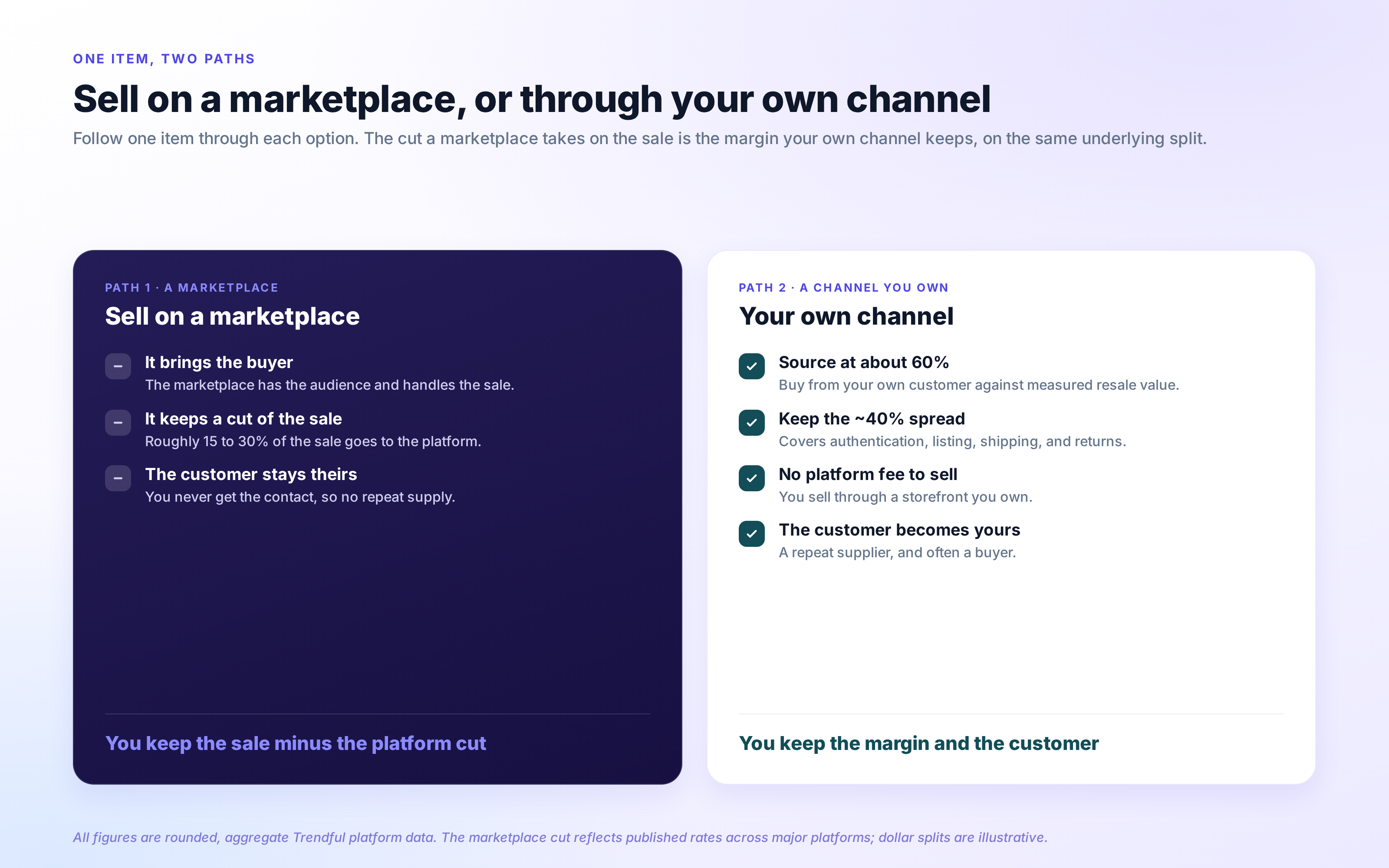
There is a second payoff that never shows up on a fee schedule: the customer is yours. When someone sells through a marketplace, they are the marketplace's customer, not yours. You do not get the contact, you cannot follow up, and you cannot turn them into a repeat supplier or a buyer. Through your own channel you keep that relationship, and in resale the relationship is the whole game. Up to 45% of the customers who sell to you go on to buy from you, and about half of those who accept an offer come back to sell again. That only happens on a channel you own, which is also why the two moments where you quietly lose people, covered in why half your customers do not come back, are worth fixing, and why store credit turns customers into buyers is such a cheap lever once the customer is yours.
Building a channel mix, and adjusting your sourcing strategy
None of this means deleting your marketplace listings. The move is to be intentional about which channel does which job, and to let your sourcing strategy shift as you grow.
A simple way to hold it: use marketplaces to move stock and reach new buyers, and build your own channel to source cheaply, protect your margin, and keep your customers. If you are early and most of your inventory comes from wholesale or your own buying on marketplaces, that is a fine place to start. As your audience grows, shift more of your sourcing toward your own customers, because that channel gets cheaper and more dependable every time someone comes back, while a wholesale account costs the same every month no matter how long you have been at it.
Your offers stay flexible too. Trendful serves merchants who run any mix of buyout, consignment, trade-in, and store credit, so your own channel is not a consignment-only thing, and the complete comparison of those four models walks through the tradeoffs. Most offers are quoted by hand, with suggested numbers built from the data and approved before anything reaches the customer, and sending and receiving quotes covers that flow. Automatic instant offers are an option you can switch on, not the default, so quoting stays a deliberate step unless you choose otherwise.
What it takes to run your own channel
Standing up a channel you own is more approachable than it sounds, because the hard parts are the software, not a storefront you build from scratch. You need a branded place for customers to submit items, a way to price those items against real resale data, the payout options you want to offer, and the shipping and payouts handled behind them.
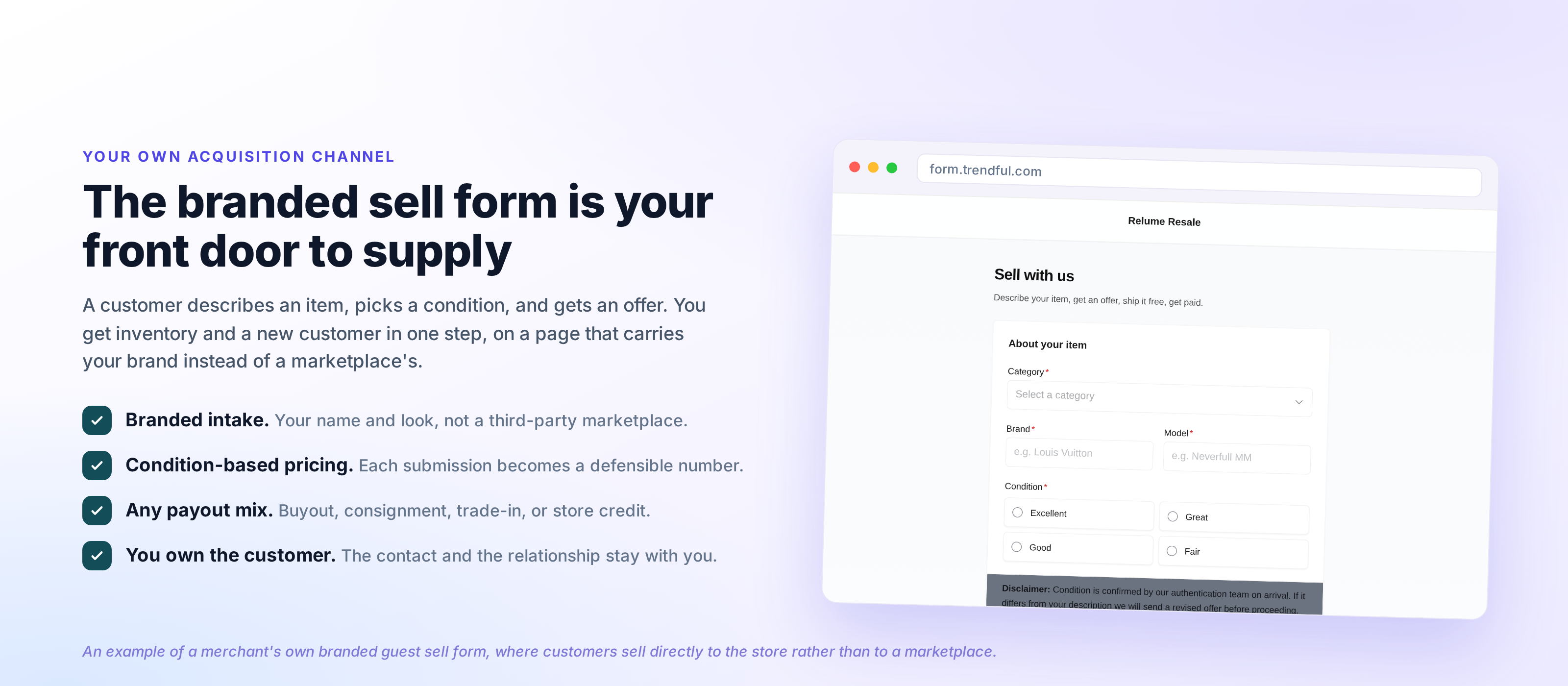
A branded sell form is the front door: a customer describes an item, picks a condition, and gets an offer, and you get inventory and a new customer in one step. Behind it, condition-based pricing turns each submission into a number you can defend, and keeping every offer on one organized record instead of a spreadsheet is what keeps the channel tidy as it grows. Standing one up is a step in the larger playbook for starting a resale business, and it pairs with positioning your brand so the customers you attract are the ones you actually want to buy from.
The takeaway
Selling and sourcing are both channel decisions, and every channel has a price. Marketplaces keep somewhere between roughly an eighth and a third of each sale in exchange for their buyers. Your own storefront keeps that cut in your pocket but asks you to bring the traffic. On the sourcing side, your own customers are the cheapest and most repeatable channel you have, at about 60% of resale value, and they come back. The winning setup is rarely one channel. It is a deliberate mix: rent demand from marketplaces where it helps, and build the channel you own so you source cheaply, protect your margin, and keep your customers.
Frequently asked questions
Where should I sell my resale inventory, on a marketplace or my own site? Both, for different jobs. Marketplaces bring you buyers you could not reach on your own and move stock quickly, but they keep a cut of every sale, roughly 13 to 15% on eBay, a flat 20% on Poshmark, about 15% all-in on Vestiaire Collective, and often 30% or more on The RealReal. Your own storefront charges no platform fee, so you keep the full sale, but you have to bring the traffic yourself. Most merchants use marketplaces to move stock and their own storefront to protect margin.
What does it cost to sell on a marketplace? It is charged when the item sells, as a share of the sale. As published rates stand now, eBay keeps about 13 to 15%, Poshmark a flat 20% on sales of 15 dollars and up, Vestiaire Collective about 15% once commission and payment processing are combined, and The RealReal a sliding share that often leaves the platform 30% or more on a typical item. Rates move and vary by category and price, so confirm on each platform before you plan around them.
What is "my own acquisition channel"? It is a branded place your own customers sell items directly to you, usually a sell form on your site, instead of you buying stock on a marketplace or from a wholesaler. It is a sourcing channel, not a selling channel: the item comes in as inventory and the person who sent it becomes your customer rather than a marketplace's. It works alongside whatever you use to sell.
How much does it cost to source from my own customers? A common anchor is about 60% of the item's resale value, a little lower, near 55%, on a buyout paid in cash up front. That is the share your customer keeps, which leaves you roughly 40% to cover authentication, listing, shipping, and returns. Treat it as a starting point and tune it by category, brand, and condition rather than applying one flat number to everything.
Do I have to pick just one channel? No, and most merchants should not. Use marketplaces for demand, where paying a cut to reach buyers is worth it, and build your own channel for cheap, repeatable sourcing and for keeping the customer relationship. As your audience grows, you can lean more on your own customers for supply, since that channel gets cheaper and steadier the more people come back.
Get started
Want to see the branded sell form, condition-based pricing, and the offer options behind your own acquisition channel? Create an account and pick the plan that fits how you operate today, or book a demo and we will walk you through it.
Keep reading
- Where to sell pre-owned inventory: marketplace fees vs your own storefront
Most operators pick a sales channel on audience fit and never run the math on what a typical sale nets. Here is where to sell pre-owned…
- Authentication is not optional: how to authenticate pre-owned luxury
One undetected fake can undo months of trust building. Here is what the leading authentication providers cost, how to build authentication…
- Pricing pre-owned luxury for acquisition: offers sellers accept without killing margin
Price a resale offer too low and you can lose the sale; too high and the margin gets thin. Here is how condition-based fair market value…